AI That Understands Your Products: A Simple Guide for Ecommerce Brands
You ask AI to write a post for your product.
It gives you something polished.
It sounds clean. It has a nice hook. It has a friendly caption. It even adds a few hashtags.
But something feels off.
The post could fit almost any product from almost any brand.
That happens because the AI does not really know what you sell.
It does not know your product’s material, size, price, variants, use case, image, audience, or what claims to avoid. It does not know whether the product is premium, playful, technical, local, handmade, functional, seasonal, or built for a very specific customer.
So it guesses.
And when AI guesses, ecommerce content becomes generic.
Product-aware AI content fixes that by starting with your actual product details.
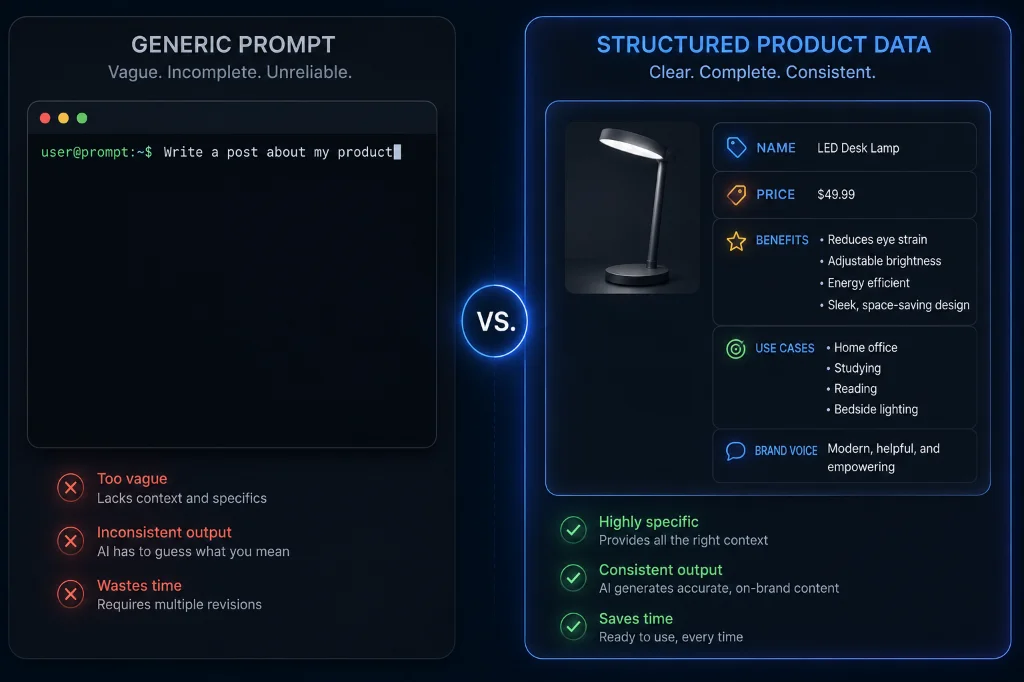
Generic AI starts with a prompt.
Product-aware AI starts with your product.
That one difference changes everything.
Quick answer
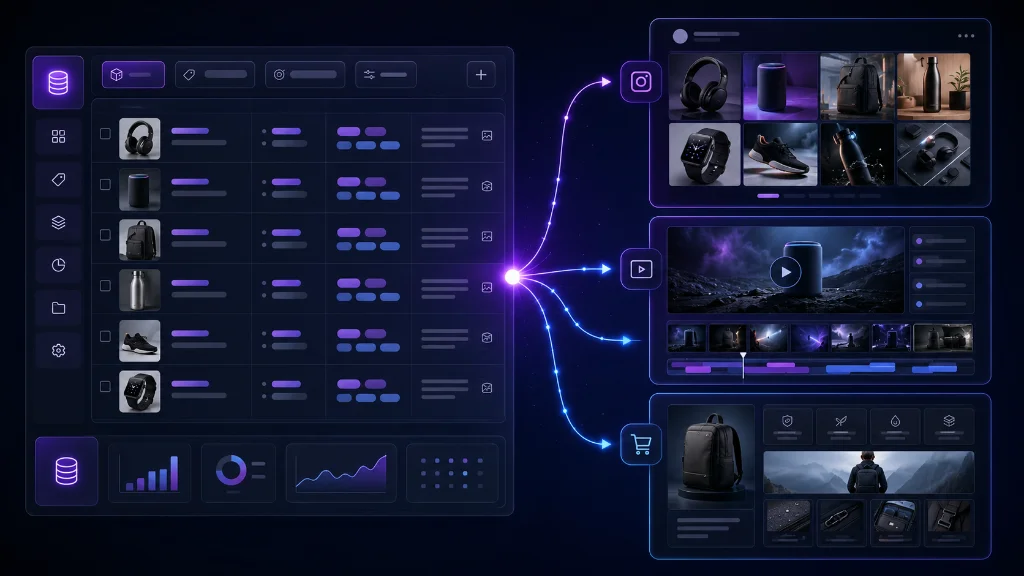
Product-aware AI content means AI-created content based on your real products: their names, images, descriptions, prices, variants, features, benefits, and use cases. Instead of asking AI to guess from a blank prompt, you give it product facts first. Then it can create better social posts, product images, videos, listings, campaigns, and review-ready content.
What is product-aware AI content?
Product-aware AI content is content created by AI using real product context.
That context can include:
- Product name
- Product description
- Product images
- Price
- Variants
- Materials
- Ingredients
- Dimensions
- Benefits
- Use cases
- Target customer
- Product category
- Claims to avoid
- Platform or marketplace target
In simple words:
Product-aware AI knows what the product is before it creates content.
A generic AI tool may write:
“Upgrade your everyday routine with this stylish and practical product.”
A product-aware AI tool can write something more specific because it knows the item.
For example:
“Keep chargers, pens, and notebooks in one place with a compact desk organizer made for small work-from-home setups.”
That is better because it starts from the product.
It is not just nicer writing.
It is more useful content.
Why generic AI content feels wrong for ecommerce
Generic AI content often feels weak because it misses the product facts.
It may sound professional, but it does not say anything specific.
You see lines like:
- “Perfect for everyday use.”
- “Designed for modern lifestyles.”
- “A must-have for your routine.”
- “Upgrade your space.”
- “Made for people on the go.”
- “High quality and easy to use.”
These lines are not always wrong.
They are just too vague.
They do not answer real customer questions.
A shopper wants to know:
- What is this product?
- What does it do?
- Why should I care?
- Is it right for me?
- How is it different?
- How do I use it?
- What does it look like?
- Will it fit my need?
- Can I trust the claim?
If AI does not know the product, it cannot answer those questions well.
That is why product context matters.
Product-aware AI vs generic AI
Here is the simplest comparison.
| Generic AI | Product-aware AI |
|---|---|
| Starts with a prompt | Starts with product details |
| Needs you to explain the product every time | Reuses product context |
| Often creates vague captions | Creates more specific content |
| Can miss product facts | Uses product name, images, description, benefits, and use cases |
| Needs more manual correction | Gives a stronger starting point |
| Works for general ideas | Works better for ecommerce content |
| Good for brainstorming | Better for product posts, visuals, videos, and listings |
The goal is not to make AI sound fancy.
The goal is to make AI useful for real products.
What product details should AI know?
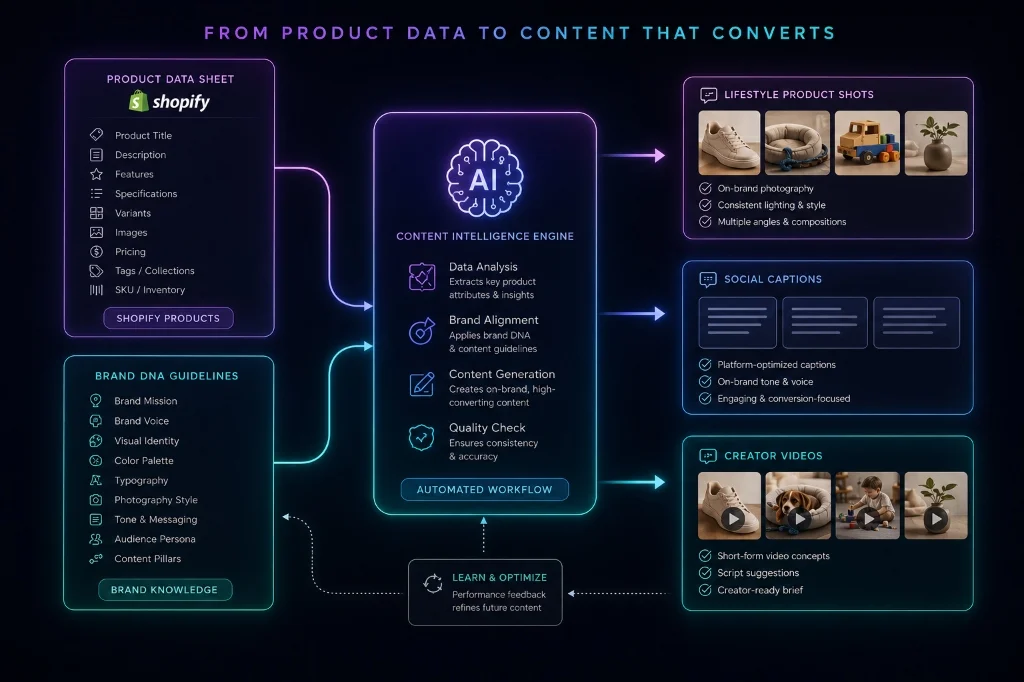
A good ecommerce AI workflow should know enough about the product to avoid guessing.
| Product detail | Why it matters |
|---|---|
| Product name | Keeps the content tied to the right item |
| Product description | Gives the AI the basic product story |
| Product images | Helps with visual content and accuracy |
| Price | Useful for offers, positioning, and product context |
| Variants | Prevents wrong size, color, or model claims |
| Materials or ingredients | Helps explain features accurately |
| Dimensions | Useful for size, scale, and marketplace content |
| Use cases | Helps create lifestyle content |
| Benefits | Helps create posts, videos, and listing copy |
| Target customer | Helps match the language to the buyer |
| Claims to avoid | Helps reduce risky or exaggerated content |
| Platform target | Helps format content for social, marketplace, email, or ads |
The more useful the product data, the better the AI starting point.
But product data still needs review.
If your catalog has old prices, missing images, weak descriptions, or incomplete details, AI output can still be weak.
Product-aware AI is not magic.
It is better input leading to better output.
Why brand context still matters
Product context tells AI what you sell.
Brand context tells AI how to talk about it.
Both matter.
The same product can sound very different depending on the brand.
Imagine three brands selling a desk lamp.
A premium home decor brand may say:
“Soft, adjustable lighting for calm evening workspaces.”
A student-focused brand may say:
“Bright, compact lighting for late-night study sessions.”
A productivity brand may say:
“Clear desk lighting that keeps your setup focused without taking over your space.”
Same product category.
Different brand voice.
That is why product-aware AI works best when it is also brand-aware.
The AI should know both:
- What the product is
- How the brand should sound
What product-aware AI can create
Product-aware AI is useful because one product can become many content pieces.
Social posts
A product can become:
- Instagram post
- Facebook post
- LinkedIn founder note
- Threads post
- Carousel
- Product launch post
- Educational post
- Social proof post
- Offer post
For example, a pet travel mat can become:
- “3 ways to make car rides easier for your dog”
- “Why we made a foldable mat for travel days”
- “A small travel essential for hotel stays, road trips, and outdoor breaks”
That is much stronger than:
“Your pet deserves the best.” Learn more about this in our guide on AI social media automation for ecommerce brands.
Product images
Product-aware AI can help create visual ideas or assets such as:
- Studio shots
- Lifestyle images
- Product-in-use scenes
- Flat lays
- Detail shots
- Environmental images
- Ad visuals
- Marketplace image sets
For example, a laptop sleeve can become:
- Clean product shot
- Desk flat lay
- Travel bag scene
- Detail image showing inner padding
- Lifestyle image for daily commute
Product context matters here because the image must show the product correctly. Read about this in AI product image automation for ecommerce.
Product videos
Product-aware AI can help with:
- Creator-style video scripts
- Product explainers
- Founder videos
- Short ad videos
- Launch teasers
- Product demo ideas
- Reels concepts
- Video captions
For example, a foldable storage bag can become:
- “How I pack seasonal clothes in 30 seconds”
- “Small apartment storage tip”
- “Before/after closet reset”
- “Why this folds flat when not in use”
The product gives the video a real story. Learn more in AI product video automation.
Marketplace listings
Marketplace content needs even more product accuracy.
Product-aware AI can help create:
- Listing images
- Feature callouts
- Infographics
- Product highlights
- Comparison points
- Size/scale explanations
- Listing copy
- A+ style content
Marketplace assets need careful review because each platform has its own expectations.
AI can help create a strong starting point.
The seller still needs to check product accuracy, claims, image rules, and platform fit.
Campaigns
A product can also become a full campaign.
For example, a new desk organizer can become a 5-day campaign:
| Day | Content angle |
|---|---|
| Day 1 | The messy desk problem |
| Day 2 | Product reveal |
| Day 3 | Feature explanation |
| Day 4 | Desk setup lifestyle image |
| Day 5 | Offer or final reminder |
This is where product-aware AI becomes more useful than simple caption generation.
It can help turn one product into a sequence. Read about automating this in ecommerce content calendar automation.
Simple example: generic AI vs product-aware AI
Let’s say the product is a compact desk organizer.
Generic prompt
“Write an Instagram caption for a desk organizer.”
Possible AI output:
“Keep your workspace neat and stylish with our desk organizer. Perfect for staying productive every day.”
Not terrible.
Also not very memorable.
Product-aware input
Product details:
- Compact organizer for small desks
- Has three compartments
- Includes hidden cable slot
- Made from matte black recycled plastic
- Designed for work-from-home setups
- Fits notebooks, pens, chargers, and sticky notes
Better output:
“Small desk, less mess. This compact organizer keeps pens, chargers, notes, and daily work tools in one place — with a hidden cable slot so your setup looks cleaner by Monday morning.”
That is the difference.
The second version has product truth.
Example: product-aware AI for a D2C apparel brand
Product: linen summer shirt
Product details:
- Relaxed fit
- Breathable linen blend
- Three colors
- Designed for warm weather
- Lightweight fabric
- Works for travel and daily wear
Product-aware content ideas:
- Instagram carousel: “3 ways to style one linen shirt”
- Product image: shirt on hanger with summer travel accessories
- Lifestyle image: person wearing shirt in a relaxed outdoor setting
- Reel script: “Pack one shirt for three summer looks”
- Email teaser: “Lightweight linen for warmer days”
- Product page FAQ: fit, fabric, care instructions
This is useful because the AI is not writing about “fashion” in general.
It is creating content around the actual product.
Example: product-aware AI for a pet brand
Product: foldable pet travel mat
Product details:
- Washable fabric
- Foldable design
- Carry strap
- Two sizes
- Useful for road trips, hotel stays, outdoor breaks
Product-aware content ideas:
- Social post: “A small comfort mat for dogs who travel”
- Carousel: “What to pack for a dog-friendly road trip”
- Product image: mat beside a travel bag and leash
- Creator video script: “What I bring for hotel stays with my dog”
- Marketplace image: foldable design, size, washable material
- Campaign: 5-day travel season launch
This is the kind of content generic AI struggles to create without product context.
Example: product-aware AI for a home brand
Product: kitchen drawer organizer
Product details:
- Expandable design
- Bamboo finish
- Multiple compartments
- Fits cutlery and cooking tools
- Designed for small kitchens
Product-aware content ideas:
- Before/after drawer reset
- Product-in-use image
- “Small kitchen organization” carousel
- Short video: “One drawer reset in under one minute”
- Listing image showing compartments
- Email section for spring cleaning campaign
The product details make the content useful.
Why product-aware AI is important for small brands
Small brands usually do not have large creative teams.
The founder or marketer may be doing everything:
- Product uploads
- Social posts
- Product photos
- Ads
- Emails
- Marketplace listings
- Customer support
- Packing orders
- Agency coordination
They do not have time to explain the product to every AI tool.
They need a workflow where product context is already there.
Product-aware AI helps because it reduces repeated work.
The brand adds product details once, then uses them across content formats. This is detailed in our guide on reusable catalog content.
Why product-aware AI is important for agencies
Agencies manage multiple brands.
That makes repeated context even more painful.
One client may sell skincare.
Another sells pet products.
Another sells home goods.
Another sells fitness accessories.
Each brand has different products, tone, visuals, claims, and review rules.
If the agency uses generic AI tools, the team has to constantly explain:
- Which brand is this?
- Which product is this?
- What tone should we use?
- What claims are safe?
- What platform is this for?
- Which assets are approved?
Product-aware AI makes client work easier because each brand and product can have its own context.
What product-aware AI should not do
Product-aware AI should not mean “publish everything automatically.”
Ecommerce content still needs human review.
The team should check:
- Is the product described correctly?
- Is the image accurate?
- Are claims supported?
- Is the price current?
- Are variants represented correctly?
- Does the content fit the platform?
- Does the content match the brand?
- Does marketplace content need extra checking?
- Is the final asset saved in the right place?
AI can create a stronger starting point.
People still make the final call.
This matters because product content affects trust.
A wrong caption is not just a typo.
A wrong claim, wrong price, wrong product image, or misleading visual can hurt the brand. Check our workflow recommendations in AI content approval workflow.
How AgenixSocial helps with product-aware AI content
AgenixSocial is built around the idea that ecommerce content should start from the brand and product.
It is not a generic writing tool.
It helps teams create content from reusable brand and product context.
Here is how the pieces fit together:
| Content need | AgenixSocial module |
|---|---|
| Reusable brand context | Brand DNA |
| Product source of truth | Products |
| Product social posts | Content Studio / Quick Post |
| Product visuals | Product Shots |
| Creator-style videos | AI Creator Videos |
| Product launch campaigns | Campaigns |
| Marketplace image sets | Marketplace Listing Studio |
| Amazon-style A+ content | Amazon A+ Studio |
| Human review | Approval Queue |
| Scheduling | Calendar |
| Asset reuse | Media Library |
| Flexible usage | Pay-as-you-go credits |
Brand DNA helps AgenixSocial understand how the brand should sound and feel.
Products give the system real product context.
Content Studio turns that context into different content formats.
Product Shots helps create product and lifestyle visuals.
AI Creator Videos helps create creator-style product videos.
Campaigns helps plan product or brand campaigns.
Marketplace Listing Studio helps create marketplace image sets.
Approval Queue keeps human review inside the workflow.
Calendar helps with scheduling.
Media Library keeps generated and uploaded assets organized for reuse.
AgenixSocial gives ecommerce teams a stronger starting point by grounding workflows in reusable brand and product context. Teams still review final assets for product accuracy, claims, marketplace fit, platform fit, and brand tone before publishing.
The simple workflow
A product-aware workflow can be simple:
- Add your brand.
- Add or import your products.
- Select a product.
- Choose what you want to create.
- Generate a strong starting point.
- Review the output.
- Schedule, download, or save it for reuse.
That is much easier than starting every request with a blank prompt.
When product-aware AI is better than generic AI
Product-aware AI is better when:
- You sell physical products
- You manage many SKUs
- You create content every week
- You need product images and videos
- You sell on marketplaces
- You run launches or campaigns
- You need approvals before publishing
- You want reusable assets
- You are tired of repeating product details in prompts
Generic AI is fine for brainstorming.
Product-aware AI is better for repeatable ecommerce content. This is a strong fit for D2C founders, ecommerce marketers, marketplace sellers, and agencies managing brand content.
FAQ
What is product-aware AI content?
Product-aware AI content is AI-created content based on real product details, such as product names, descriptions, images, prices, variants, benefits, and use cases. It helps ecommerce brands create more specific social posts, product images, videos, listings, and campaigns.
What does product-aware AI mean?
Product-aware AI means the AI understands the product before creating content. Instead of starting from a blank prompt, it uses product data as context.
Why does generic AI content sound vague?
Generic AI content sounds vague because the AI does not have enough product detail. Without product context, it often creates broad lines that could fit almost any product.
What product data should I give AI?
Useful product data includes product name, description, images, price, variants, materials, ingredients, dimensions, benefits, use cases, target audience, and claims to avoid.
Can AI create social posts from product details?
Yes. AI can use product details to create product showcase posts, launch posts, carousels, educational posts, social proof posts, and offer posts.
Can AI create product images from product context?
Yes. AI can help create product images and visual ideas from product context, especially when product images and use cases are available. Human review is still needed to check accuracy.
Can AI create product videos from product data?
Yes. Product data can help AI create video scripts, creator-style videos, product explainers, launch teasers, and short ads. The final script and video should still be reviewed.
Can product-aware AI create marketplace listings?
Product-aware AI can help create marketplace content such as listing images, feature callouts, infographics, product highlights, and A+ style content. Sellers still need to check platform rules and product accuracy.
Is product-aware AI better for ecommerce brands?
Yes, product-aware AI is usually better for ecommerce brands because ecommerce content depends on real product facts. It helps reduce vague content and repeated manual prompting.
Does product-aware AI replace human review?
No. Human review remains important. Teams should check product accuracy, claims, visual truth, marketplace fit, platform fit, and brand tone before publishing or uploading content.
How does AgenixSocial use product context?
AgenixSocial uses Brand DNA and Products to ground content workflows in reusable brand and product context. Teams can create product-aware social posts, product visuals, creator videos, campaigns, marketplace assets, and review-ready content from one workspace.
Conclusion
AI content works better when it understands what you sell.
Generic AI starts with a prompt.
Product-aware AI starts with your product.
That means better starting context, more specific outputs, and less repeated explanation.
For ecommerce brands, this matters because content is tied to real products.
A post should know the product.
An image should show the product accurately.
A video should explain the product correctly.
A listing should reflect the product truth.
A campaign should be built around a real product story.
Product-aware AI does not remove human judgment. It gives teams a better starting point.
Add the product details once.
Add the brand context once.
Then create content from there.
That is the simpler path for ecommerce brands that want AI content to feel less generic and more useful.