Amazon Product Title Requirements 2026: What Sellers Need to Know Beyond the 75-Character Limit
Amazon product title requirements are changing again.
For years, many sellers treated the product title as the place to fit everything: brand, product type, size, keywords, benefits, materials, audience, use cases, compatibility, promotional phrases, and sometimes repeated terms.
That old approach is becoming harder to defend.
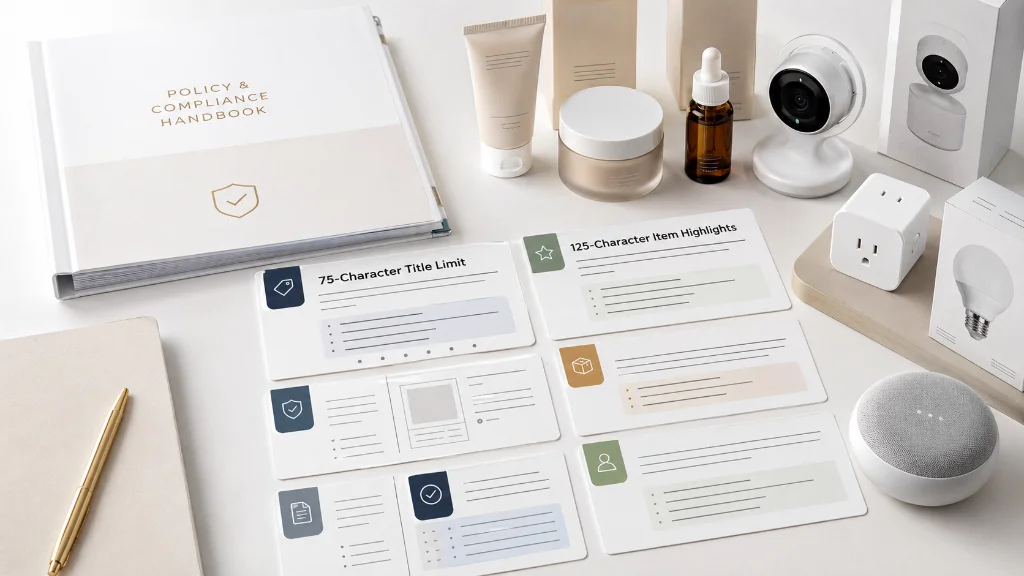
Amazon has announced that starting July 27, 2026, titles in most non-media categories need to be 75 characters or fewer, including spaces. At the same time, Item Highlights give sellers 125 characters for supporting details such as materials and recommended use cases.
That means sellers need a new title strategy.
Not just shorter titles.
Cleaner titles.
Better allocation.
Less repetition.
More review.
This guide explains Amazon product title requirements in 2026 and how sellers should prepare.
Quick answer: what are Amazon product title requirements in 2026?
Amazon product title requirements in 2026 require sellers to use clear, concise, product-identifying titles. Starting July 27, 2026, most non-media category titles need to be 75 characters or fewer, including spaces. Sellers should preserve brand, product type, variant, and size in the title, move useful secondary details into Item Highlights, reduce repetition and noisy separators, review unsupported claims, and prepare updates from reliable catalog source data.
The big 2026 change: 75-character titles
The most important 2026 change is the 75-character title limit for most non-media categories.
The 75-character count includes spaces.
That means a title like this is no longer practical:
SOULBAR Mystic Musk Handmade Soap with Moroccan Red Clay & Goat Milk | Detox Bath Bar for Pore Cleansing & Moisturizing | Exotic Musk Fragrance | Organic Paraben Free | Unisex Gift for Diwali & Spa | 100g
It tries to do too much.
A cleaner title would be:
SOULBAR Mystic Musk Soap with Red Clay & Goat Milk, 100g
This shorter title preserves product identity without carrying the entire product story.
Why Amazon is pushing shorter titles
Shorter titles are not only about policy.
They are about readability.
Long titles can be hard to read on mobile, difficult to compare in search results, and filled with repeated or promotional wording. A cleaner title helps shoppers understand the product faster.
The seller challenge is to keep enough information to identify the product while removing clutter.
Part 1: Reconciling the 2025 and 2026 Title Policies
Amazon’s transition to the 75-character limit is the second phase of a multi-year project to enforce cleaner listings. Understanding the evolution of these policies is helpful context for marketplace teams.
The January 2025 Foundation
In January 2025, Amazon updated its title requirements to target catalog noise. This update established guidelines that are still enforced today:
- The 200-Character Maximum: Historically, this was the absolute cap for most categories, though it was rarely enforced strictly. The 2025 update tightened this ceiling across categories.
- Prohibited Special Characters: Amazon officially restricted characters like emojis, trademark symbols (
™,®), and unnecessary punctuation marks. - Repeated Words: The system began flagging titles that repeated the brand name or primary keywords, which was a common strategy to manipulate search algorithms.
- Promotional Text: Words like "free shipping", "100% quality guaranteed", or "best seller" were banned.
The July 2026 Evolution
The July 27, 2026 update does not replace the 2025 requirements; it builds upon them with a stricter character limit and a new metadata field:
- 75-Character Ceiling: This is a dramatic reduction from the 200-character cap. It applies to all non-media categories.
- Item Highlights Integration: To compensate for the loss of title characters, Amazon introduced the 125-character Item Highlights field.
- Automated AI Recommendations: Amazon has said over-limit titles may be gradually updated to AI recommendations after the July 27, 2026 deadline. Brand owners have a 14-day review window to modify or approve these recommendations in Seller Central.
Part 2: Product Title Structure and Anatomy
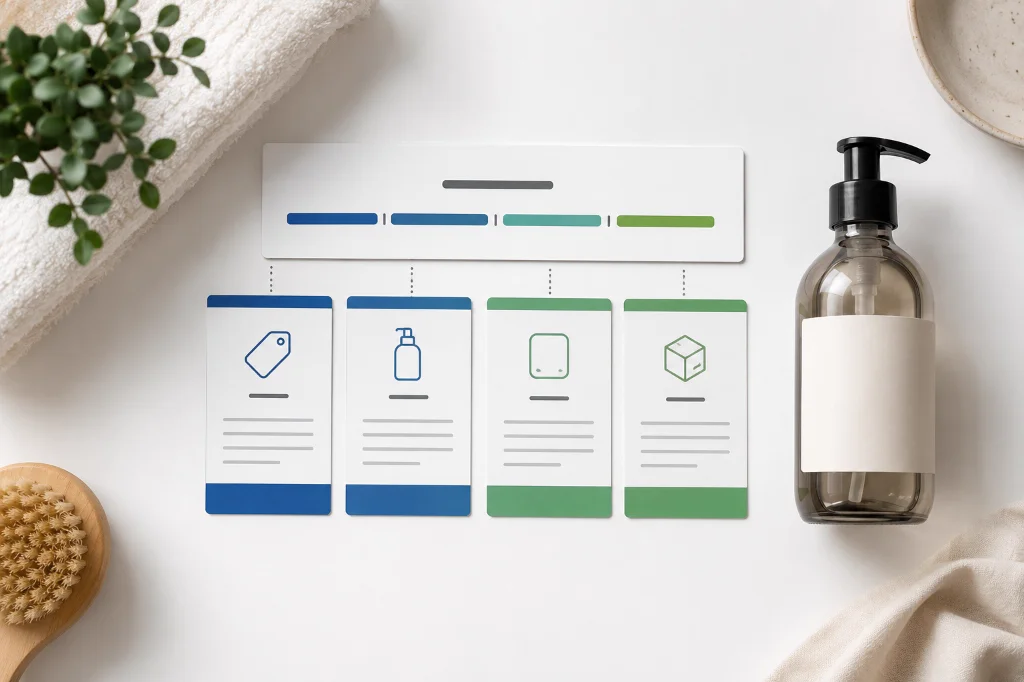
Understanding the anatomy of a product title is essential for maintaining brand integrity under the new constraint. The title should not be chopped randomly; instead, it should be restructured around a consistent pattern.
graph LR
    A["Brand Name"] --> B["Variant/Model"]
    B --> C["Product Type"]
    C --> D["Key Attribute"]
    D --> E["Size/Quantity"]
    E --> F["Compliant Title (≤75 chars)"]
What should stay in the Amazon product title?
The title should keep the information needed to identify the product.
In most cases, prioritize:
- Brand name (crucial for identity and brand search matching)
- Product type or category indicator (what the item actually is)
- Variant, model, color, or style details (which one is it?)
- Size, quantity, or pack count (how much does the customer get?)
- One essential differentiator if space allows
A practical formula:
Brand + Variant/Model + Product Type + Key Attribute + Size
Let's look at how specific categories map this anatomy to their titles:
| Category | Brand | Variant/Model | Product Type | Key Attribute | Size / Pack | Compliant Title (≤75 Char) |
|---|---|---|---|---|---|---|
| Beauty | SOULBAR | Mystic Musk | Soap | Goat Milk | 100g | SOULBAR Mystic Musk Soap with Goat Milk, 100g |
| Electronics | ArcLite | Silent | Wireless Mouse | USB Receiver | Black | ArcLite Silent Wireless Mouse, Black |
| Home | UrbanNest | Comfort | Cotton Towels | Absorbent | Pack of 4 | UrbanNest Comfort Cotton Towels, Pack of 4 |
| Food | BeanCo | Arabica | Ground Coffee | Medium Roast | 250g | BeanCo Arabica Ground Coffee, Medium Roast, 250g |
| Apparel | Stitched | Classic | Crewneck T-Shirt | Slim Fit | L | Stitched Classic Crewneck Cotton T-Shirt, L |
Part 3: What Should Move Out of the Title?
Move details out of the title when they are useful but not essential to product identification.
Good candidates for Item Highlights or other fields:
- materials
- ingredients
- fragrance
- benefits
- use cases
- audience
- compatibility
- surface type
- texture
- feature details
- recommended usage
- secondary differentiators
Example:
- Title:
Soulbar Royal Musk Car Perfume Spray, 80 ml - Item Highlights:
hanging card, long-lasting freshener, 700+ sprays
The title identifies the product. Item Highlights preserve useful detail.
What are Amazon Item Highlights?
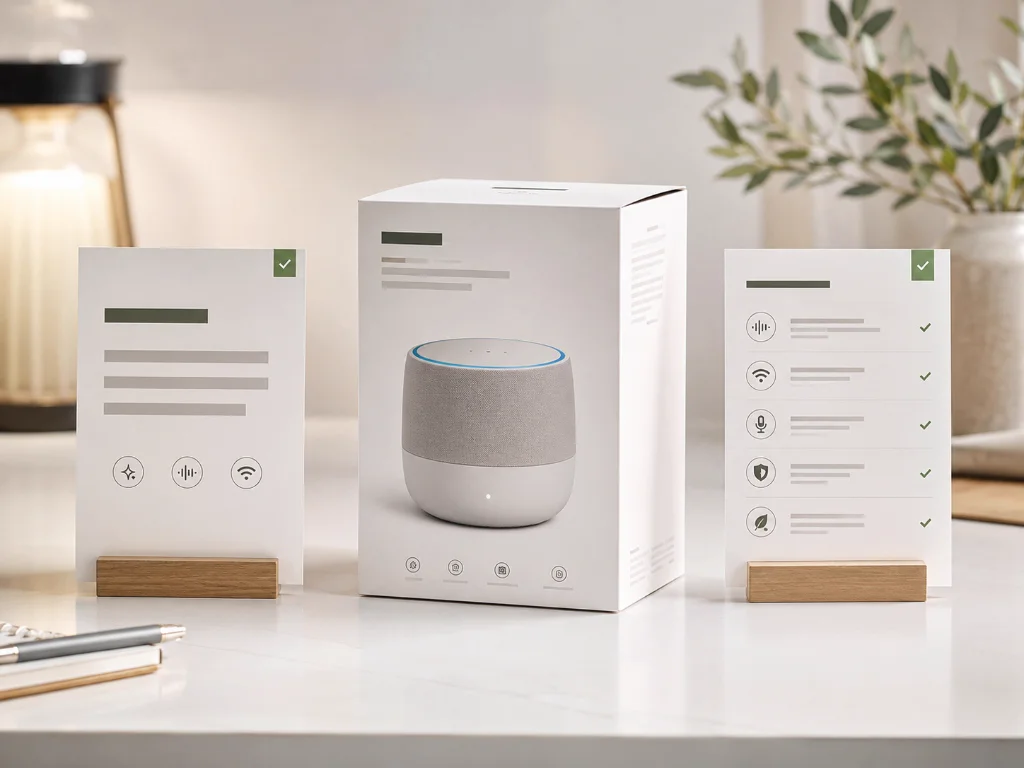
Amazon Item Highlights are a compact supporting field that gives sellers 125 characters for product details such as materials, recommended use cases, or comparison information.
They are not full bullet points.
They are not backend keywords.
They are not a second product title.
Good Item Highlights look like:
Moroccan clay, goat milk, musk fragrance, moisturizing bath bar
Bad Item Highlights look like:
soap bath soap goat milk soap handmade soap moisturizing soap musk soap
The first version helps shoppers. The second looks like keyword stuffing.
Item Highlights requirements sellers should follow
Use these rules:
- Keep Item Highlights within 125 characters.
- Count spaces and punctuation.
- Use source-supported details.
- Avoid paragraph-style wording.
- Avoid unnecessary title repetition.
- Avoid keyword stuffing.
- Review sensitive claims.
- Keep it readable.
A useful structure is:
material or ingredient + benefit + use case + secondary differentiator
Example:
USB receiver, ergonomic design, long battery life, laptop use
To learn more about the differences between these fields, review our guide on Amazon title vs Item Highlights.
Part 4: Clean Punctuation, Repetition, and Special Characters
The shorter title structure makes bad writing habits more obvious. Amazon has specifically targeted noisy formatting, repeated terms, and promotional language to clean up search results pages.
Repeated words and keyword stuffing
Repeated words are one of the biggest title cleanup problems.
- Old style (stuffed):
Wireless Mouse for Laptop, Wireless Mouse for Office, Black Wireless Mouse, Silent Wireless Mouse - New style (clean):
ArcLite Silent Wireless Mouse for Laptop, Black
The cleaner title keeps product identity without repeating "wireless mouse" again and again.
Sellers should remove:
- repeated product type terms
- repeated audience terms
- repeated use cases
- repeated adjectives
- redundant brand phrases
- keyword chains that do not read naturally
Special characters and noisy separators
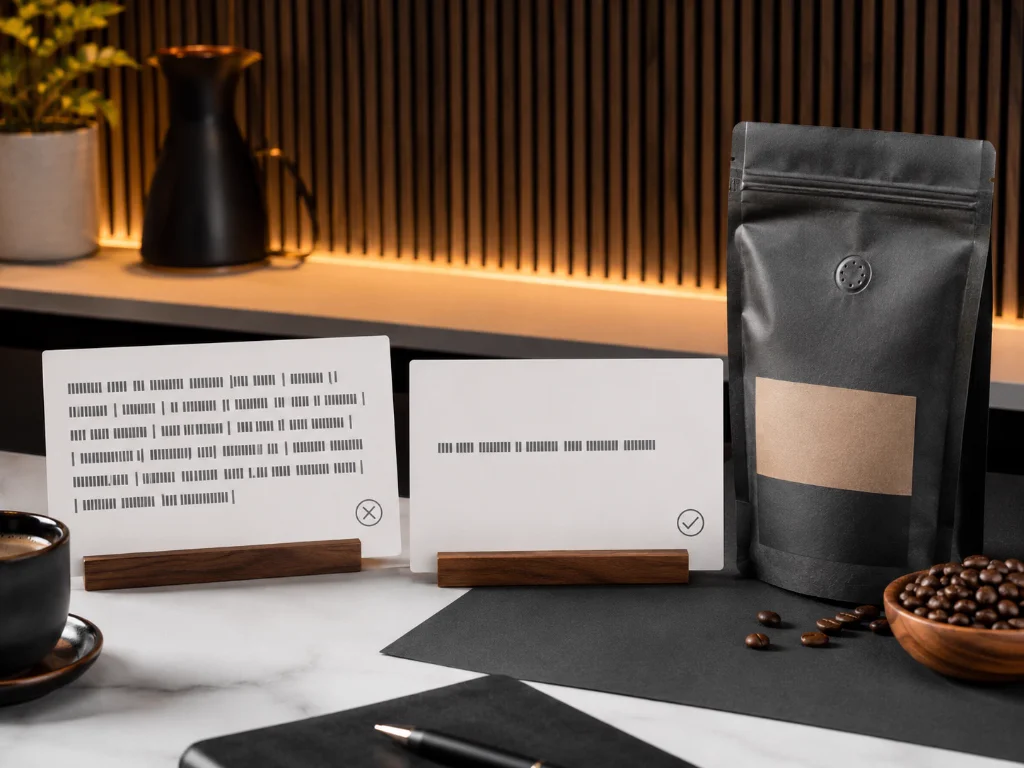
Many old Amazon titles rely on separators such as |, //, !!!, repeated dashes, decorative symbols, excessive commas, or brackets packed with phrases. A clean title usually needs fewer separators.
- Old style:
SOULBAR | Royal Musk | Car Perfume Spray | Long Lasting | 80 ml - New style:
Soulbar Royal Musk Car Perfume Spray, 80 ml
The supporting details can move into Item Highlights.
Promotional wording
Promotional wording often wastes title space. Examples to review:
- best
- premium
- top quality
- must-have
- perfect gift
- new launch
- amazing
- superior
- ultimate
- trending
When space is limited, product clarity wins.
Claims still need review
Shorter titles do not remove claim responsibility. Review claims such as:
- organic
- natural
- non-toxic
- chemical-free
- clinically proven
- dermatologist-approved
- anti-aging
- medical-grade
- child-safe
- pet-safe
- guaranteed
- compatible with specific devices
A claim may be valid, but it should be supported. If a claim is risky in the title, it may still be risky in Item Highlights, bullet points, images, or A+ content. Avoid making mistakes with listing claims; consult our analysis on Amazon title compliance mistakes for more.
Part 5: Category-Specific Title Rules
Because Amazon's search behavior varies by category, title rules must adapt to the specific type of product being sold. Applying a generic formula across a diverse catalog can result in poor search performance.
1. Beauty & Personal Care
In beauty, ingredients and variant names drive conversion.
- Priority: Brand name, variant details (color/shade/fragrance), product type, and net volume.
- Example:
GLOWVERA Rose Gold Face Oil, Moisturizing Elixir, 30ml - Highlight Focus: Hydrating formula, organic rose oil, daily use, suitable for dry skin.
2. Consumer Electronics
Tech shoppers search by model names, compatibility, and key specifications.
- Priority: Brand name, model series, product type, primary specification, and color.
- Example:
VOXIS H200 Wireless Bluetooth Headphones, Over-Ear, Black - Highlight Focus: Active noise cancellation, 40-hour battery, travel case, Bluetooth 5.2.
3. Apparel & Fashion
Fashion titles need to be clean and free of keyword stuffing to comply with styling guidelines.
- Priority: Brand name, apparel style, fabric blend, color, and size.
- Example:
STITCHED Classic Cotton Crewneck T-Shirt, Navy Blue, L - Highlight Focus: 100% organic cotton, slim fit style, preshrunk fabric, ribbed neck.
4. Home & Kitchen
Sellers in this space must prioritize pieces, pack sizes, and primary materials.
- Priority: Brand name, material, product type, dimensions/size, and quantity.
- Example:
URBANNEST Turkish Cotton Bath Towel Set, Pack of 4, Sage - Highlight Focus: High absorbency towels, quick-drying fibers, durable double-stitch hem.
Part 6: Catalog Operations and Workflows
Sellers with hundreds or thousands of products cannot afford to manually update listings one by one. A structured catalog operations workflow is required.
graph TD
    A["Download Amazon Inventory Report (TXT)"] --> B["Audit Title Lengths"]
    B --> C["Segment Listings into Priority Batches"]
    C --> D["Generate Titles & Highlights in Bulk"]
    D --> E["Verify Claims & Length Limits"]
    E --> F["Export Review-Ready XLSX"]
    F --> G["Apply to Seller Central"]
How to get the Amazon TXT export
To prepare the catalog, start with the original Amazon Seller Central TXT export.
- Log in to your Amazon Seller Central account.
- Navigate to Reports, then click Inventory Reports.
- Choose Active Listings Report, All Listings Report, or Category Listings Report from the dropdown menu.
- Click Request Report.
- Wait until the report status changes to Ready.
- Click Download and save the file.
If you require a detailed tutorial on this workflow, refer to our walkthrough on Amazon Seller Central TXT export.
Why sellers should not wait for Amazon AI recommendations
Amazon has said over-limit titles may be gradually updated to AI recommendations after the July 27, 2026 deadline. That does not mean sellers should wait.
Seller-controlled rewrites let teams preserve:
- brand naming
- variant consistency
- product identity
- claim review
- category-specific structure
- cross-channel naming
- internal approval
To organize the broader catalog update project, refer to our Amazon listing cleanup workflow guide.
Part 7: Mobile Readability Optimization
A critical driver behind Amazon's title cap reduction is mobile search presentation. Over 70% of Amazon customers browse using mobile devices, where titles are truncated much earlier than on desktop screens.
The Mobile Truncation Point
On the Amazon mobile app and mobile web browsers, product titles are often truncated to as few as 50 to 60 characters in list views.
[ Mobile Search Result Mockup ]
--------------------------------------------
|  [Product Image]   SOULBAR Mystic Musk... |
|                    ★★★★★ (142)           |
|                    $14.99 ($4.25/oz)      |
--------------------------------------------
If your primary identifier (such as variant, flavor, or pack size) is placed at character 65, it will be invisible to mobile searchers.
Mobile Best Practices
- Frontload Identifiers: Place the brand name and product type at the very beginning of the title.
- Punctuate Early: Use commas and spaces cleanly to prevent word wrapping issues.
- Shift Non-Visuals: Put details like technical compatibility, material listings, and secondary features directly into Item Highlights, which are optimized to display cleanly on mobile search detail pages.
Part 8: Compliance Strategies Compared: Manual vs. Amazon AI vs. Programmatic
With the July 27, 2026 deadline approaching, sellers have three primary paths to bring their catalogs into compliance. Each method has distinct implications for resource allocation, listing quality, and brand control.
1. Manual Copywriting & Single-Product Updates
For brands with very small catalogs (e.g., fewer than 10 SKUs), updating titles manually directly inside Seller Central or via single-product flat files is the most straightforward path.
- How it works: A copywriter or channel manager logs into Seller Central, navigates to "Manage All Inventory," opens each listing, edits the title to conform to the 75-character limit, populates the 125-character Item Highlights field, and submits the changes.
- Pros: Absolute human oversight. Each title is crafted with precise brand tone and optimized for SEO.
- Cons: Extremely slow and error-prone at scale. There is no automated validation to prevent accidental character count overruns before submission, and version control across multiple marketplaces is difficult to maintain.
2. Relying on Amazon's Automated AI Recommendations
Sellers who do not take action before the deadline will see their listings updated automatically by Amazon’s AI catalog systems.
- How it works: Amazon's machine learning models analyze the product page (description, bullet points, A+ content) and generate a shortened 75-character title. These suggestions are placed in a queue in Seller Central under "Review Listing Changes." If the seller does not reject or modify the recommendation within 14 days, it goes live.
- Pros: Low manual effort. The system does the rewriting for you.
- Cons: Severe risk of brand dilution. The AI may strip critical identifiers, misinterpret variant specifications, or introduce forbidden promotional keywords found in old bullets. Rejecting hundreds of AI recommendations in a 14-day window creates operational chaos.
3. Programmatic & Data-First Workflows
For agencies and D2C brands managing complex or multi-variant catalogs, a data-first programmatic workflow bridges the gap between manual precision and AI speed.
- How it works: Sellers download their Active Listings Report in tab-delimited TXT format, run it through a programmatic validation tool to generate compliant titles and Item Highlights in bulk, review all suggestions against validation rules in a spreadsheet, and upload the final review-ready XLSX file back to Seller Central.
- Pros: Highly scalable. Preserves brand voice and variant structure. Ensures 100% policy compliance before any listing modifications are submitted to Amazon.
- Cons: Requires dedicated software or scripts to parse the files and generate matching Item Highlights.
| Metric | Manual Updates | Amazon AI Recommendations | Programmatic (e.g., AgenixSocial) |
|---|---|---|---|
| Catalog Scale Suitability | Small (1-10 SKUs) | Unsuitable (Creates massive review queues) | Enterprise & Agency (10-10,000+ SKUs) |
| Time to Complete | High (Hours per SKU at scale) | Zero (Automated by Amazon) | Low (Bulk generation in minutes) |
| Brand Voice Protection | High (Human-curated) | Low (Strips variant logic, generic phrasing) | High (Rules-based constraints, human review) |
| Error & Suppression Risk | Medium (Accidental overruns) | High (Incorrect spec mapping or Suppressed rows) | Low (Pre-submission validation flags) |
| Operational Control | Full | None (Unless managed in tight 14-day queues) | Full (Offline review before upload) |
Part 9: How AgenixSocial Helps with Amazon Product Title Requirements
AgenixSocial is a brand-aware, product-aware workspace built to support commerce teams.
For compliance preparation, the Amazon 75-Character Title Compliance workflow accepts original Amazon Seller Central tab-delimited TXT exports. It uses row-level details (like item-name and description) to generate shorter title proposals, 125-character Item Highlights, validation notes, and confidence indicators.
Sellers can:
- Upload original Amazon TXT exports (retaining original columns)
- Generate all valid rows or select specific rows
- Edit generated titles and Item Highlights directly
- View character lengths and flag violations
- Export a review-ready XLSX file
Note: AgenixSocial is a tool for compliance preparation. It does not publish changes directly to Amazon, and it does not promise that Amazon will approve every change. Sellers should review all outputs for category fit, brand tone, and claim safety.
Sellers can explore the workspace with 100 free products. Beyond that, usage is calculated at 1 credit per 100 additional products. Read more on the pricing page.

Final checklist for sellers
Before applying title updates to your live catalog, run through this quick checklist:
- Title Length: Title is 75 characters or fewer including spaces.
- Brand Name: Brand name is preserved at the beginning of the title.
- Keyword Repetition: Repeated words and stuffed keywords have been removed.
- Separator Cleanup: Decorative symbols (
|,//,!!!) are removed. - Item Highlights Length: Highlights are 125 characters or fewer.
- Highlights Content: Highlights are source-supported and do not repeat the title.
- Claims Verification: Sensitive claims (organic, natural, compatible) have been reviewed.
- ID Mapping: SKU, ASIN, and product IDs are preserved.
- Handoff Quality: XLSX is exported and reviewed before submission.
- Implementation: Approved values are applied through Category templates or Seller Central.
To learn more about the broader policy requirements, read our flagship article on the Amazon 75-character title limit, download our Amazon title compliance checklist, and check out how we help Amazon seller content workflows.
Conclusion
Amazon product title requirements in 2026 are not just about making titles shorter.
They are about making product information cleaner.
Sellers need to identify what belongs in the title, what belongs in Item Highlights, what belongs in bullets, images, or A+ content, and what should be removed or reviewed.
The safest workflow is to start from the original Amazon TXT export, preserve listing identifiers, generate title and Item Highlights together, review claims, and export a review-ready file before applying approved updates.
AgenixSocial helps sellers do that. Upload your Amazon TXT export, generate 75-character title proposals and 125-character Item Highlights, review confidence and validation notes, edit or regenerate where needed, and export a review-ready XLSX.
CTA: Prepare review-ready Amazon titles and Item Highlights with AgenixSocial’s Amazon 75-Character Title Compliance workflow.