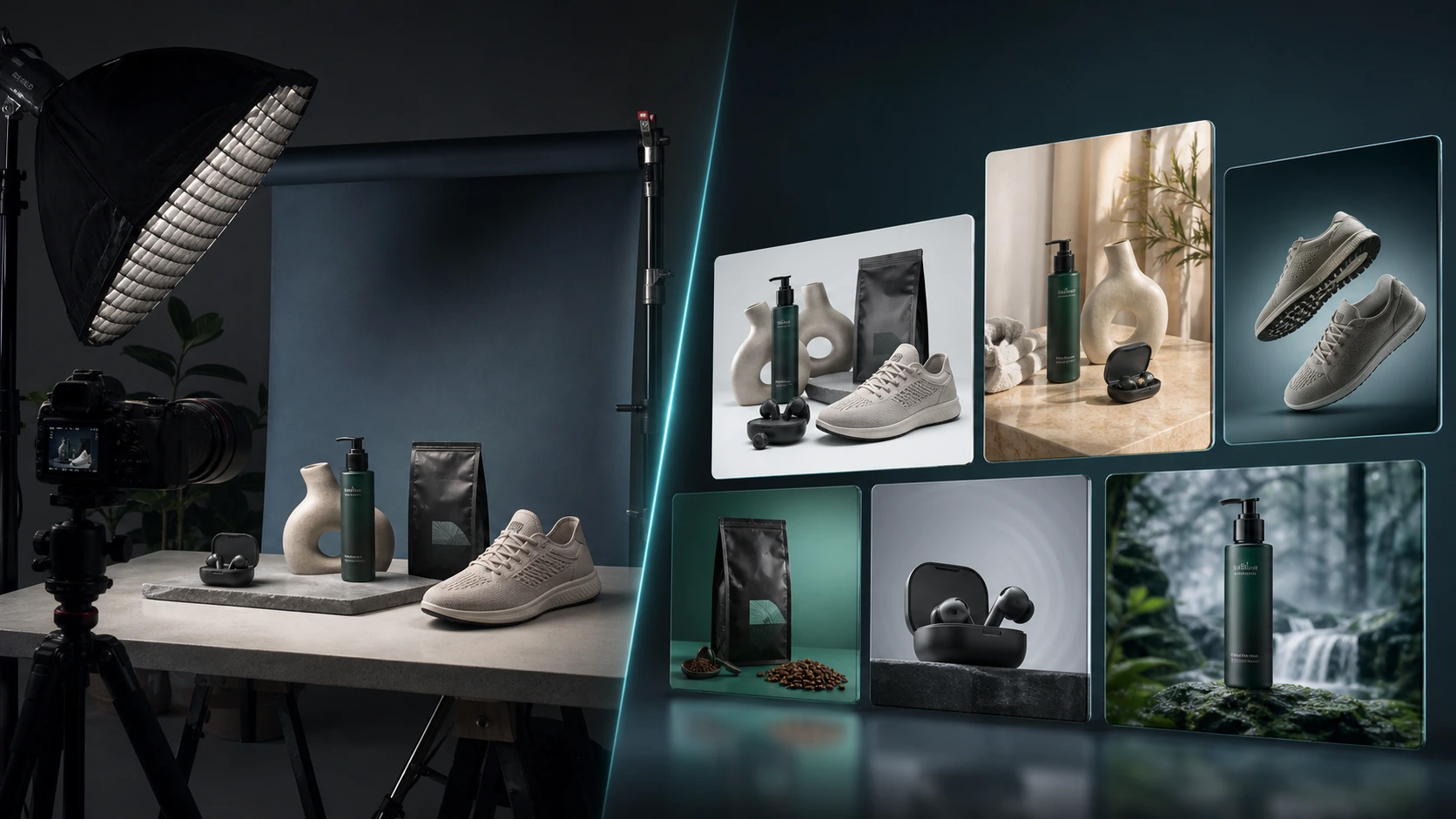
AI product photography vs traditional photoshoots: which is better for ecommerce?
Short answer
AI product photography is better for everyday ecommerce visuals, catalog refreshes, marketplace images, social creatives, and creative testing because it is faster, easier to scale, and less coordination-heavy than a traditional photoshoot. Traditional photoshoots are still better when the brand needs precise physical control over every element, including the set, model, lighting, texture, reflections, props, and final composition.
The better question is not "Will AI replace product photography?"
The better question is:
Where should ecommerce teams use AI, where should they still shoot, and where does a hybrid workflow make the most sense?
For most ecommerce brands, AI product photography should become the default workflow for high-volume product visuals. Traditional photoshoots should become the exception for hero campaigns, flagship launches, complex physical realism, and brand moments where every detail needs to be controlled.
Why this comparison matters now
Ecommerce brands need more product content than ever.
A single product may need images for a Shopify product page, Amazon listing, marketplace gallery, social post, ad creative, email campaign, landing page, product launch, A/B test, seasonal refresh, and Amazon A+ content.
That is not one photoshoot.
That is a content operation.
Traditional photoshoots were built for control. They are valuable when the brand needs a precise final image. But they are also slow, expensive, coordination-heavy, and difficult to repeat across a large catalog.
AI product photography was built for speed and variation. It can create product visuals faster, test multiple scenes, and support larger catalogs without setting up a physical shoot every time.
Both have a role.
The mistake is treating this as a binary decision.
The smartest ecommerce teams will not choose AI or traditional photoshoots forever. They will use AI for everyday product content and reserve traditional shoots for moments where physical control, realism, or brand prestige matters most.
What is traditional product photography?
Traditional product photography is the process of capturing product images using a physical camera, real product samples, lighting, backdrops, sets, props, photographers, stylists, models, and post-production.
It can include:
- white background product shots
- studio product photography
- lifestyle shoots
- model shoots
- campaign photography
- macro detail shots
- flat lays
- hero images
- catalog photography
- brand storytelling shoots
Traditional photoshoots are valuable because they give the brand physical control. The team can control the product, camera, lighting, set, materials, human model, texture, reflections, movement, and final composition. Shopify's product photography guide is a useful baseline for understanding how much setup and process a traditional workflow still requires.
That level of control still matters.
If a brand is launching a flagship product, shooting luxury visuals, working with a celebrity, capturing highly specific material detail, or creating a campaign where every physical element must be exact, a traditional shoot can still be the right choice.
What is AI product photography?
AI product photography uses AI tools and product references to create ecommerce product visuals without setting up a full physical shoot for every output.
It can create:
- studio-style product images
- lifestyle product shots
- flat lays
- product-in-use visuals
- marketplace listing images
- social ad creatives
- campaign visuals
- Amazon A+ style modules
- seasonal variations
- background and scene variations
The strongest use case is not one random AI-generated image.
The strongest use case is repeatable ecommerce visual production.
A brand can take a product reference, product description, brand context, and shot direction, then generate multiple product visuals for different channels much faster than planning a new physical shoot each time.
That is why AI product photography is useful for product pages, marketplaces, social content, ads, and catalog refreshes.
The real difference: control vs scale
Traditional product photography gives you physical control.
AI product photography gives you creative scale.
That is the simplest way to understand the difference.
Traditional photoshoots are better when the exact image matters more than speed. AI product photography is better when output volume, speed, testing, and repeated variation matter more.
Here is the practical comparison:
| Factor | AI product photography | Traditional photoshoots |
|---|---|---|
| Speed | Fast for generating many product visuals | Slower because planning, shooting, editing, and coordination take time |
| Cost burden | Lower production burden once the workflow is set up | Higher total burden due to team, studio, props, location, retouching, and revisions |
| Creative testing | Strong fit because many variations can be created quickly | Limited by shoot time, budget, and available setups |
| Catalog scale | Strong fit for many SKUs and repeated refreshes | Harder to scale across large catalogs |
| Physical control | Limited because the scene is generated | Strong because every physical element can be controlled |
| Product realism | Strong when references and review are good | Strongest when exact physical capture matters |
| Brand prestige | Useful for everyday branded visuals | Stronger for flagship campaigns and luxury creative |
| Workflow fit | Better for ecommerce content operations | Better for high-control campaign production |
| Best use | Product pages, marketplace images, ads, social, testing, refreshes | Hero campaigns, model shoots, luxury launches, precise product capture |
Where AI product photography is better
AI product photography is better when the brand needs speed, volume, variations, and repeatability.
Everyday ecommerce product visuals
Most ecommerce product visuals are not flagship campaign assets.
They are practical images that need to explain the product, show the benefit, fit the channel, and help the buyer understand what they are looking at.
AI is a strong fit here because it can create visuals quickly without restarting a full production cycle.
Catalog refreshes
Catalog refreshes are painful with traditional shoots.
If a brand has 50, 100, or 500 SKUs, even small visual updates can become a large production project.
AI product photography makes catalog refreshes easier because the team can create new backgrounds, lifestyle scenes, seasonal variations, and marketplace visuals without physically reshooting every product.
Marketplace listing images
Marketplace sellers often need image sets, not single images.
A product listing may need a clean product image, benefit image, lifestyle shot, scale visual, product-in-use scene, comparison visual, and supporting creative. Amazon says every listing needs at least one image and recommends additional images and video to help customers evaluate the product, which is why this matters so much for marketplace sellers and Amazon sellers. See Amazon Seller Central's product image guide.
AI product photography is useful here because marketplace content is repetitive, format-heavy, and SKU-heavy.
Social creative testing
Social content and ads need constant variation.
A brand may want to test:
- different backgrounds
- different hooks
- different product angles
- different lifestyle settings
- different benefit framing
- different seasonal directions
- different social ad compositions
Traditional shoots make this expensive. AI makes it much easier to create multiple directions and test which one performs better.
Campaign variations
AI is useful when a campaign needs multiple image variants across Instagram, Facebook, email, landing pages, and product pages.
The brand can generate many campaign directions before deciding what to push harder.
Amazon A+ and product storytelling modules
AI can support visual modules for Amazon A+ content and product storytelling, especially when the brand already has product references and clear benefit messaging.
For premium brands, a hybrid approach may still work best: use real product hero shots where exact realism matters, then use AI to build supporting visuals, module concepts, lifestyle extensions, and story-led variations.
Where traditional photoshoots are still better
Traditional photoshoots are still required when the brand needs something very specific and every physical element must be controlled precisely.
That includes:
- exact lighting
- exact texture
- exact reflection
- exact transparency
- exact product behavior
- exact material detail
- exact model interaction
- exact set design
- exact prop placement
- exact camera angle
- exact physical composition
AI can create strong visuals, but it is still generated. When the brand cannot tolerate drift, a real shoot is safer.
Hero campaigns
A hero campaign is not just another product image.
It may define the product launch, brand identity, and creative direction for months. If the campaign needs full control, a traditional shoot is often worth it.
Flagship launches
For flagship launches, the brand may want total confidence in every detail. The physical product, lighting, set, model, and creative direction may need to be captured exactly.
Luxury storytelling
Luxury brands often care deeply about material realism, texture, reflections, mood, and prestige. AI can support ideation and variation, but traditional photography still gives more physical confidence.
Complex human-product interaction
If the product needs a human model to wear, hold, apply, bend, fit, pour, stretch, or use it in a physically accurate way, traditional photoshoots may still be better.
This is especially true for apparel fit, jewelry scale, skincare application, complex hand interaction, transparent objects, liquid behavior, and reflective materials.
Regulated or high-risk product accuracy
If exact representation matters for legal, regulatory, medical, technical, or high-risk product reasons, real capture may be safer.
AI-generated visuals still need human review. For some categories, review is not enough. Exact capture is required.
Use-case comparison: which option is better?
| Use case | Better option | Why |
|---|---|---|
| Everyday product page visuals | AI product photography | Fast, repeatable, and good for standard ecommerce needs |
| Catalog refresh | AI product photography | Easier to scale across many SKUs |
| Marketplace listing images | AI product photography | Strong fit for repeated image sets and benefit visuals |
| Social creative testing | AI product photography | Many variations can be generated quickly |
| Paid ad variations | AI product photography | Useful for testing angles, benefits, and visual styles |
| Seasonal content refresh | AI product photography | Faster than planning new shoots for every season |
| Amazon A+ modules | AI or hybrid | AI can create supporting visuals, but real shots may anchor premium modules |
| Hero campaign | Traditional or hybrid | More control and brand polish may be needed |
| Flagship product launch | Traditional photoshoot | Full production control may matter more |
| Luxury brand campaign | Traditional photoshoot | Physical texture, lighting, and prestige are critical |
| Complex model interaction | Traditional photoshoot | Real fit, movement, and human-product interaction may need real capture |
| Founder or creator-led content | Traditional, AI creator workflow, or hybrid | Depends on whether authenticity, speed, or scale matters most |
Cost comparison: the real cost is the production burden
Traditional photoshoots are not expensive only because of the photographer.
The real cost includes:
- planning
- creative direction
- product samples
- location
- props
- styling
- models
- photographer
- studio time
- coordination
- revisions
- retouching
- resizing
- delays
- team time
- opportunity cost of waiting
That last point matters.
If a campaign is delayed because images are not ready, the brand loses time. If a catalog refresh takes weeks, the team cannot test fast enough. If every product needs a new shoot, the content backlog never ends.
AI product photography also has costs.
It still requires product references, direction, generation, review, selection, and workflow setup. But once brand and product context are reusable, creating more variations becomes much easier and the production burden drops sharply.
The advantage of AI is not just cheaper images.
The advantage is lower friction across the full content workflow.
Speed comparison: AI wins for iteration
Speed is one of AI product photography's clearest advantages.
A traditional photoshoot has dependencies. You need the product, photographer, set, lighting, props, schedule, creative approval, editing, and final delivery.
AI workflows can produce multiple directions faster because the team can generate, review, adjust, and regenerate without waiting for another production day.
That speed matters most when the brand needs:
- quick campaign tests
- product launch visuals
- marketplace refreshes
- seasonal content
- social ads
- multiple creative angles
- product page experiments
Traditional shoots can still be fast if the team has an established studio workflow, but AI is usually stronger when the question is, "How many versions can we test this week?"
Creative testing: AI changes the economics of variation
Traditional shoots make variation expensive.
If a team wants to test ten backgrounds, ten lighting styles, ten usage scenes, and ten benefit angles, that can become a large production plan.
AI makes variation easier.
The team can test:
- minimal studio shots
- warm lifestyle scenes
- premium editorial scenes
- marketplace benefit visuals
- seasonal versions
- social-first ad visuals
- product-in-use images
- flat lays
- macro details
- campaign concepts
This changes the creative process.
Instead of betting on one shoot direction, ecommerce teams can explore more directions before committing.
That is especially useful for small brands that cannot afford large creative experiments through traditional production.
Catalog scale: AI is built for repeatability
Catalog scale is where AI product photography becomes especially useful.
A single product shoot is manageable.
A 100-SKU catalog is different.
Each SKU may need product page images, marketplace images, social creatives, ad variants, seasonal refreshes, and supporting campaign visuals.
Traditional photoshoots can handle catalog work, but they require planning, batching, production days, retouching, and coordination. The more SKUs you add, the heavier the operation becomes.
AI product photography is better suited for repeatability.
If the workflow already knows the brand and product context, the team can generate more variations without rebuilding the creative process every time.
This is where a brand-aware system matters.
A generic AI image generator may create one good visual. A commerce content workflow should help the team create product visuals repeatedly across products, channels, and campaigns.
Quality comparison: AI is good, but review still matters
AI product photography can look excellent.
But ecommerce quality is not just about beauty.
A product image must be accurate, usable, and trustworthy.
Teams should review:
- product shape
- packaging
- label
- color
- material
- reflections
- texture
- proportions
- text readability
- claims
- badges
- hands
- model interaction
- platform format
- brand consistency
Traditional photoshoots reduce some accuracy risks because the product is physically captured. But even traditional images still require retouching review, color checks, and final approval.
AI product photography adds a different review need. The image may look realistic but still change something important.
That is why AI should not remove human review.
It should reduce production bottlenecks while keeping the team in control.
What not to use AI product photography for yet
AI product photography is powerful, but it is not the best tool for every visual.
Avoid relying only on AI when:
- the product must be captured exactly as-is for legal, regulatory, or high-risk accuracy reasons
- exact physical texture, reflection, transparency, liquid behavior, or material behavior matters
- the campaign requires a real model, real creator, real founder, or real location
- the brand wants a flagship hero asset with full production control
- the product needs complex human interaction that AI may distort
- the final image will be used as proof of exact fit, function, size, or physical behavior
This does not make AI weak.
It makes the workflow smarter.
Use AI where it gives speed and scale. Use traditional shoots where exact physical control matters.
The hybrid workflow: the smartest option for many brands
The best workflow is often hybrid.
Use traditional photoshoots to create your highest-control hero assets.
Use AI product photography to extend, adapt, refresh, test, and scale product visuals across everyday ecommerce channels.
A hybrid workflow may look like this:
- Capture real hero product shots through a traditional shoot.
- Use those shots as the brand's most accurate visual foundation.
- Use AI to create supporting lifestyle variants, seasonal edits, marketplace visuals, and ad concepts.
- Use AI to test creative directions before the next shoot.
- Use the best-performing AI concepts to inform future physical shoot planning.
- Use AI for catalog refreshes where a new shoot would be too slow or expensive.
- Reserve real shoots for flagship creative moments.
This approach avoids both extremes.
It does not pretend AI should replace every photoshoot.
It also does not force the brand to use physical production for every everyday asset.
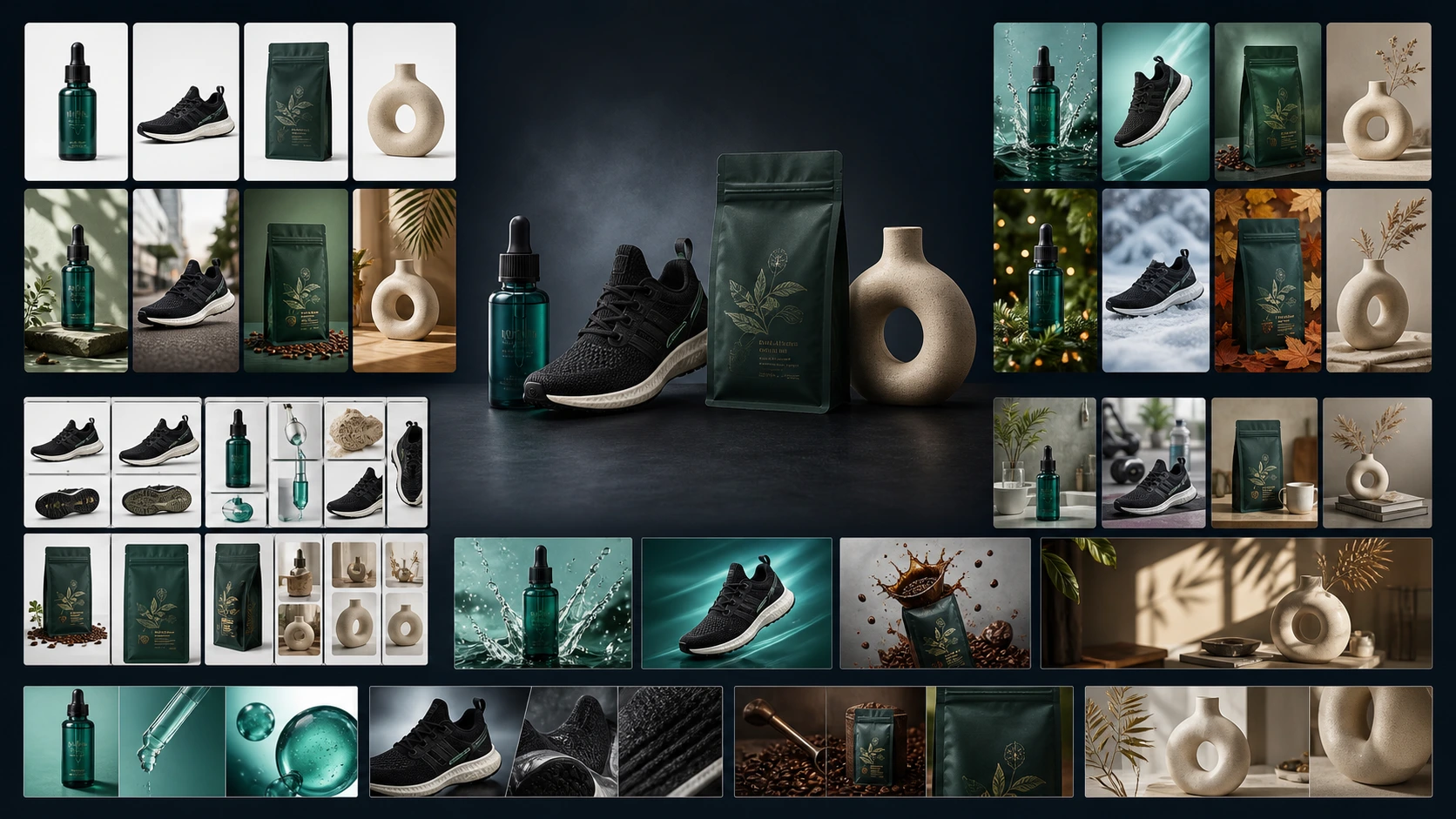
Decision framework: AI, traditional, or hybrid?
Use AI product photography when:
- you need speed
- you need many variations
- you are refreshing a catalog
- you are testing creatives
- you need marketplace images
- you need social or ad visuals
- you want to reduce shoot coordination
- you need product visuals across many SKUs
- you need seasonal or campaign variations quickly
Use traditional photoshoots when:
- every physical detail must be controlled
- exact lighting, texture, reflection, or set design matters
- the campaign is a flagship brand moment
- the image involves complex human-product interaction
- product accuracy requires real capture
- the brand needs a real model, real founder, real creator, or real location
- the image will carry premium brand storytelling
Use a hybrid workflow when:
- you already have strong real product shots
- you want to extend them into marketplace, social, ad, and campaign variants
- you want real product accuracy plus AI creative scale
- you want to test AI concepts before planning a real shoot
- you want to reduce shoot frequency without giving up physical hero assets
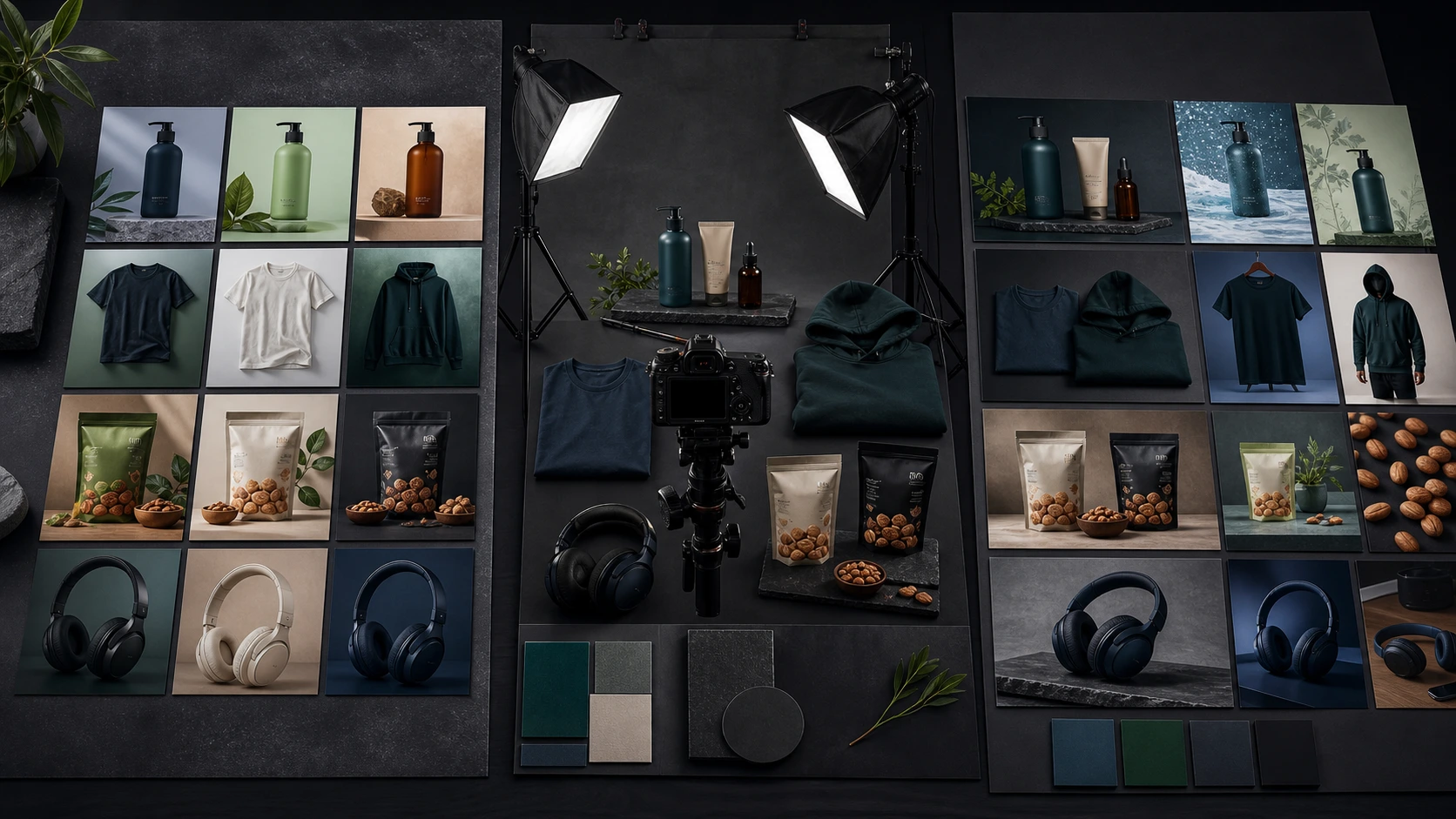
How AgenixSocial fits into this decision
AgenixSocial should not be thought of as only a photoshoot replacement.
It is better understood as a commerce content workflow.
Product Shots can help create studio, lifestyle, flat lay, in-use, macro, environmental, marketplace, and ad-style visuals from product context. Brand DNA gives the system reusable brand context, so every visual does not start from a blank prompt. Marketplace Listing Studio helps plan image sets for marketplace sellers. Amazon A+ Studio helps create visual modules for Amazon storytelling. Campaigns help turn product or brand goals into planned content sets.
That matters because ecommerce teams do not only need product photos.
They need product content.
They need visuals for:
- product pages
- marketplaces
- Amazon A+ content
- ads
- social posts
- campaigns
- launches
- catalog refreshes
- testing
- approvals
- downloads
- scheduling
AgenixSocial helps teams decide when to create AI product visuals, when to build marketplace assets, when to create Amazon A+ content, when to generate ads or campaigns, and when to keep using real shoot assets.
That is the broader value.
It is not "never do a photoshoot again."
It is "stop using photoshoots for every everyday ecommerce visual."
Practical example: a D2C brand with 80 products
Imagine a D2C brand with 80 products.
The team needs new visuals for:
- product pages
- marketplace listings
- social ads
- seasonal campaigns
- email banners
- Amazon A+ content
- product launch announcements
A traditional-only workflow means planning batches of shoots, waiting for edits, resizing assets, and repeating production cycles whenever products, seasons, or campaigns change.
An AI-only workflow may work for speed, but the team still needs product accuracy checks and creative direction.
A hybrid workflow is stronger.
The brand can use real photography for flagship product shots and high-control hero assets. Then it can use AI product photography to extend those assets into everyday ecommerce visuals, test new creative angles, refresh catalog scenes, and create marketplace or campaign variations.
This is how the production model changes.
The team stops treating every visual as a new shoot.
For teams like D2C founders, the practical shift is not just lower cost. It is a much faster content operating rhythm.
Common mistakes when comparing AI and traditional photoshoots
Mistake 1: Comparing only image cost
The real comparison is not just cost per image.
It is the full production burden: planning, coordination, editing, review, resizing, delays, and team time.
Mistake 2: Assuming AI replaces all photography
AI should not replace every shoot.
It should reduce the number of shoots needed for everyday ecommerce content.
Mistake 3: Ignoring product accuracy
AI outputs need review.
A beautiful but inaccurate product image is still a bad ecommerce asset.
Mistake 4: Using traditional shoots for every small variation
If every background, seasonal refresh, ad variation, and marketplace visual requires a new shoot, the brand will move too slowly.
Mistake 5: Using AI without brand context
Generic AI output can look polished but still feel wrong for the brand.
Brand context is what makes the output usable.
Mistake 6: Forgetting catalog scale
A workflow that works for five images may fail for 500.
Ecommerce teams should judge the workflow by how it performs across a catalog, not by one impressive sample.
Final takeaway
AI product photography and traditional photoshoots are not enemies.
They solve different problems.
Traditional photoshoots are best when the brand needs precise physical control over the set, model, lighting, texture, reflection, product behavior, and final composition.
AI product photography is best when the brand needs speed, lower production burden, creative testing, catalog refreshes, marketplace images, social creatives, and everyday ecommerce visuals.
The winning workflow is practical:
Use traditional photoshoots for the moments that need full control.
Use AI product photography for the product visuals your ecommerce team needs every week.
Use a hybrid workflow when you want real product accuracy and AI creative scale.
Turn one product catalog into product shots, marketplace visuals, Amazon A+ assets, ads, and campaigns with AgenixSocial.
If you want the two companion guides first, start with what AI product photography is and then see how to create ecommerce product photos with AI. Teams that want production flexibility without seat-based lock-in can also review AgenixSocial's pay-as-you-go pricing.