Why Generic AI Content Feels Off-Brand and How to Fix It
Quick answer
Generic AI content feels off-brand because the AI is missing reusable brand context, product catalog context, buyer context, visual direction, claim boundaries, and channel rules. Better prompts can help, but the stronger fix is a Brand DNA layer that gives every future image, video, listing, campaign, and script the right starting point.
The problem is not that AI cannot create useful ecommerce content.
The problem is that most AI tools are asked to create content without truly understanding the brand or the product.

If you want the product workflow behind this topic, start with Brand DNA. If you want to see where that context gets reused later, look at Product Shots, AI Creator Videos, Marketplace Listing Studio, and Campaigns.
Why off-brand AI content is so common
Most ecommerce teams have tried some version of the same workflow.
They open an AI tool.
They write a prompt.
They ask for a caption, product ad, marketplace image, script, founder post, listing blurb, or campaign idea.
The result sounds fine at first.
It may be grammatically correct.
It may look polished.
It may even be close enough to use after editing.
But it still does not feel like the brand.
The tone sounds generic.
The product is described vaguely.
The visual direction looks like it belongs to another company.
The script sounds like any ecommerce brand could have written it.
That is the real problem.
Off-brand AI content is often not obviously terrible.
It is just forgettable.
That is why it slips through so easily.
What “off-brand AI content” actually means
Off-brand AI content is AI-generated content that does not match the brand’s voice, product truth, visual identity, buyer context, market position, or channel behavior.
It can show up as:
- captions that sound too generic
- product visuals that look like a different brand
- AI creator video scripts that overpraise the product
- marketplace assets that ignore buyer clarity
- ad copy that exaggerates claims
- Amazon A+ content that tells the wrong story
- founder-style posts that do not sound like the founder
- multilingual content that sounds translated but not localized
Off-brand does not always mean “bad.”
Sometimes it means “competent but not distinct.”
That is the version that causes the most damage over time, because it lets a brand publish more content while quietly becoming less recognizable.
Why generic AI defaults to generic content
Generic AI tools are built to be broadly useful.
That makes them good at producing plausible output.
It does not make them good at protecting brand distinctiveness.
If the tool does not know your brand deeply, it fills the gaps with common patterns:
- neutral tone
- safe corporate phrasing
- common ecommerce claims
- generic lifestyle scenes
- broad customer assumptions
- polished but vague captions
- benefit language that could fit any competitor
Adobe’s recent analysis of brand consistency at scale makes the same structural point in a different way: guidelines alone do not stop drift because the problem is not only knowledge, it is interpretation, enforcement, and learning across the full workflow. Adobe Experience League
Contentstack frames a similar problem from the AI writing side: when AI does not have enough specific brand grounding, it falls back to a neutral corporate tone that is technically fine but not meaningfully yours. Contentstack
That explains why so many AI outputs sound “right” but still feel wrong.
The system is optimizing for plausibility.
Your brand needs specificity.
The 7 reasons AI content feels off-brand
| Problem | What happens | Better fix |
|---|---|---|
| Weak brand context | Content sounds generic | Create reusable Brand DNA |
| Missing product context | AI invents or blurs product details | Use product catalog and images |
| Vague tone instructions | Output sounds like any brand | Define examples, rules, and avoid-list |
| No visual direction | Images and videos drift visually | Store visual style and scene guidance |
| No claim boundaries | AI overstates benefits | Define what the brand should not say |
| Same prompt for every channel | Content ignores platform context | Adapt by workflow and channel |
| No review process | Mistakes reach publishing | Add human review before use |
Better prompting can improve all seven.
But if the team has to repeat the same brand briefing every single time, the workflow is still broken.

Mistake 1: Weak brand context
A vague brand prompt is not enough.
Prompt:
"Write this in a premium, friendly, helpful tone."
That can create usable copy.
But it does not tell the AI:
- what the brand sells
- who the buyer is
- what the brand avoids
- what visual world the brand belongs to
- what product claims are safe
- how the brand speaks in ads versus listings versus videos
- what clichés should be avoided
For an ecommerce brand, “premium and friendly” is not a real voice system.
It is a loose adjective pair.
A stronger reusable brand context includes:
- brand position
- buyer profile
- product categories
- product use cases
- voice rules
- visual direction
- claim boundaries
- channel behavior
- examples of good and bad output
This is where Brand DNA matters.
It turns brand context into something reusable instead of something the team has to keep re-explaining.
Mistake 2: Missing product catalog context
A lot of AI content feels off-brand because it is not grounded in the product.
For ecommerce, that is a major problem.
A brand does not only need nice copy.
It needs content about real products.
If the AI does not know the actual catalog, it may:
- invent features
- use the wrong product name
- show the wrong type of product in visuals
- write vague scripts
- mismatch the product with the buyer
- create listing assets that feel disconnected from the real item
Product catalog context changes the quality of AI output because it gives the system real material to work from:
- product names
- descriptions
- images
- categories
- variants
- use cases
- positioning
- claims to avoid
That is why this topic is bigger than copywriting advice.
Even perfect brand tone will not save content that is built on vague product understanding.

Mistake 3: Vague tone instructions
Tone instructions often sound helpful but fail in practice.
Weak instruction:
"Make it premium."
Better instruction:
"Use calm, practical language. Avoid hype. Do not use discount-heavy phrasing. Focus on organized workspace benefits. Keep product claims specific. Do not overpromise productivity."
The second version works better because it gives the model actual decision rules.
Tone should include:
- words to use
- words to avoid
- sentence style
- level of formality
- emotional range
- claim boundaries
- example outputs
- channel differences
A brand voice without examples is easy to misread.
HubSpot’s current brand voice setup guidance shows the same broader idea from a tooling angle: the system performs better when it analyzes real tone and personality patterns rather than relying only on a short instruction line. HubSpot Knowledge Base
Mistake 4: No visual direction
Off-brand AI content is not only a copy problem.
It also appears in images and videos.
Imagine a fictional premium home-office accessories brand that sells:
- desk trays
- laptop stands
- cable organizers
- workspace lamps
A generic AI image might show:
- random neon lighting
- a cluttered desk
- unrealistic product scale
- an overly futuristic office
- cartoonish props
- disconnected people
- styling that looks more luxury hotel than practical workspace
But the brand may really need:
- clean desk surfaces
- premium but practical styling
- believable home-office setups
- organized workspaces
- realistic props
- modern lighting without sci-fi effects
Visual direction needs to be part of the reusable context.
Otherwise, the AI may create images that are attractive in isolation but wrong for the brand.
Mistake 5: No claim boundaries
AI writes with confidence.
That can be useful.
It can also create risk.
For a home-office accessories brand, risky claims might include:
- “guaranteed productivity”
- “fixes posture”
- “best desk setup”
- “perfect for everyone”
- “scientifically improves focus”
- “ergonomic” without support
Safer language might include:
- “helps keep small desk items in one place”
- “designed for cleaner desk setups”
- “useful for work, study, or home office”
- “made for people who want a more organized workspace”
- “helps reduce visual clutter on your desk”
Claim boundaries should sit inside the reusable brand layer.
If they are missing, the model often reaches for more dramatic language because dramatic language sounds persuasive.
Mistake 6: One prompt for every channel
A brand should not sound identical everywhere.
The brand should stay consistent.
The format should change.
The same product may need different content for:
- Meta ads
- AI creator videos
- marketplace listing images
- Amazon A+ content
- founder-led posts
- email campaigns
- blog articles
- product pages
One prompt cannot handle all of that well.
A Product Shots workflow is not the same as an AI Creator Videos workflow.
A Marketplace Listing Studio image is not the same as a founder story.
An Amazon A+ Studio module is not the same as a quick post.
This is the difference between brand consistency and content sameness.
Mistake 7: No human review
AI can reduce repetitive content work.
It does not remove accountability.
Before publishing, someone still needs to review:
- product accuracy
- brand tone
- visual style
- claim safety
- channel fit
- offer accuracy
- whether the content sounds generic
Human review is not proof that AI failed.
It is the quality-control layer that makes AI usable.
Example: a fictional premium home-office accessories brand
To make this practical, let’s use one fictional brand example across the article.
The brand sells:
- desk trays
- laptop stands
- cable organizers
- workspace lamps
Its tone is:
- clean
- practical
- premium
- organized
- useful for remote workers, students, founders, and creative professionals
- not discount-heavy
- not cartoonish
- not over-luxury
Generic AI output
"Transform your workspace with our amazing desk organizer. It is perfect for anyone who wants to boost productivity and create the ultimate setup."
This sounds polished.
But it has problems:
- “transform” is vague
- “amazing” is generic
- “perfect for anyone” is too broad
- “boost productivity” may be unsupported
- “ultimate setup” sounds like category filler
- the product is barely described
More brand-aware output
"Small desk items have a way of spreading everywhere. This tray gives keys, earbuds, cables, and notes one clean place to land."
This version works better because:
- it is specific
- it names the use case
- it sounds practical
- it avoids exaggerated claims
- it fits the brand tone
- it explains why the product exists
The difference is not only writing skill.
The difference is context.
Generic prompt vs Brand DNA workflow
| Step | Generic AI prompt workflow | Brand DNA workflow |
|---|---|---|
| Brand context | Re-explained manually | Stored as reusable brand context |
| Product context | Pasted each time | Imported or manually added |
| Visual direction | Rewritten in every prompt | Available across workflows |
| Tone | Described vaguely | Defined with rules and examples |
| Claim boundaries | Often missing | Stored as part of brand context |
| Channel behavior | User must specify each time | Adapted by workflow |
| Output | Plausible but inconsistent | More grounded and consistent |
| Review | Still required | Still required, but starts closer to usable |
The goal is not to remove review.
The goal is to stop starting from zero.
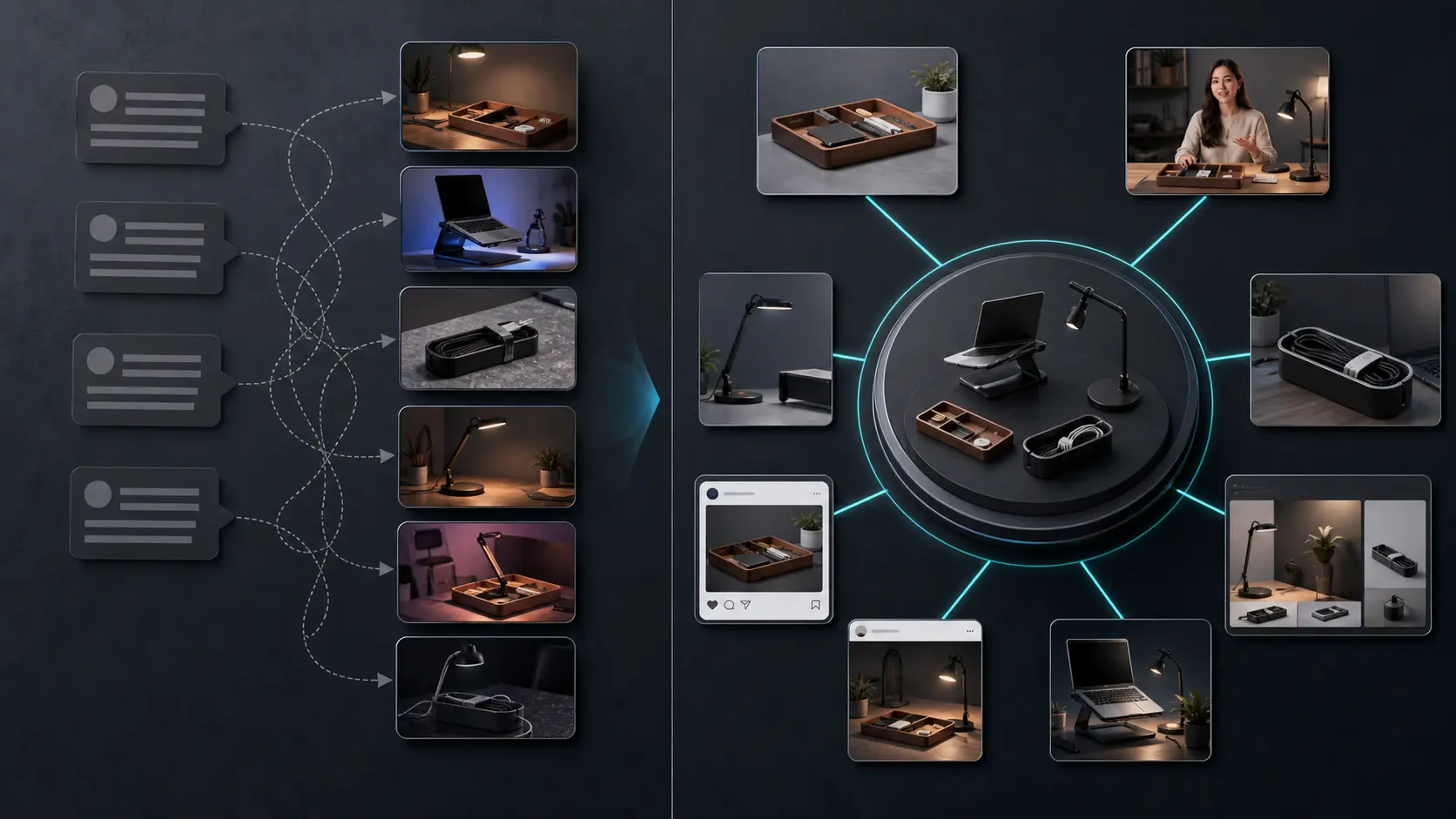
How to fix off-brand AI content
The fix is not “write better prompts” and hope.
The fix is to give the system a better foundation.
Step 1: Build reusable brand context
Do not rely on one-off prompts alone.
Create a reusable brand profile with:
- brand voice
- visual identity
- buyer context
- product categories
- good and bad examples
- claim boundaries
- channel rules
This gives the system a stable starting point.
Step 2: Add product catalog context
For ecommerce, product context is not optional.
The AI should know:
- product names
- descriptions
- images
- categories
- variants
- use cases
- claim boundaries
- product positioning
Without this, even a strong voice layer can still create weak product content.
Step 3: Define visual rules
For images and video, define:
- background style
- lighting
- scene types
- props
- people or no people
- product scale
- category-specific settings
- visual do and don’t examples
This reduces the chance of visually polished but off-brand output.
Step 4: Define channel behavior
Map how the brand should behave across workflows:
| Channel | Brand behavior |
|---|---|
| Social posts | Short, visual, product-aware |
| AI creator videos | Natural spoken language, use-case-led |
| Product shots | Visual consistency and product accuracy |
| Marketplace assets | Clear, scannable, buyer-focused |
| Amazon A+ content | Structured, educational, story-led |
| Campaigns | Consistent sequence and message hierarchy |
| Founder posts | More direct and personal |
| Ads | Hook-led, claim-safe, product-specific |
This is why a product-aware workspace matters more than a generic prompt box.
Step 5: Add review checkpoints
Every AI workflow should still include review.
Ask:
- Does this sound like the brand?
- Is the product accurate?
- Are the claims safe?
- Does the visual style fit?
- Is this right for the channel?
- Does it sound generic?
- Would the buyer understand the product?
This review step does not need to be heavy.
It does need to be real.
How AgenixSocial Brand DNA fits
AgenixSocial’s positioning here should stay simple and honest.
The value is not “press a button and everything becomes perfect.”
The value is:
- reusable brand context
- product-aware content starting points
- shared visual direction
- reusable claim boundaries
- workflow-specific outputs across the workspace
The product grounding matters.
AgenixSocial starts from real brand and product context rather than asking the team to keep re-briefing generic tools.
That context can then feed workflows such as:
- Product Shots
- AI Creator Videos
- Marketplace Listing Studio
- Amazon A+ Studio
- Campaigns
- founder content
- media library reuse
This is the stronger claim:
AgenixSocial helps ecommerce teams stop re-explaining the brand and product for every content workflow.
It should not be described as total automation.
It should be described as a much better starting point for brand-aware, product-aware content creation.
What AgenixSocial should not claim
AgenixSocial should not claim:
- every output will be perfect
- it replaces the marketing team
- it removes the need for review
- it guarantees marketplace compliance
- it fully automates the brand
- it works with every commerce platform automatically
The safer position is stronger:
AgenixSocial replaces messy tool-stitching and repeated briefing, not human judgment.
Off-brand AI content checklist
Use this checklist before publishing AI-generated ecommerce content.
| Review item | What to check |
|---|---|
| Brand voice | Does it sound like the brand? |
| Product accuracy | Does it describe the right product correctly? |
| Product image fit | Does the visual match the real product? |
| Buyer context | Is it speaking to the right buyer? |
| Visual identity | Does the image or video fit the brand world? |
| Claim safety | Are all claims accurate and supportable? |
| Channel fit | Does the content fit the platform or workflow? |
| Tone consistency | Is the tone consistent without sounding repetitive? |
| Specificity | Does it include concrete product detail? |
| Genericness | Could any competitor say the same thing? |
| Reuse readiness | Can the asset be adapted across future workflows? |
| Human approval | Has a person reviewed it before publishing? |
The most useful question is still the simplest one:
Could any brand in the category say this?
If the answer is yes, the content is probably too generic.

Practical framework: Context, Product, Channel, Review
If you want one simple framework to remember, use this:
1. Context
Give the system reusable brand context:
- voice
- tone
- identity
- market
- buyer
- examples
- avoid-list
2. Product
Ground the output in real product data:
- product name
- images
- descriptions
- features
- use cases
- variants
- claims to avoid
3. Channel
Adapt the content to the workflow:
- image
- video
- marketplace listing
- Amazon A+
- campaign
- social post
- ad
4. Review
Check before publishing:
- brand fit
- product accuracy
- claim safety
- visual quality
- channel fit
- buyer clarity
If these four layers are missing, the content will probably drift.
Final take
Generic AI content feels off-brand because the AI is missing context.
It may not know the brand voice.
It may not know the product catalog.
It may not know the buyer.
It may not know the visual direction.
It may not know which claims to avoid.
It may not know how the content should change by channel.
Better prompts help, but prompts alone still force teams to repeat the same briefing again and again.
The stronger fix is Brand DNA: reusable brand and product context that gives every image, video, listing, campaign, and script a better starting point.
That is how off-brand AI content becomes more specific, more usable, and more recognizably yours.