What Is Founder-led Marketing?
Quick answer
Founder-led marketing is the practice of using the founder’s voice, product knowledge, values, customer insight, and story as part of the brand’s marketing. Instead of only publishing polished brand posts, the company also shares content from the founder’s perspective: why the product exists, what problem it solves, what customers should understand, and what the founder believes about the category.
For D2C and marketplace brands, founder-led marketing is especially useful for product launches, product education, customer trust, behind-the-scenes storytelling, category education, and social content that feels less generic.
If you want the product page behind this topic, start with Founder Studio. If you want the supporting context layer, see Brand DNA, Campaigns, and AI Creator Videos.
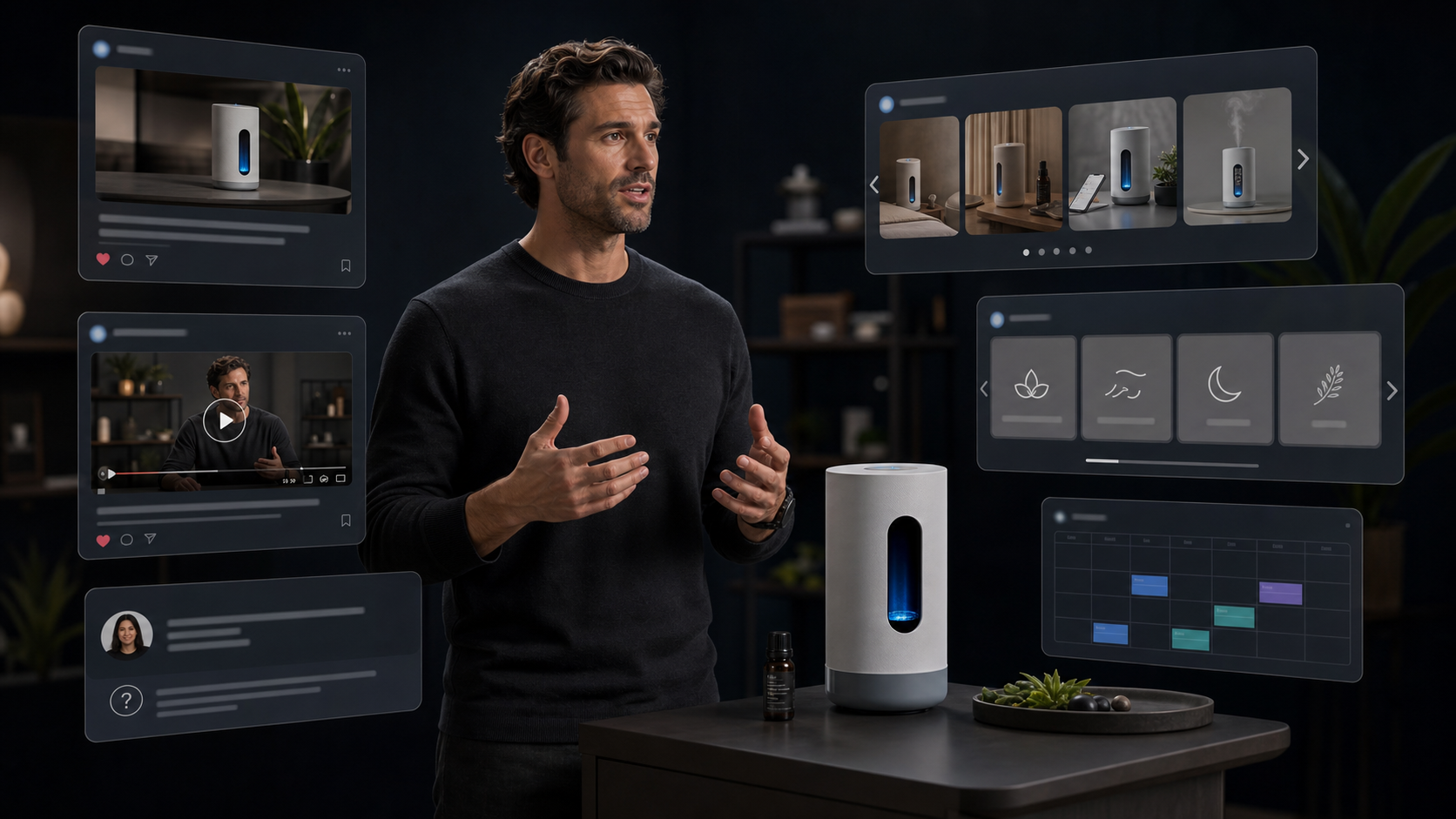
Why founder-led marketing matters
Customers see polished product ads every day. They also see influencer promotions, discount-led campaigns, AI-generated content, and brand posts that sound like they were approved by too many people.
That creates a trust problem.
A founder can help solve part of that problem because the founder usually has three things generic brand content often lacks:
- A clear reason for why the product exists.
- Direct understanding of customer pain points.
- A point of view about the category.
That combination is hard to fake.
A founder can explain why a product was made, what tradeoffs were considered, what customer feedback shaped it, and why the brand chose one path over another. This gives the audience a more believable reason to care.
That trust-led framing also matches how recent founder-led marketing guides describe the category. Refine Labs treats founder proximity to the product as a credibility advantage, while CXL shows how founder content often becomes a trust and authority engine when it stays structured and useful. See Refine Labs on founder-led marketing and CXL’s founder-led marketing guide.
Founder-led marketing vs personal branding
Founder-led marketing and personal branding overlap, but they are not the same thing.
| Area | Founder-led marketing | Personal branding |
|---|---|---|
| Main goal | Build trust in the brand and product | Build visibility for the individual |
| Content focus | Product thinking, customer problems, brand story, category education | Career, opinions, expertise, personal journey |
| Best for | Brand trust, launches, product education, community | Reputation, speaking, hiring, networking |
| Risk | Brand becomes too dependent on one person | Content may drift away from business goals |
| Best approach | Connect founder voice to brand and product context | Build a recognizable individual point of view |
The best version is not founder versus brand.
It is founder plus brand.
The founder creates trust. The brand creates memory. The product creates proof.
Founder-led marketing vs influencer marketing
Influencer marketing borrows trust from someone else’s audience. Founder-led marketing builds trust from inside the brand.
Both can work, but they solve different problems.
| Question | Founder-led marketing | Influencer marketing |
|---|---|---|
| Who is speaking? | The founder or founding team | External creator or influencer |
| What creates trust? | Proximity to the product and brand decisions | Relationship with the creator’s audience |
| Best use case | Product story, education, launch narrative, values | Reach, creator-style validation, social proof |
| Main limitation | Founder time and consistency | Cost, creator fit, authenticity, coordination |
| Content lifespan | Can become part of long-term brand memory | Often campaign-specific |
For ecommerce brands, the two can work together. A founder can explain the product’s origin, while creators can show how customers experience it in real life.

Why D2C brands use founder-led marketing
Founder-led marketing is especially useful for D2C brands because many D2C products need explanation.
A customer may want to know:
- Why this product exists.
- Why it costs what it costs.
- What makes it different from cheaper alternatives.
- How to use it correctly.
- What problem it solves.
- Whether the brand understands people like them.
A product page can answer some of this. A founder-led post or video can answer it with more personality.
This matters most when the product is new, premium, category-specific, ingredient-led, design-led, founder-invented, or hard to understand from images alone.
Recent trust research supports that direction. Edelman’s brand trust work continues to show that belief, relevance, and confidence matter when people decide which brands deserve attention. See Edelman Brand Trust 2025.
Founder-led content formats for ecommerce brands
Founder-led marketing does not have to mean daily selfies or endless motivational posts. For ecommerce, the best content usually connects the founder’s perspective to the product.
| Content format | Example | Best use |
|---|---|---|
| Origin story | "Why we created this product after seeing customers struggle with..." | Brand introduction |
| Product education | "Here is how to choose the right size, shade, flavor, or variant." | Reducing hesitation |
| Ingredient or material explanation | "Why we use this material instead of the cheaper option." | Trust and differentiation |
| Behind the scenes | "What changed between prototype one and the final product." | Launch storytelling |
| Founder POV | "What most brands get wrong about this category." | Thought leadership |
| Customer objection response | "Is this product right for you if...?" | Conversion support |
| Launch announcement | "We built this because customers kept asking for..." | Product launches |
| Values and standards | "What we will never compromise on." | Brand trust |
What founder-led marketing looks like in practice
Imagine a D2C home fitness brand launching a resistance band kit.
A generic brand post might say:
"Premium resistance bands for your daily workout. Shop now."
A founder-led post might say:
"We built this kit because most resistance bands fail in two places: weak handles and unclear resistance levels. I wanted something beginners could trust without guessing. So we tested three handle materials, color-coded the resistance levels, and added a simple workout card for first-time users."
The second version does more than announce the product. It explains the thinking behind it.
The customer learns what problem the founder noticed, what decision was made, and why the product is designed that way.
The founder-led marketing framework
A practical founder-led content strategy has five parts.
1. Founder point of view
The founder needs a repeatable point of view. This does not need to be dramatic. It simply needs to be clear.
Examples:
- "Good skincare should be easy to understand."
- "Fitness gear should work for beginners, not only athletes."
- "Marketplace sellers should not need agency-level budgets to create better listing content."
- "Parents need safer, simpler product choices without confusing claims."
2. Product truth
Founder-led marketing must stay connected to what the product actually does.
This is where many brands go wrong. They publish founder content that sounds inspiring but does not help the customer understand the product.
Strong founder-led content should answer:
- What does the product do?
- Who is it for?
- What problem does it solve?
- What tradeoffs were made?
- What should customers know before buying?
3. Customer insight
The founder should speak to real customer problems, not abstract brand values.
Weak: "We care about quality."
Stronger: "Customers told us they were tired of bottles leaking during travel, so we changed the cap design and tested it inside packed bags."
4. Repeatable formats
Founder-led marketing should become a system, not a random burst of posts.
Useful recurring formats include:
- Founder explains
- Product decision of the week
- Customer question answered
- Behind the launch
- What we changed and why
- Myth vs reality
- Founder review checklist
- Product comparison explainer
5. Review before publishing
Founder-led content still needs review. This is especially important when the content includes product claims, marketplace-related claims, health or beauty claims, pricing, offers, customer results, or performance promises.
The founder’s voice can make content more trusted, but it does not remove the need for accuracy.
When founder-led marketing is not enough
Founder-led marketing is powerful, but it is not magic.
It cannot fix:
- a weak product
- unclear positioning
- poor customer experience
- false or exaggerated claims
- inconsistent fulfillment
- confusing product pages
- bad creative review habits
- a founder who posts often but says nothing useful
It can also create founder dependency if every piece of trust has to come directly from one person.
The goal is not to trap the brand inside the founder’s personality. The goal is to transfer founder trust into the brand, the product, the content system, and the customer experience.
The B2B Playbook makes a similar scaling point: founder trust works best when it becomes a structured system rather than a single-person bottleneck. See The B2B Playbook on scaling founder trust.
Where AI fits into founder-led marketing
AI can help founders create more founder-led content, but it should not replace the founder’s judgment.
Useful AI support includes:
- turning rough founder notes into post drafts
- creating founder-led video scripts
- adapting one product idea into multiple content formats
- generating launch content variations
- converting product context into founder-style explanations
- creating founder image or video concepts
- planning campaign content around founder POV
But AI should not invent the founder’s beliefs, exaggerate product claims, fake customer results, or publish without review.
The strongest workflow is simple:
Founder insight + product context + brand context + AI-assisted creation + human review.
That balance also fits the broader market direction. Sprout Social’s latest social media reporting highlights the tension between growing AI experimentation and audience demand for content that still feels human. See Sprout Social State of Social Media 2026.

How AgenixSocial helps with founder-led marketing
AgenixSocial helps ecommerce founders turn product context, Brand DNA, founder POV, and campaign goals into founder-led content.
Founder Studio is built for founder-led images and videos. A founder can create a founder profile, upload a headshot, and optionally add a short voice sample for video workflows. The product includes consent before founder face and voice setup.
From there, teams can create founder-led images and videos for product launches, brand storytelling, product education, and thought leadership.
The difference is context.
AgenixSocial is not starting from a blank prompt box. Brand DNA creates reusable brand context, and the product catalog acts as the source of truth for what the brand actually sells. That means founder-led content can be grounded in product names, images, descriptions, prices, and other product details instead of becoming generic motivational content.
AgenixSocial gives ecommerce teams a stronger starting point by grounding workflows in reusable brand and product context. Teams still review final assets for product accuracy, claims, marketplace fit, and brand tone before publishing.
Founder-led marketing examples by ecommerce category
| Category | Founder-led angle |
|---|---|
| Skincare | Explain ingredient choices, routine mistakes, product use order, and formulation philosophy. |
| Food and beverage | Share sourcing, taste testing, recipe development, nutrition positioning, and usage ideas. |
| Apparel | Explain fabric, fit, sizing, styling, production choices, and customer feedback. |
| Home and decor | Explain design inspiration, materials, room use cases, and care instructions. |
| Electronics accessories | Explain compatibility, durability, testing, and practical use cases. |
| Baby and parenting products | Explain safety considerations, parent pain points, usage guidance, and design tradeoffs. |
| Marketplace products | Explain variant selection, product comparison, image clarity, and common buyer questions. |
A simple founder-led content workflow
Use this five-step workflow:
- Pick one product, launch, or customer question.
- Write the founder’s actual point of view.
- Add product facts: features, materials, use cases, price, variants, and customer objections.
- Turn that into formats: post, video script, product story, launch announcement, carousel, or founder image.
- Review for accuracy, claims, brand tone, and channel fit before publishing.
The goal is not to create more content for the sake of it. The goal is to make the brand easier to trust and the product easier to understand.
Conclusion
Founder-led marketing works because it gives the brand a human voice and gives the product a clearer story.
For D2C and marketplace brands, that can be powerful. Customers want to know what the product does, why it exists, who made it, what decisions shaped it, and whether the brand understands their problem.
The best founder-led marketing is not random posting. It is a repeatable content system built around founder POV, product truth, customer insight, and careful review.
AgenixSocial helps ecommerce teams create that system by connecting Founder Studio with Brand DNA, product catalog context, campaigns, media workflows, and publishing support. The result is founder-led content that starts from the brand and product, not from a blank prompt.