What Is Brand DNA in AI Content Creation?
Quick answer
Brand DNA in AI content creation is the reusable brand and product context layer that teaches an AI system how a brand looks, sounds, sells, and presents its products. Instead of explaining the brand again for every image, video, campaign, listing, or script, Brand DNA gives future content workflows a shared starting point.
For ecommerce brands, Brand DNA is not only brand voice.
It is brand voice plus product context.
If you want the product page behind this topic, start with Brand DNA. If you want to see where that context gets used next, see Product Shots, AI Creator Videos, Marketplace Listing Studio, Amazon A+ Studio, and Campaigns.

Why Brand DNA matters now
Most AI content tools start from a prompt.
That sounds flexible, but it creates a problem for ecommerce teams.
The user has to explain the brand again and again:
- What does the brand sell?
- Who is the buyer?
- What does the brand sound like?
- What should the product look like?
- What claims should be avoided?
- What style should the content follow?
- What product images are accurate?
- What kind of content does the brand usually create?
- What should the AI not do?
This gets tiring fast.
It also creates inconsistent output.
One prompt produces a premium brand voice.
The next prompt sounds discount-heavy.
One image looks like the brand.
The next image looks like a different company.
One product video explains the product correctly.
The next one invents features.
Brand DNA exists to solve this repeated briefing problem.
Instead of making every content request start from zero, the AI system first learns the brand and product context. Then future content workflows can use that shared context.
The simple definition
Brand DNA is the reusable brand and product context that helps AI-generated content stay consistent, accurate, and useful across product images, videos, marketplace assets, campaigns, and scripts.
It helps answer:
- What does this brand sound like?
- What does this brand look like?
- What does this brand sell?
- What products should content be grounded in?
- What should the content avoid?
- What type of buyer is the brand speaking to?
- What kind of visuals, scenes, and language fit the brand?
A normal AI prompt gives one instruction.
Brand DNA gives the system a reusable memory of the brand.
Brand DNA vs AI brand voice
Brand voice is how a brand sounds.
Brand DNA is broader.
| Area | AI brand voice | Brand DNA |
|---|---|---|
| Main focus | Tone, wording, personality, writing style | Voice, identity, product context, visual direction, catalog, content workflows |
| Best for | Emails, captions, product copy, social text | Images, videos, listing assets, campaigns, scripts, product content |
| Input | Existing writing, website copy, guidelines | Website, brand identity, products, product images, descriptions, social context |
| Output | Reusable writing style | Reusable brand and product context |
| Ecommerce fit | Useful but incomplete | Stronger for product-led content workflows |
An AI brand voice generator can help with tone.
Brand DNA should help with the whole content system.
For ecommerce, that difference matters.
A brand is not only the way it writes.
A brand is also the way it shows products, explains benefits, chooses scenes, uses people, frames offers, and creates trust.
HubSpot’s setup flow for AI brand voice centers on analyzing writing style, personality, tone, website domain, ideal client profile, products, and competitive context before applying that information to future content. See HubSpot’s set up brand voice using AI.
Brand DNA vs brand guidelines
Brand guidelines are usually a document.
They may include:
- logo rules
- colors
- typography
- tone of voice
- imagery style
- layout guidance
- do and don’t examples
Brand DNA is different.
Brand DNA should be usable by the content workflow itself.
| Area | Brand guidelines | Brand DNA |
|---|---|---|
| Format | Usually a static document or brand kit | Reusable context inside an AI content system |
| Use | Humans read and apply it | AI workflows use it before generating content |
| Scope | Visual and verbal rules | Visual, verbal, product, market, and workflow context |
| Updating | Manual document refresh | Can be refreshed when brand or product context changes |
| Ecommerce value | Helps teams stay consistent | Helps generation start from brand and product truth |
Brand guidelines still matter.
But they are not enough by themselves if the AI tool does not use them when creating content.
Brand DNA turns brand knowledge into working context.
Figma’s framing for AI brand guideline generation is also useful here. It treats personality, values, color, typography, layout, imagery, and voice as structured rules that can be turned into a working system instead of staying as a loose creative description. See Figma’s AI brand guidelines generator.
What should Brand DNA contain?
For ecommerce brands, useful Brand DNA should include:
| Brand DNA element | Why it matters |
|---|---|
| Brand voice | Keeps copy, scripts, and captions consistent |
| Brand identity | Helps visuals match the brand’s look and feel |
| Product catalog | Grounds content in what the brand actually sells |
| Product images | Reduces product mismatch and visual drift |
| Product descriptions | Helps scripts and captions stay accurate |
| Buyer context | Shapes tone, scenes, and use cases |
| Visual direction | Guides product shots, ads, and lifestyle scenes |
| Market context | Helps generated people, settings, and examples fit the audience |
| Claim boundaries | Reduces exaggerated or unsupported messaging |
| Content history | Helps the system understand prior social or content patterns |
| Priority improvements | Shows what the brand should fix or improve first |
The most important point:
Brand DNA should not be only a tone profile.
It should connect voice, visuals, and product truth.
How AgenixSocial Brand DNA works
AgenixSocial Brand DNA is built to be the foundation layer before content creation.
The user shares the brand website.
AgenixSocial analyzes the brand, imports Shopify products where supported, and creates reusable brand context.
A typical Brand DNA run creates a working brand profile with:
- brand identity
- brand voice
- product context
- imported product information
- product imagery where available
- recommendations
- priority improvements
For brands that do not use Shopify, or sell mainly through marketplaces, the user can add products manually.
That manual fallback matters because many marketplace-first brands may not have a traditional Shopify storefront.
The product page copy in this repo is explicit on the core promise: teach AgenixSocial the brand once, then reuse that brand twin across the other studios. The current Brand DNA page also states that a typical Brand DNA run completes in around 30 seconds, Shopify is the strongest supported import path, and manual product creation keeps marketplace-only brands included.
The key idea:
Teach AgenixSocial your brand once, then use that brand twin across every content workflow.
Why product catalog context matters
Generic AI often writes content that sounds plausible but is not grounded in the actual product.
That creates problems:
- wrong product features
- incorrect use cases
- exaggerated benefits
- inconsistent visuals
- invented packaging details
- mismatched product scenes
- unclear listing images
- generic scripts
- off-brand campaigns
Product catalog context reduces that problem.
If the system knows the product name, image, description, price, category, and key details, it can create more grounded content.
For ecommerce brands, this is essential.
A social post, AI creator video, product shot, marketplace listing image, and Amazon A+ module should not be based on vague product assumptions.
They should start from what the brand actually sells.

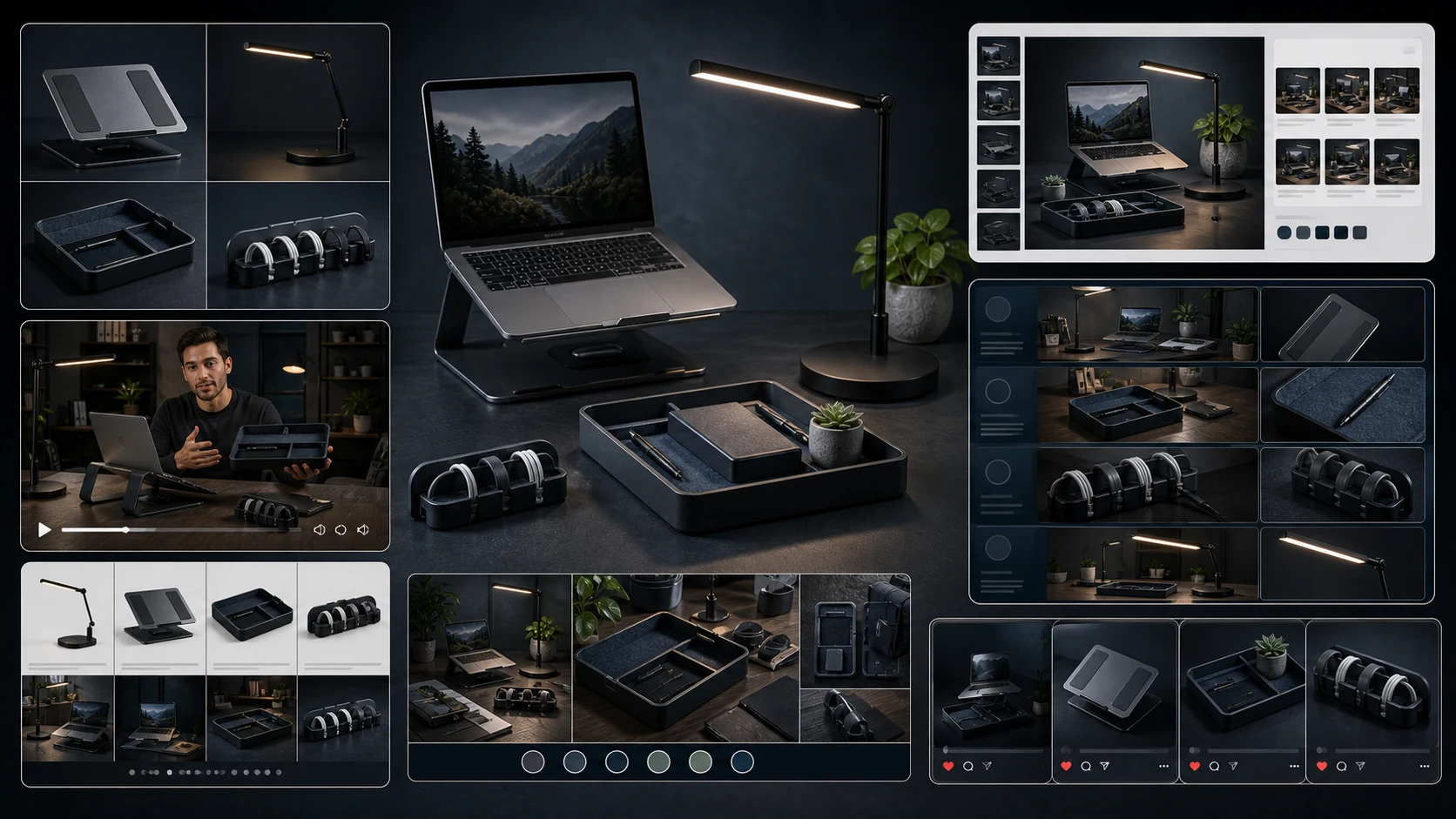
Example: premium home-office accessories brand
Let’s use a fictional brand:
Brand: a premium home-office accessories brand.
Products:
- desk trays
- laptop stands
- cable organizers
- workspace lamps
Brand position:
- clean
- practical
- premium but not flashy
- focused on better workspaces
- useful for remote workers, students, founders, and creative professionals
Without Brand DNA, the user may need to explain this again every time:
"Use a clean premium tone. Do not make it sound too luxury. Do not make it too playful. Use practical workspace language. Show realistic desk setups. Avoid exaggerated productivity claims. Do not say our products are medical or ergonomic unless the product supports it."
With Brand DNA, this context becomes reusable.
Now a future product shot, video script, campaign, or listing image can start from that brand context.
What Brand DNA improves most
Brand DNA improves four things especially well.
1. Brand consistency
The brand should not sound premium in one post and cheap in the next.
It should not look minimal in one product visual and chaotic in the next.
Brand DNA helps maintain consistency across:
- product images
- AI creator videos
- captions
- campaigns
- marketplace assets
- Amazon A+ content
- founder-led content
- quick social posts
Consistency is not about making every asset identical.
It is about making every asset feel like it belongs to the same brand.
2. Product accuracy
Ecommerce content needs product accuracy.
If the product is a desk tray, the AI should not invent a drawer.
If the product is a cable organizer, the AI should not show a lamp.
If the product is a workspace lamp, the AI should not claim medical benefits.
Brand DNA works better when it is connected to product catalog context.
Product accuracy is one of the biggest differences between generic AI content and product-aware AI content.
3. Less dependency on agencies and designers
Agencies and designers can still be valuable.
Brand DNA is not here to replace human judgment.
But many small ecommerce teams depend on external help for repetitive tasks:
- social posts
- product visuals
- simple ad creatives
- listing image directions
- campaign drafts
- product scripts
- launch content
Brand DNA makes it easier for the brand to generate useful first drafts and product-aware assets internally.
The team can still review, edit, and improve.
But it no longer starts from a blank prompt or a fresh agency brief every time.
4. Less repetitive briefing
This may be the most practical benefit.
Most AI content workflows fail because the user keeps re-explaining the same context.
Brand DNA reduces repetitive briefing.
The brand no longer has to say:
- This is our tone.
- This is our buyer.
- This is the product.
- These are our products.
- This is how we should look.
- Do not make it too generic.
- Do not invent product features.
The system already has a working brand and product profile to start from.
Generic AI prompt vs Brand DNA workflow
| Step | Generic AI prompt workflow | Brand DNA workflow |
|---|---|---|
| Brand context | User explains it repeatedly | Stored as reusable brand context |
| Product context | User pastes product details each time | Imported or manually added once |
| Visual direction | User describes style every time | Brand identity guides future visuals |
| Voice | User adds tone instructions repeatedly | Brand voice is reused |
| Output quality | Depends heavily on prompt quality | Starts from brand and product truth |
| Team effort | High repetitive briefing | Less repeated explanation |
| Review | Still required | Still required, but with better starting context |
| Best use | One-off generation | Repeated commerce content workflows |
The goal is not to remove review.
The goal is to start closer to the right output.

How Brand DNA powers different content workflows
Brand DNA is useful because it does not stop at the brand profile.
It should power the work that comes next.
| Workflow | How Brand DNA helps |
|---|---|
| Product Shots | Guides visual style, product context, setting, and brand fit |
| AI Creator Videos | Helps scripts, creator direction, language, and product messaging stay on-brand |
| Marketplace Listing Studio | Grounds listing image sets in product details and brand positioning |
| Amazon A+ Studio | Helps storyboard product benefits, brand story, and module tone |
| Campaigns | Keeps multi-day campaign content consistent |
| Quick Post | Helps generate platform-aware posts from product and brand context |
| Image Ads | Improves product-led ad direction and copy consistency |
| Founder Studio | Keeps founder-led content aligned with brand voice and product story |
| Media Library | Helps approved assets stay connected to brand and product context |
This is why Brand DNA should be treated as the foundation layer.
It is not just another feature.
It is the context layer behind the other features.
Brand DNA and visual content
Many AI brand voice tools focus mostly on text.
But ecommerce content is visual.
Brand DNA should help with visual decisions too:
- What kind of settings fit the brand?
- Should people appear in the content?
- What kind of product environments are natural?
- Should the brand feel premium, playful, minimal, bold, or practical?
- What colors and compositions feel right?
- What product use cases should be shown?
- What scenes should be avoided?
For the home-office accessories example, Brand DNA might guide content toward:
- clean desks
- natural light
- organized workspaces
- practical product use
- premium but simple styling
- no exaggerated luxury staging
- no chaotic work-from-home cliches
This visual context matters for product shots, social posts, listing images, AI creator videos, and campaigns.
Brand DNA and cultural or market context
AgenixSocial’s product notes include a useful point: Brand DNA can affect generated content at a detailed visual and cultural level.
For example, if the brand is Indian, generated people and surroundings may need to fit Indian market context. If the brand is American, the scenes and surroundings may need to fit that audience instead.
This does not mean stereotyping.
It means generated content should not feel randomly imported from another market.
A brand selling in India, the US, the Middle East, or Southeast Asia may need different people, scenes, interiors, language, and product usage contexts.
Brand DNA helps the system start with that context.
Klaviyo’s positioning around Brand Voice AI reflects a narrower version of the same idea: the AI should learn a brand’s personality and style so later messages sound like the brand across communications. See Klaviyo’s Brand Voice AI.
What Brand DNA should not be expected to do
Brand DNA is useful, but it should not be overclaimed.
It should not be described as:
- perfect brand automation
- a replacement for marketing judgment
- guaranteed compliance
- a complete audience analytics platform
- a guarantee that every output will be correct
- a replacement for reviewing claims, images, and product details
A safer and stronger claim:
Brand DNA gives AI content workflows a better starting point by grounding them in brand and product context.
The team still reviews.
The team still approves.
The team still owns the final content.
When should a brand refresh Brand DNA?
A brand should refresh or update Brand DNA when:
- the product catalog changes
- the brand enters a new market
- the brand changes its positioning
- the visual identity changes
- the tone of voice changes
- a major campaign shifts the brand direction
- new social content changes the brand pattern
- imported product data becomes outdated
- the brand starts selling on new marketplaces
Brand DNA should not be treated as a one-time file that is never revisited.
A brand changes.
The context should change with it.
Brand DNA checklist
Before using Brand DNA for content generation, check:
| Checklist item | What to confirm |
|---|---|
| Website analyzed | Has the brand website been scanned? |
| Brand voice | Does the tone match how the brand should speak? |
| Visual identity | Does the visual direction feel accurate? |
| Products imported | Are Shopify products imported where available? |
| Manual products | Are marketplace-only products added manually? |
| Product images | Are key product images available? |
| Product descriptions | Are descriptions accurate and updated? |
| Market context | Does the brand context fit the target market? |
| Social context | Are connected social channels available if needed? |
| Claim boundaries | Are risky or unsupported claims avoided? |
| Priority improvements | Has the team reviewed recommended improvements? |
| Refresh timing | Is the Brand DNA still current? |
This checklist helps keep Brand DNA useful.

How to think about Brand DNA as a founder
For a founder, Brand DNA is not a technical feature.
It is a way to stop repeating the same brand explanation.
Instead of briefing every tool, freelancer, designer, and AI prompt from scratch, the founder builds a reusable brand profile once.
That profile becomes the base for future content.
For a small ecommerce team, that can be the difference between:
- random content experiments
- and a repeatable content workflow
Brand DNA is not about removing creativity.
It is about giving creativity a better starting point.
Final takeaway
Brand DNA in AI content creation is the reusable brand and product context layer that helps future content start from the right place.
It teaches the AI system how the brand sounds, looks, sells, and presents its products.
For ecommerce brands, that matters because content is not only text. It is product photos, videos, marketplace listings, Amazon A+ modules, founder-led content, campaigns, ads, and social posts.
Most AI tools make users explain the brand repeatedly.
Brand DNA changes that.
It gives the content workflow a reusable brand twin, so every future image, video, marketplace asset, campaign, or script starts with the brand already understood.
This fits naturally with Brand DNA, Product Shots, AI Creator Videos, Marketplace Listing Studio, Amazon A+ Studio, Campaigns, D2C founder workflows, agency workflows, and teams using pay-as-you-go credits.
Build your Brand DNA with AgenixSocial.
FAQ
What is Brand DNA in AI content creation?
Brand DNA is the reusable brand and product context layer that teaches an AI content system how a brand looks, sounds, sells, and presents its products. It helps future content workflows start from the brand’s voice, identity, product catalog, and visual direction.
Is Brand DNA the same as brand voice?
No. Brand voice is how a brand sounds. Brand DNA is broader. It includes brand voice, brand identity, product context, product images, buyer context, visual direction, and workflow context.
What is an AI brand twin?
An AI brand twin is a reusable digital profile of a brand that helps AI content workflows understand the brand’s voice, identity, products, buyer context, and content style before generating new assets.
How does Brand DNA keep AI content on brand?
Brand DNA gives the AI system reusable context about the brand’s voice, products, visuals, market, and content style. This reduces the need to re-explain the brand in every prompt and helps future outputs start closer to the correct brand direction.
Can AI learn from my website?
Yes. AgenixSocial Brand DNA analyzes the public brand website, imports Shopify products where supported, and creates reusable brand context. Brands can also add products manually if they sell mainly through marketplaces.
Does Brand DNA replace brand guidelines?
No. Brand guidelines are still useful. Brand DNA makes brand context usable inside AI content workflows so the system can apply brand voice, identity, and product context while generating content.
Why does generic AI content feel off-brand?
Generic AI content feels off-brand because the tool does not know the brand’s products, voice, buyer, visual style, market context, or claim boundaries unless the user explains them every time.
What should AI know before creating ecommerce content?
Before creating ecommerce content, AI should know the brand voice, product catalog, product images, descriptions, buyer context, visual direction, market context, channel, claim boundaries, and intended content use case.
Can Brand DNA help with product images and videos?
Yes. Brand DNA can help guide product shots, AI creator videos, marketplace listing images, Amazon A+ content, campaigns, and social posts by grounding them in brand and product context.
When should I refresh Brand DNA?
Refresh Brand DNA when the product catalog, brand voice, visual identity, market, positioning, or social content direction changes in a meaningful way.