How product catalog context improves AI-generated marketing content
Quick answer
Product catalog context improves AI-generated marketing content by grounding the AI in what the brand actually sells: product names, images, descriptions, variants, attributes, use cases, and claim boundaries. Without product context, AI content often becomes generic, inaccurate, or visually disconnected. With product context, images, videos, listings, ads, and campaigns can start from product truth.
For ecommerce brands, product catalog context is not a nice-to-have.
It is the source of truth.
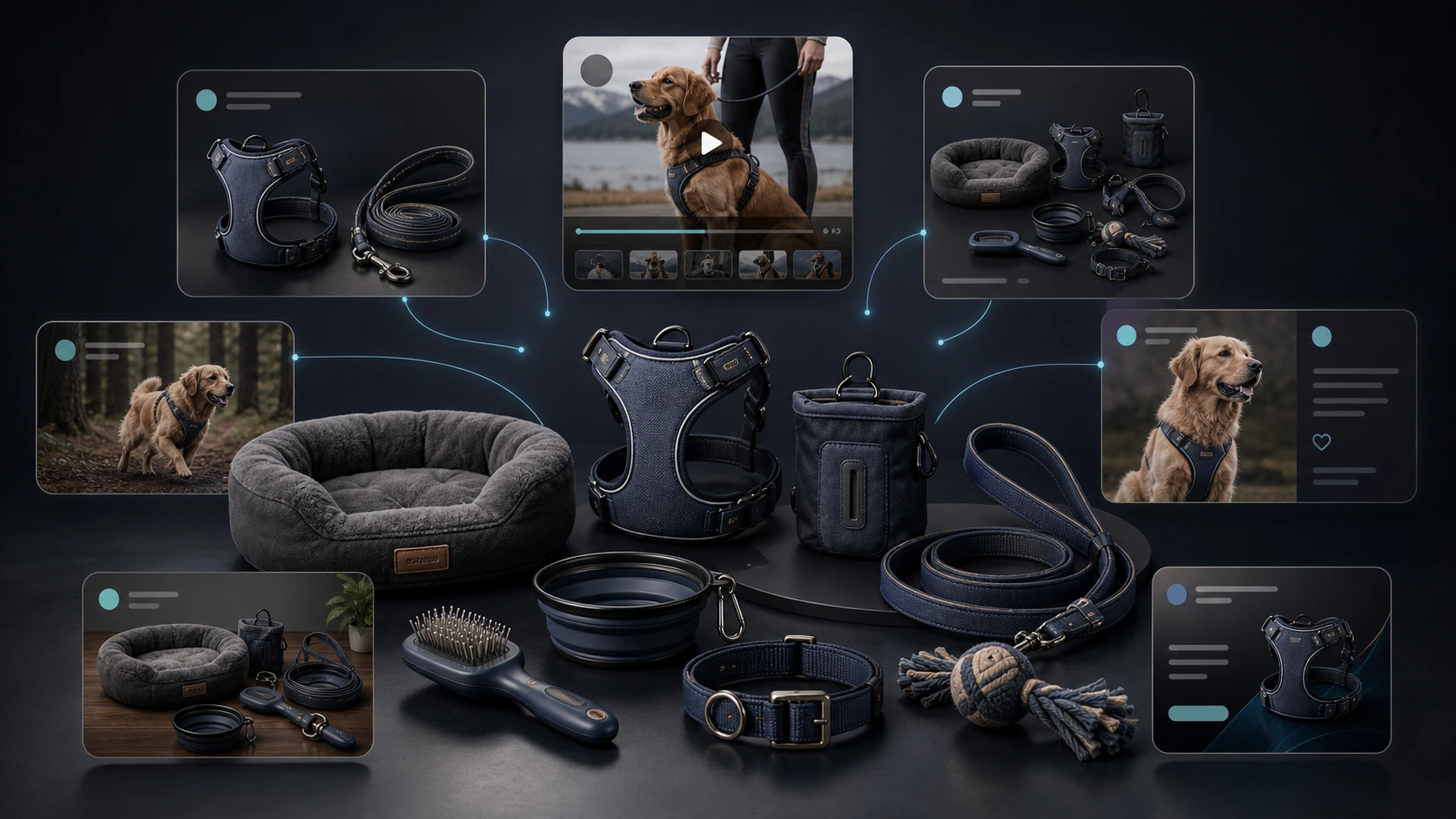
Why product catalog context matters
Most AI content tools can write a caption, generate an image prompt, draft an ad, or produce a video script.
That is useful.
But ecommerce content has a harder job.
It has to describe real products.
It has to show real products.
It has to avoid inventing features.
It has to match product images, product claims, marketplace expectations, customer use cases, and brand voice.
A generic AI tool may produce something polished, but if it does not know the product, it can still be wrong.
That is the problem product catalog context solves.
It gives the AI a factual base before generation begins.
What is product catalog context?
Product catalog context is the structured and visual product information an AI system uses before creating marketing content.
For ecommerce brands, it can include:
- product name
- product category
- product images
- product description
- price and currency where relevant
- variants
- colors
- sizes
- dimensions
- materials
- benefits
- use cases
- target buyer
- marketplace channel
- product limitations
- claims to avoid
- supporting bullet points
- packaging details
- approved product angles
The goal is simple:
AI should not guess what the product is.
It should work from the product truth.
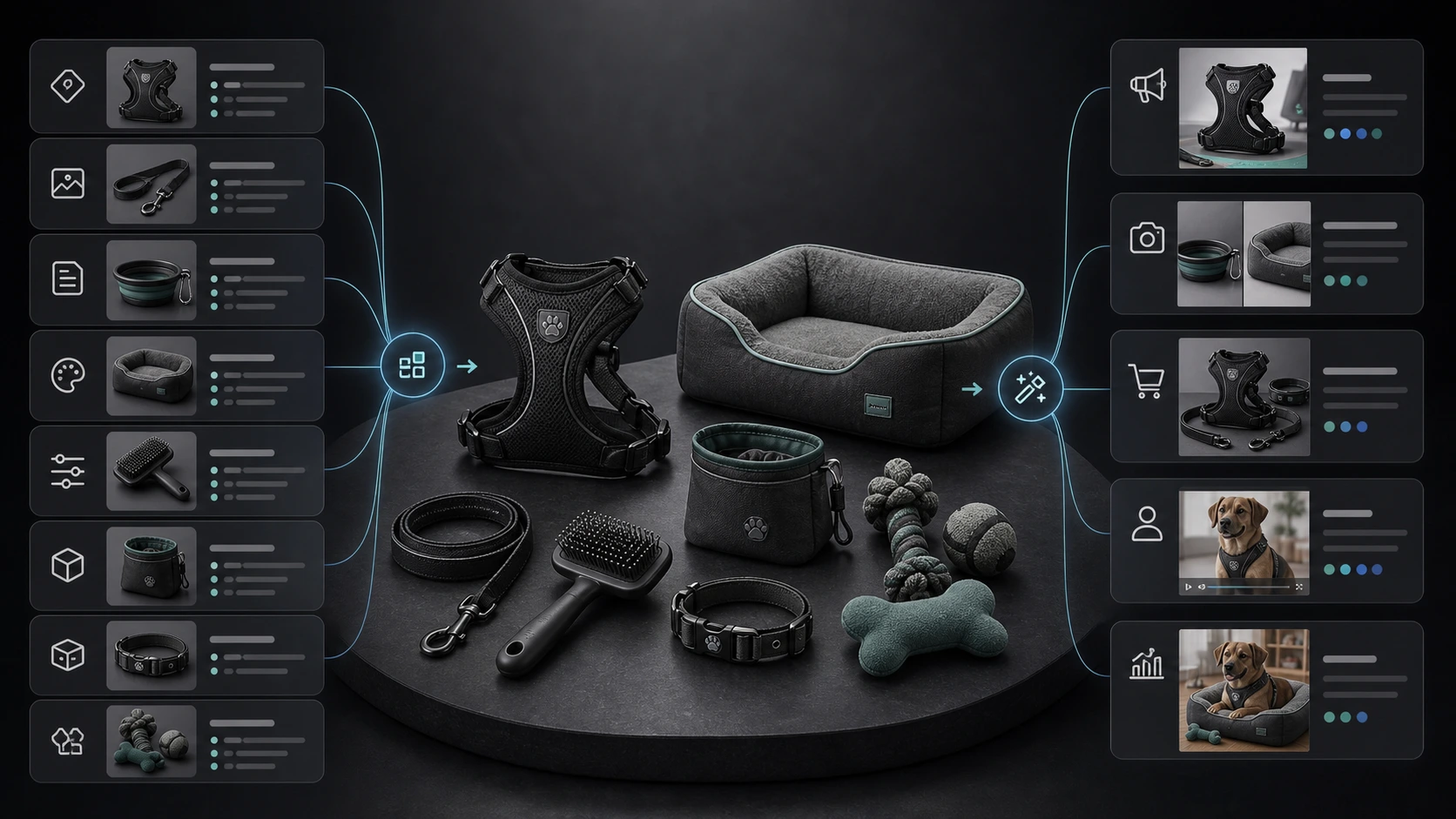
Product catalog context vs generic prompting
A generic prompt might say:
"Create a social post for our pet product."
A product-aware prompt starts from actual product context:
"Create a social post for our reflective dog harness. It has adjustable straps, soft padding, a secure buckle, and is designed for daily walks. Do not claim it prevents accidents. Position it for evening walks and active pet parents."
The second version gives the AI something real to work with.
That difference changes the output.
The problem with generic AI content for ecommerce
Generic AI content often fails in five ways.
| Problem | What happens |
|---|---|
| Product vagueness | The content could apply to any product in the category |
| Product inaccuracy | The AI invents features, materials, sizes, or claims |
| Visual mismatch | Generated images show the wrong product shape, use case, or setting |
| Weak buyer fit | The message does not match how buyers actually choose the product |
| Channel mismatch | The same generic content is used for ads, listings, videos, and campaigns |
This is why "write better prompts" is not enough.
The AI needs better context.
Running example: premium pet accessories brand
For this article, let’s use a new example:
A fictional premium pet accessories brand.
Products:
- dog harness
- leash
- travel water bowl
- pet bed
- grooming brush
- treat pouch
- collar
- toy set
Brand position:
- practical
- premium
- warm
- pet-friendly
- trust-oriented
- not overly cute
- not medical
- not exaggerated
- built for everyday pet routines
This example works well because pet products need specific product context.
A dog harness, pet bed, grooming brush, and travel bowl should not all produce the same content.
Each product has different use cases, visuals, claims, and buyer concerns.
How product catalog context changes AI output
Without product catalog context
The AI may write:
"Give your pet the comfort and care they deserve with our amazing pet accessory. Perfect for every furry friend."
This is generic.
It says almost nothing.
It could describe a leash, bed, toy, brush, bowl, or collar.
With product catalog context
If the selected product is a reflective dog harness, the AI can write:
"Evening walks are easier when the harness is easy to adjust and comfortable enough for daily use. This reflective dog harness is designed with soft padding, adjustable straps, and a secure buckle for everyday walks."
This is better because it is:
- product-specific
- use-case-specific
- buyer-aware
- less exaggerated
- easier to adapt into ads, product images, marketplace listings, and AI creator videos
What product catalog context improves
Product catalog context improves many content types.
| Content workflow | How product catalog context helps |
|---|---|
| Product descriptions | Uses actual product names, materials, features, and use cases |
| Social posts | Creates product-specific captions instead of generic category posts |
| Product shots | Guides scenes, props, angles, and visual accuracy |
| AI creator videos | Grounds scripts in real product benefits and use cases |
| Marketplace listing images | Helps plan feature, benefit, lifestyle, scale, and trust images |
| Amazon A+ content | Helps structure product story, benefit hierarchy, and module logic |
| Ads | Improves hooks, claims, product angles, and CTA accuracy |
| Campaigns | Connects each campaign post to real products and buyer use cases |
| Founder content | Helps founder-led posts talk about the actual catalog |
| Media reuse | Keeps approved assets connected to the right product context |
The product catalog is not just backend data.
It becomes creative infrastructure.
Product images matter as much as descriptions
Descriptions help AI understand what the product does.
Images help AI understand what the product looks like.
For visual content, product images are critical.
A text description may say "dog harness," but the image shows:
- color
- shape
- padding
- buckle placement
- strap layout
- reflective trim
- product scale
- packaging style
- category expectations
Without images, AI may generate something that looks like a generic harness.
With images, the workflow has a better chance of preserving the real product identity.
For ecommerce content, product images and descriptions should work together.
Product descriptions improve script and copy accuracy
Product descriptions help with:
- captions
- ad copy
- marketplace bullets
- AI creator video scripts
- Amazon A+ module copy
- campaign messaging
- product education
- launch announcements
For example, a grooming brush description may include:
- soft bristles
- ergonomic handle
- daily grooming use
- short-hair or long-hair suitability if true
- cleaning method
- product dimensions
- material
This helps AI avoid vague lines like:
"Make grooming easy and fun."
A better product-aware line:
"This grooming brush is designed for daily brushing, with soft bristles and an easy-grip handle for quick coat care."
That line is more useful because it references real product details.
Product attributes improve marketplace and listing content
Marketplace content needs clarity.
Attributes matter.
For a pet travel water bowl, useful attributes may include:
- collapsible design
- size or capacity
- material
- clip or carry feature
- dishwasher-safe status if true
- outdoor or travel use
- color variants
- product dimensions
These attributes can support:
- feature images
- comparison visuals
- scale images
- product-in-use shots
- listing bullets
- marketplace image captions
- packaging visuals
- FAQ answers
If attributes are missing, the AI may produce good-looking but weak listing assets.
Product variants improve campaign planning
Variants matter for campaign content.
For a pet bed, variants may include:
- size
- color
- material
- shape
- washable cover
- small, medium, or large pet fit
- indoor or outdoor suitability if true
A campaign can then adapt:
- "new color launch"
- "small-space pet corner"
- "bed for smaller dogs"
- "washable cover reminder"
- "gift for new pet parents"
- "cozy winter pet setup"
Without variant context, campaign content becomes generic.
With variant context, each campaign asset can be more specific.
Product use cases improve buyer relevance
Good ecommerce content connects product to use case.
For the premium pet accessories brand:
| Product | Product-aware use case |
|---|---|
| Dog harness | Daily walks, evening walks, active dogs |
| Leash | Controlled walks, training routines, city walks |
| Travel bowl | Park visits, road trips, outdoor walks |
| Pet bed | Rest corner, living room, crate area, bedroom |
| Grooming brush | Daily grooming, coat care, shedding routine |
| Treat pouch | Training sessions, walks, reward-based routines |
| Collar | Everyday ID, style, comfort, daily wear |
| Toy set | Playtime, enrichment, bonding, indoor activity |
This use-case layer makes content more human.
It helps the AI stop writing generic category copy.
Product limitations are also context
Product context should not only include selling points.
It should also include limits.
For example:
- Do not say the harness prevents accidents.
- Do not say the pet bed cures anxiety.
- Do not say the grooming brush stops shedding completely.
- Do not say the travel bowl is leakproof unless it is.
- Do not say the leash is suitable for every dog size unless true.
- Do not say a toy is indestructible unless supported.
Limitations help protect the brand from bad AI claims.
A strong product catalog should include what the AI should avoid.
Product catalog context and Brand DNA
Brand DNA explains the brand.
Product catalog context explains what the brand sells.
They work together.
Brand DNA tells the AI:
- brand voice
- visual style
- buyer context
- brand personality
- claim boundaries
- channel behavior
Product catalog context tells the AI:
- product names
- product images
- product descriptions
- product attributes
- variants
- use cases
- product-level claims
- product-level limits
Together, they create product-aware brand content.
Without Brand DNA, product content may be accurate but not on-brand.
Without product catalog context, brand content may sound good but describe the product poorly.
Generic AI vs product-aware AI
| Area | Generic AI content | Product-aware AI content |
|---|---|---|
| Starting point | Prompt only | Brand DNA plus product catalog |
| Product details | Often guessed or vague | Grounded in product names, images, descriptions, and attributes |
| Visual output | May drift from the real product | More likely to match actual product context |
| Video scripts | Generic praise | Product-specific use case and benefit |
| Marketplace assets | Broad category language | Feature, use case, scale, trust, and benefit planning |
| Campaigns | General ideas | Product-specific campaign angles |
| Claim safety | Depends on user prompting | Product and brand boundaries can guide generation |
| Review need | High | Still required, but starts closer to usable |
The difference is not that product-aware AI removes review.
It gives the team a better first draft.
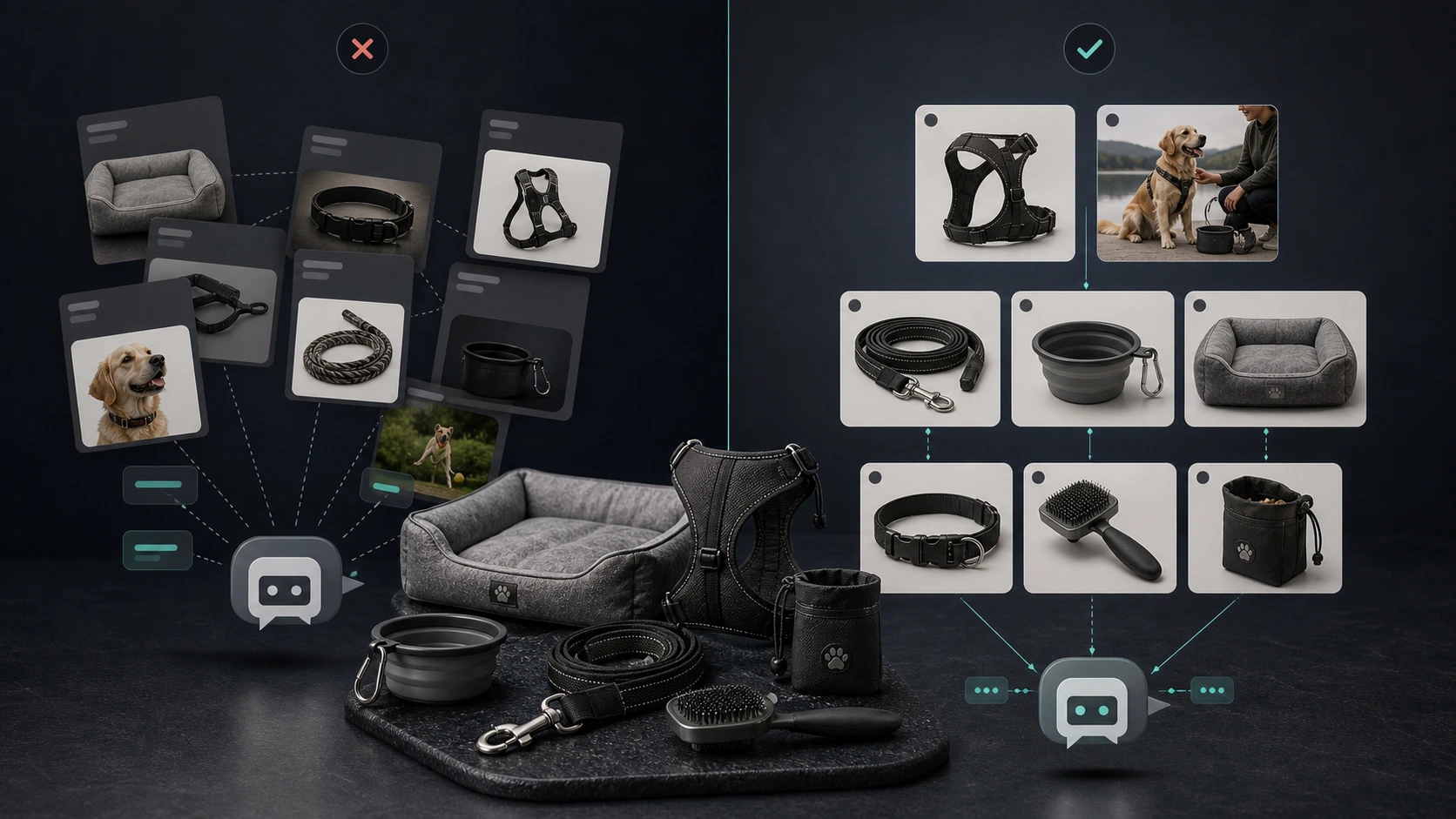
How AgenixSocial uses product catalog context
AgenixSocial is built around the idea that product catalog context should feed content creation.
Brand DNA analyzes the public brand website and creates reusable brand context.
Where supported, Shopify import can bring in product names, descriptions, prices, currency, and images.
For brands that sell through marketplaces or do not use Shopify, products can be created manually.
Users can also enrich product context with bullet points.
That context can then support multiple content workflows:
- Product Shots
- Quick Post
- AI Creator Videos
- Image Ads
- Marketplace Listing Studio
- Amazon A+ Studio
- Campaigns
- Founder Studio
- Media Library reuse
This is the main difference from one-off prompting.
The user does not need to re-explain the product every time.
Example: one pet harness across content workflows
Selected product:
Reflective padded dog harness.
Product context:
- adjustable straps
- soft padding
- secure buckle
- reflective trim
- daily walk use case
- evening walk angle
- active pet parent buyer
- no safety guarantee claim
- no "prevents accidents" claim
Social post
"Evening walks are easier when your dog’s harness is comfortable enough for daily use. Adjustable straps, soft padding, and reflective trim make this one built for everyday routines."
AI creator video script
"If your dog gets excited before every walk, the harness matters. This one has soft padding, adjustable straps, and reflective trim, so it feels practical for daily walks and evening routines."
Product shot direction
Show the harness on a clean dark-accent studio surface with leash and walking essentials nearby. Use premium lighting, visible strap detail, reflective trim highlight, and no unrealistic dog pose.
Marketplace listing image plan
- main product image
- lifestyle walk scene
- feature image showing padding and buckle
- detail image showing reflective trim
- size or fit guidance visual
- product-in-use image
- care or material image if relevant
- trust or brand image
Campaign angle
"Daily Walk Essentials"
Campaign assets could include:
- harness feature post
- leash pairing post
- travel bowl add-on
- treat pouch training routine
- evening walk safety-adjacent post without unsupported safety guarantees
This is what product catalog context enables.
It connects one product to multiple workflows.
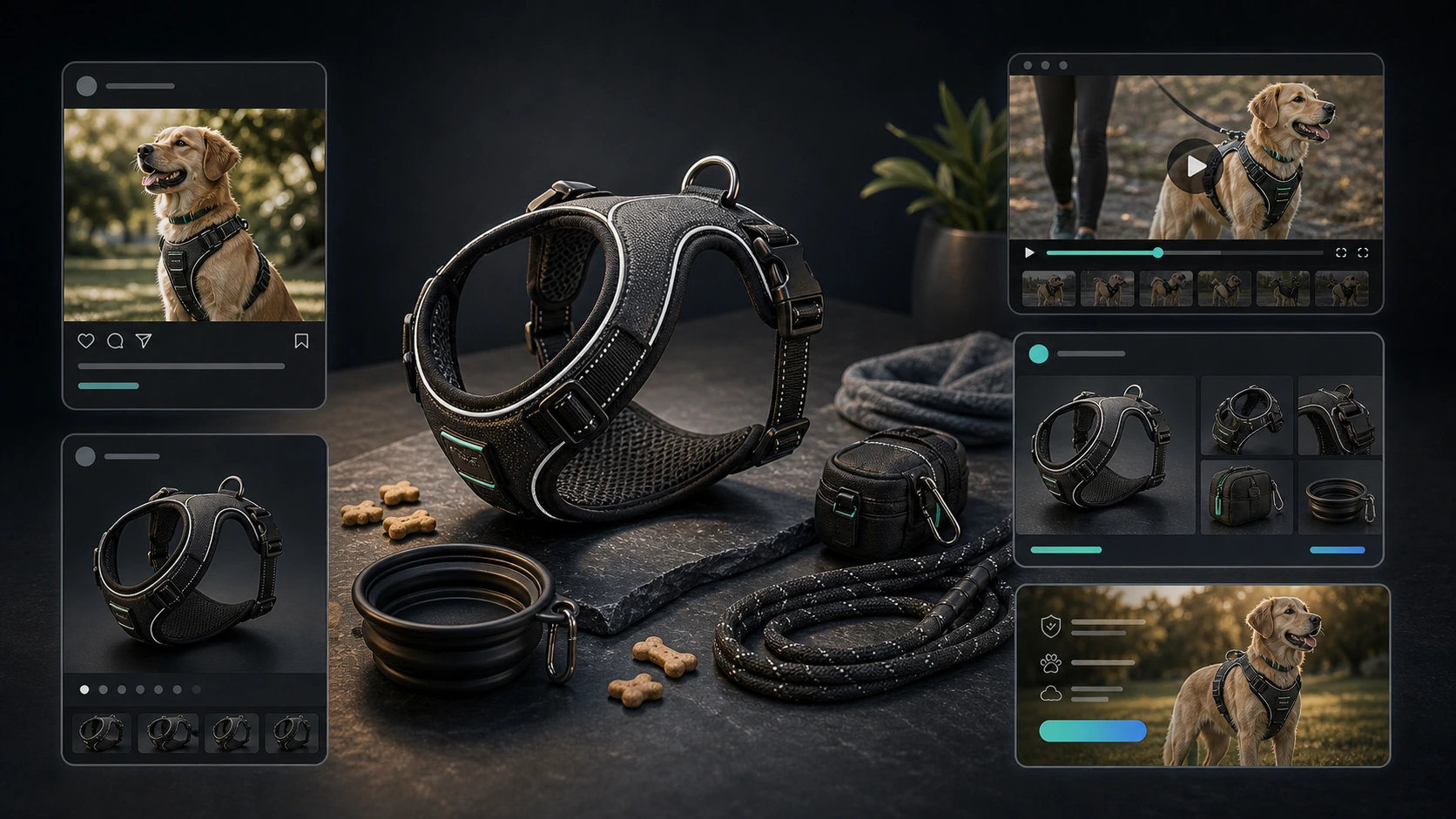
Product catalog context helps teams scale without losing accuracy
One product is manageable.
A catalog is harder.
An ecommerce brand may have 50, 100, or 500 products.
Without product catalog context, the team has to repeatedly copy-paste details into every tool.
That becomes slow and error-prone.
Product catalog context lets the system use structured product information across workflows.
It helps the team create more content without treating every asset as a fresh manual brief.
This matters for:
- product launches
- seasonal campaigns
- marketplace refreshes
- sale periods
- new collection drops
- multilingual content
- product education
- retargeting assets
- ad variation testing
The goal is not to remove human review.
The goal is to reduce repetitive briefing and product-detail errors.
What product catalog context cannot fix by itself
Product catalog context is powerful, but it is not magic.
It does not automatically guarantee:
- perfect product visuals
- marketplace compliance
- accurate claims without review
- perfect localization
- high ad performance
- brand consistency without Brand DNA
- no hallucinated details
- no need for human approval
Teams should still review:
- product accuracy
- image accuracy
- claims
- platform fit
- pricing or offer accuracy
- brand tone
- customer relevance
- marketplace rules
- final visual quality
Product context improves the starting point.
Review still protects the final output.
Product catalog context checklist
Before using AI to create ecommerce marketing content, check whether the product context includes:
| Product context item | Why it matters |
|---|---|
| Product name | Prevents vague or wrong naming |
| Product category | Helps AI choose the right scene and buyer angle |
| Product images | Improves visual accuracy and representation |
| Product description | Grounds scripts, captions, and listing content |
| Key attributes | Supports feature images and product explanations |
| Variants | Helps campaigns and listing assets stay accurate |
| Materials | Prevents wrong material claims |
| Dimensions or size | Helps scale and fit content |
| Use cases | Makes content buyer-relevant |
| Buyer type | Helps tone and message angle |
| Claims to avoid | Reduces exaggerated or unsupported messaging |
| Product limitations | Prevents overpromising |
| Approved bullets | Gives AI better creative direction |
| Channel use | Helps adapt content for social, ads, marketplace, or A+ content |
If these fields are missing, expect more generic output.
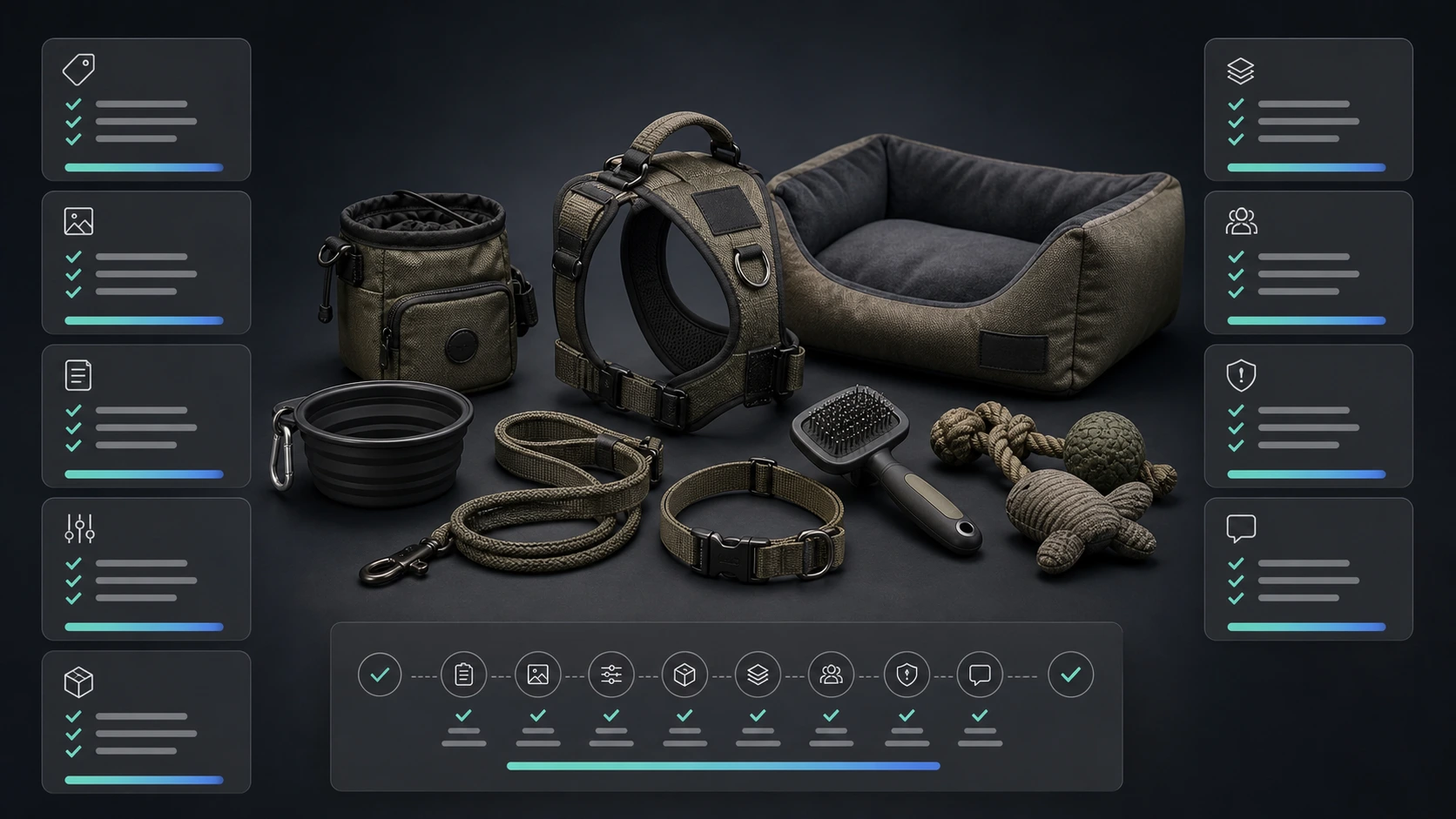
Practical framework: Product Truth -> Brand Fit -> Channel Use -> Review
Use this framework before generating ecommerce content with AI.
1. Product Truth
What is true about the product?
Name, images, descriptions, attributes, variants, and limits.
2. Brand Fit
How should the product be presented?
Voice, visual style, buyer context, tone, and claim rules.
3. Channel Use
Where will the content appear?
Social post, product shot, marketplace image, AI creator video, A+ module, ad, campaign, or email.
4. Review
Does the output match the product, brand, channel, and claim boundaries?
If not, edit before publishing.
This framework is simple, but it prevents most generic AI content mistakes.
Final takeaway
AI-generated ecommerce content gets better when it starts from the product catalog.
Not just a prompt.
Not just a tone instruction.
Not just a generic product category.
Product catalog context gives AI the product truth: names, images, descriptions, attributes, variants, use cases, and claim boundaries.
Brand DNA gives the AI the brand truth: voice, identity, buyer context, visual direction, and channel behavior.
Together, they help ecommerce teams create more accurate product images, videos, ads, marketplace assets, Amazon A+ content, campaigns, and social posts.
AgenixSocial is built around this idea: teach the system your brand, import or add your products, then create content from one product-aware workspace.
Create product-aware marketing content with AgenixSocial Brand DNA.
FAQ
What is product catalog context in AI marketing content?
Product catalog context is the product information an AI system uses before generating marketing content. It can include product names, images, descriptions, variants, attributes, use cases, materials, sizes, and claims to avoid.
Why does product catalog context matter for ecommerce AI content?
It helps AI generate content based on real products instead of vague category assumptions. This improves product accuracy, visual direction, scripts, listing assets, ads, and campaign ideas.
Is product catalog context only useful for product descriptions?
No. Product catalog context improves product shots, AI creator videos, marketplace listing images, Amazon A+ content, ad scripts, social posts, campaign planning, and founder-led content.
What happens when AI does not have product catalog context?
The content may sound generic, invent product features, use the wrong scene, create vague scripts, or make unsupported claims.
What product data should AI use?
Useful product data includes product name, category, images, description, attributes, variants, size, material, use cases, buyer type, claims to avoid, and product limitations.
How does AgenixSocial use product catalog context?
AgenixSocial can import Shopify products where supported or let users add products manually. Product images, descriptions, and enriched product details then help power workflows like Product Shots, AI Creator Videos, Marketplace Listing Studio, Amazon A+ Studio, and Campaigns.
Does product catalog context remove the need for review?
No. Product catalog context improves the starting point, but teams should still review product accuracy, claims, visual output, channel fit, marketplace suitability, and final messaging before publishing.
Can marketplace-only brands use product catalog context?
Yes. In AgenixSocial, brands that sell through marketplaces or do not have a Shopify store can manually create products and still use the content studios from that product context.