Brand DNA vs Brand Guidelines: What Ecommerce Teams Actually Need
Quick answer
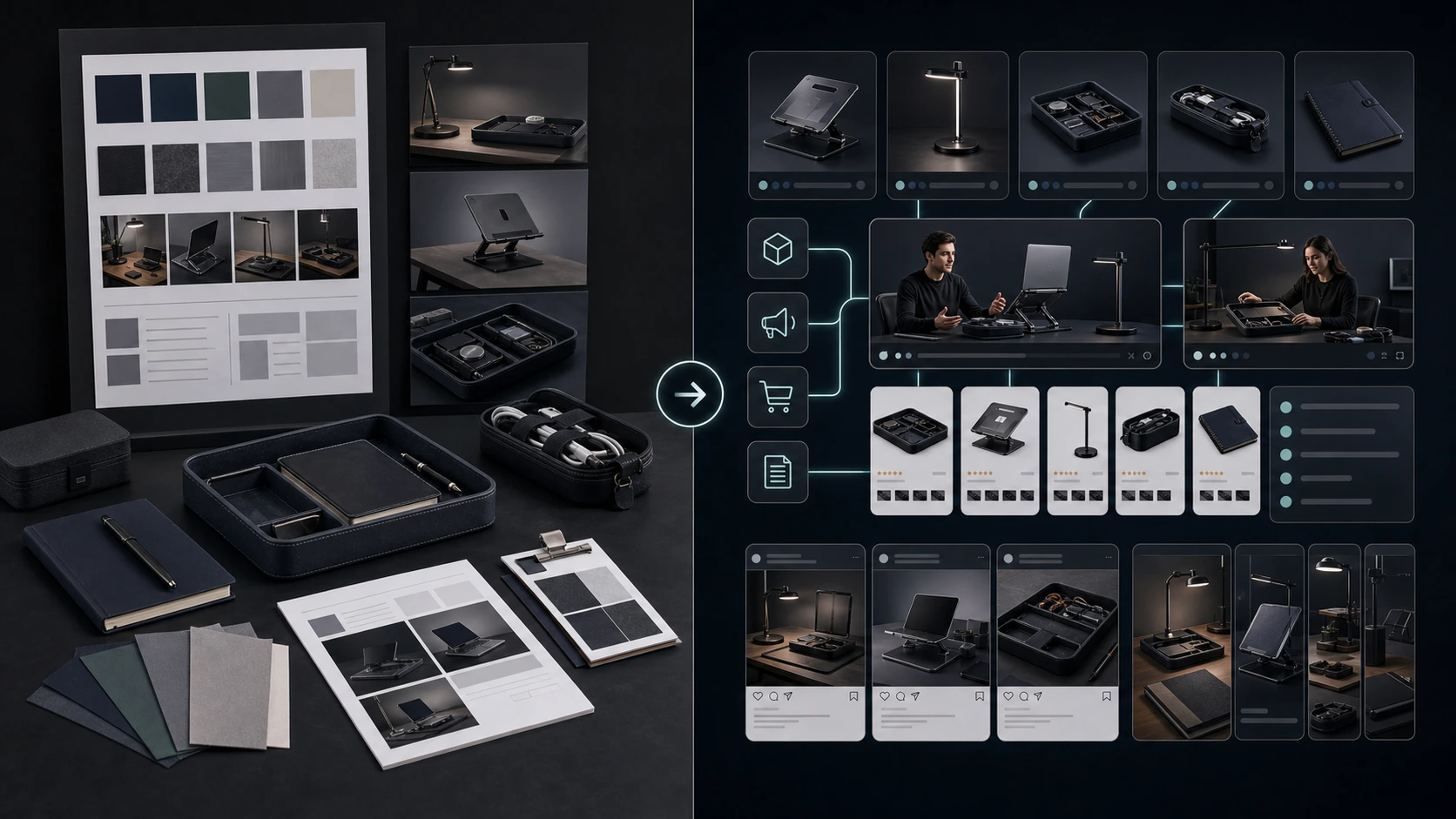
Brand guidelines tell humans how a brand should look, sound, and behave. Brand DNA gives AI content workflows reusable brand and product context so future product images, videos, marketplace assets, campaigns, captions, and scripts do not start from zero.
Brand guidelines are still useful.
But they were not designed for AI content workflows.
Ecommerce teams now need brand context that can be used by the system, not just read by humans.
If you want the product page behind this topic, start with Brand DNA. To see where that context gets used next, see Product Shots, AI Creator Videos, Marketplace Listing Studio, Amazon A+ Studio, Campaigns, and pay-as-you-go credits.
Why this comparison matters
Most ecommerce brands already have some version of brand guidelines.
It may be a PDF, Notion page, Google Doc, Figma file, brand kit, moodboard, or agency deck.
It may include:
- logo rules
- colors
- typography
- tone of voice
- visual references
- product photography style
- social media rules
- writing examples
- do and don’t examples
That is useful.
But when the brand starts using AI for content creation, a static brand guideline document is not enough by itself.
Why?
Because AI workflows need usable context.
A human designer can read a brand guideline document, interpret it, ask questions, and apply judgment.
A generic AI tool does not automatically know what to do with that document unless the user keeps explaining it.
That is where Brand DNA becomes useful.
Brand DNA is not a replacement for brand guidelines.
It is the operational layer that makes brand and product context usable inside AI content workflows.
What are brand guidelines?
Brand guidelines are a set of rules that explain how a brand should appear and communicate.
They usually help humans make consistent decisions.
A traditional brand guideline system may include:
- logo usage
- color palette
- typography
- spacing
- icon style
- image style
- tone of voice
- brand values
- messaging pillars
- copy examples
- social media rules
- packaging or marketplace guidance
Brand guidelines help teams avoid random output.
They are especially useful for:
- designers
- agencies
- copywriters
- marketers
- freelancers
- sales teams
- packaging teams
- web teams
- social media teams
They create a shared reference.
That is important.
But the format matters.
Most guidelines are made to be read by people, not used directly by AI generation systems.
Figma’s current positioning is useful category context here. Its AI brand guidelines generator describes turning brand personality, values, and visual direction into structured rules for color, type, layout, imagery, and voice. That still starts from a guideline system, not a product-aware ecommerce workflow. Figma AI brand guidelines generator
What is Brand DNA?
Brand DNA is the reusable brand and product context layer that teaches an AI content system how the brand looks, sounds, sells, and presents its products.
For ecommerce brands, Brand DNA should include:
- brand voice
- visual identity
- product catalog
- product images
- product descriptions
- buyer context
- market context
- content history where available
- claim boundaries
- visual direction
- channel behavior
- reusable workflow context
Brand DNA is not just a document.
It is the brand context that future AI workflows can use.
That is the key difference.
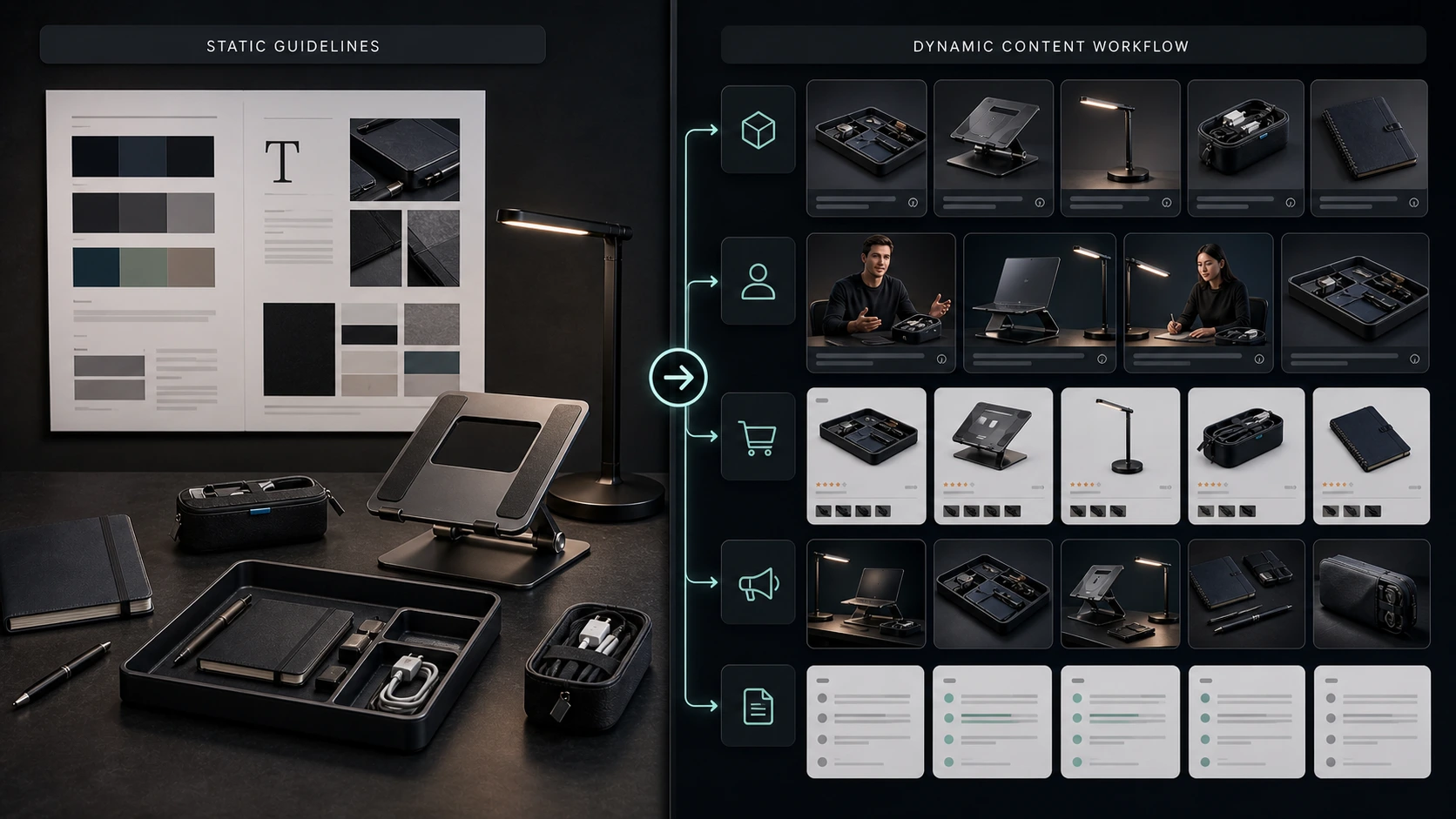
Brand guidelines vs Brand DNA
| Area | Brand guidelines | Brand DNA |
|---|---|---|
| Primary user | Humans | AI workflows and humans |
| Format | Static document, style guide, deck, brand kit | Reusable brand and product context inside a system |
| Main purpose | Tell people how the brand should look and sound | Help AI generate content from brand and product truth |
| Scope | Visual identity, tone, logo, design rules | Voice, identity, product catalog, images, descriptions, market context, content workflow |
| Product context | Often limited or separate | Central to the workflow |
| AI usability | Needs manual translation into prompts | Designed to be reused by generation workflows |
| Ecommerce fit | Useful but incomplete | Stronger for repeated product-led content |
| Updates | Manual refresh | Can be refreshed when brand and product context changes |
| Best use | Governance and human alignment | AI content creation across images, videos, listings, campaigns, and scripts |
The simplest distinction:
Brand guidelines tell people what the brand should be.
Brand DNA helps the AI system use that brand context while creating content.
Why brand guidelines alone are not enough for AI content
Brand guidelines are useful, but they leave gaps in AI workflows.
1. They are not always connected to product data
A guideline document may define tone and colors, but it may not include the live product catalog.
For ecommerce, that is a problem.
AI-generated content often needs product details:
- product name
- product images
- product description
- price or currency where relevant
- category
- variants
- use cases
- claims to avoid
- marketplace context
Without product context, AI may produce content that sounds polished but is product-inaccurate.
2. They require repeated explanation
If the brand guidelines sit in a PDF, the user still has to translate them into prompts.
That creates repeated briefing.
The user keeps saying:
- “Use our premium but practical tone.”
- “Do not make it too playful.”
- “Use clean workspace visuals.”
- “Do not invent features.”
- “This product is a desk tray, not a drawer.”
- “This is for marketplace images, not Instagram.”
- “Keep the copy clear and non-hype.”
That repeated explanation is exactly what Brand DNA should reduce.
3. They do not automatically adapt by workflow
A brand guideline document may explain the brand voice generally.
But ecommerce content changes by workflow.
A product shot prompt is not the same as an AI creator video script.
A marketplace listing image is not the same as a founder post.
An Amazon A+ storyboard is not the same as an Instagram carousel.
Brand DNA should help the system adapt brand context across workflows.
4. They do not prevent AI from inventing product claims
AI can overstate benefits.
It may generate phrases like:
- “guaranteed productivity”
- “perfect for everyone”
- “best in class”
- “solves all your workspace problems”
- “completely clutter-free forever”
A brand guideline document may say “be confident,” but ecommerce content also needs claim boundaries.
Brand DNA should include what the brand should not say.
5. They are not always refreshed with the business
A brand changes.
Products change.
Markets change.
Positioning changes.
Social content changes.
If the AI system keeps using old context, output starts drifting.
Brand DNA should be refreshable when the brand or product catalog changes.

What ecommerce teams actually need
Ecommerce teams need both.
They still need brand guidelines for human alignment.
But they also need Brand DNA for AI-assisted content creation.
A strong ecommerce content system should include:
| Need | Why it matters |
|---|---|
| Brand voice | Keeps copy, captions, ads, and scripts consistent |
| Visual identity | Keeps generated images and videos visually aligned |
| Product catalog | Grounds content in what the brand actually sells |
| Product images | Reduces visual mismatch and product drift |
| Product descriptions | Helps generate accurate scripts, captions, and listing assets |
| Buyer context | Helps content speak to the right audience |
| Channel rules | Ad, marketplace, social, email, and A+ content need different styles |
| Claim boundaries | Prevents exaggerated or unsupported product claims |
| Content history | Helps AI learn from real posts and past patterns |
| Review workflow | Keeps humans responsible for final approval |
Brand guidelines define the brand.
Brand DNA activates the brand inside the content workflow.
Example: premium home-office accessories brand
Let’s continue with a fictional brand:
A premium home-office accessories brand selling:
- desk trays
- laptop stands
- cable organizers
- workspace lamps
The brand position:
- clean
- practical
- premium
- organized
- useful for remote workers, students, founders, and creative professionals
- not overly luxury
- not discount-heavy
- not cartoonish
What brand guidelines might say
A brand guideline document may say:
- Use a clean, minimal visual style.
- Use neutral backgrounds.
- Avoid cluttered scenes.
- Keep copy calm and practical.
- Use premium but simple language.
- Avoid hype.
- Use product photos in modern workspace settings.
That is useful.
What Brand DNA should add
Brand DNA should make this usable across workflows.
It should know:
- product catalog: desk trays, laptop stands, cable organizers, workspace lamps
- product images
- product descriptions
- buyer context
- visual environment
- claim boundaries
- platform use cases
- channel behavior
- content patterns
- what to avoid
For example:
Desk tray content should not invent a drawer.
Laptop stand content should not make medical posture claims.
Cable organizer content should not show random kitchen cables.
Workspace lamp content should not claim eye-health benefits unless supported.
This is why product context matters.
How the same brand context changes by workflow
The same brand should behave differently depending on the content type.
| Workflow | How Brand DNA helps |
|---|---|
| Product Shots | Guides product setting, visual style, lighting, and product use case |
| AI Creator Videos | Helps scripts sound natural, product-specific, and on-brand |
| Marketplace Listing Studio | Grounds image sets in product details and buyer clarity |
| Amazon A+ Studio | Helps structure product story, module tone, and brand narrative |
| Campaigns | Keeps multi-day campaign assets consistent |
| Quick Post | Generates platform-aware posts from brand and product context |
| Founder Studio | Keeps founder-led content aligned with product and brand story |
| Image Ads | Helps create product-specific, claim-safe ad directions |
A brand guideline document may describe all of this in theory.
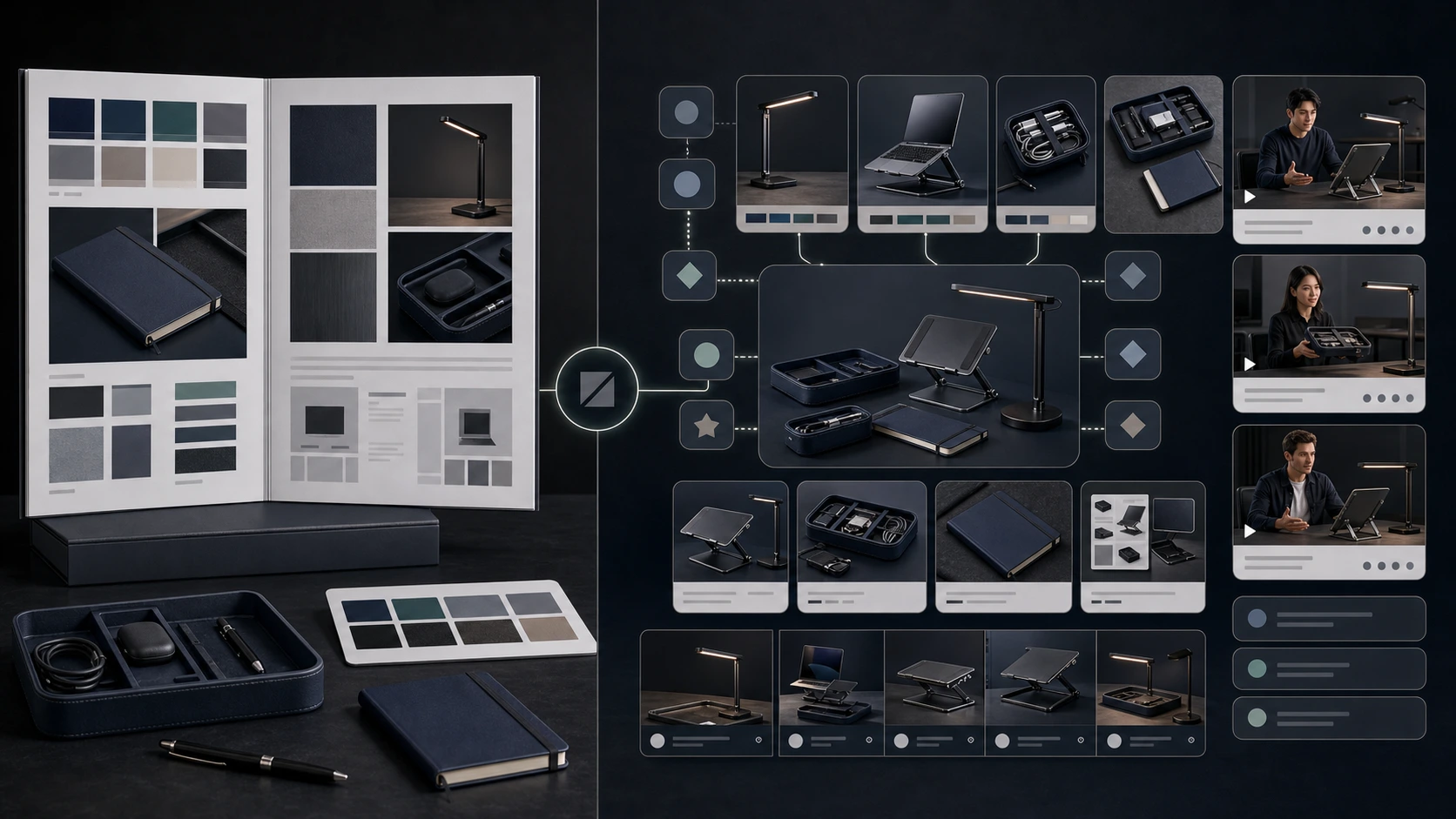
Brand DNA helps the system use it.
When brand guidelines are still needed
Brand guidelines are still important.
Use brand guidelines when you need:
- human design alignment
- agency onboarding
- logo rules
- packaging consistency
- typography rules
- visual identity governance
- copywriter onboarding
- internal team alignment
- retail or partner-facing documentation
- approval standards
Brand guidelines are especially useful when multiple people need a shared source of truth.
They help keep humans aligned.
They should not disappear.
When Brand DNA is needed
Brand DNA becomes important when the team is using AI to create repeated ecommerce content.
You need Brand DNA when you are generating:
- product photos
- lifestyle images
- marketplace listing images
- Amazon A+ content
- AI creator videos
- product scripts
- image ads
- social posts
- campaign plans
- founder-led content
- multilingual or market-specific content
You also need Brand DNA when your team keeps re-explaining the same brand context to every tool, agency, prompt, freelancer, or content workflow.
That repeated explanation is a sign that brand context is not operational yet.
HubSpot and Klaviyo both frame the category mainly around reusable brand voice for AI-assisted messaging. HubSpot says its tools analyze writing personality and tone, while Klaviyo says brand voice AI learns a brand’s personality and style so content sounds like the brand. That is useful, but it is still narrower than product-aware ecommerce Brand DNA. See HubSpot brand voice using AI and Klaviyo Brand Voice AI.
The decision table
| Situation | Use brand guidelines | Use Brand DNA |
|---|---|---|
| You need logo rules | Yes | Not primary |
| You need design governance | Yes | Supports but does not replace |
| You need agency onboarding | Yes | Useful supporting context |
| You need AI-generated product images | Not enough | Yes |
| You need AI creator videos | Not enough | Yes |
| You need marketplace asset generation | Not enough | Yes |
| You need product-aware campaigns | Not enough | Yes |
| You need reusable AI brand context | Limited | Yes |
| You need product catalog context | Usually separate | Yes |
| You need human approval rules | Yes | Yes |
| You need less repetitive prompting | Limited | Yes |
The best answer is not “brand guidelines or Brand DNA.”
It is:
Use brand guidelines for human governance.
Use Brand DNA for AI content workflows.
Why generic AI tools struggle with brand guidelines
Generic AI tools can use brand guidelines if the user pastes them in, uploads them, or summarizes them.
But the problem remains:
- context may not persist across workflows
- product data may still be missing
- visual output may not use the brand properly
- channel behavior may need repeated explanation
- user must keep prompting carefully
- different tools may interpret the same guidelines differently
- product accuracy still depends on manual input
This is why tool-stitching becomes messy.
A founder may use one tool for copy, one for images, one for video, one for scheduling, one for marketplace content, and one for campaigns.
Each tool needs brand context.
Each tool may output something different.
Brand DNA should reduce that fragmentation by keeping brand and product context inside one workspace.
How AgenixSocial Brand DNA fits
AgenixSocial Brand DNA does not replace brand guidelines.
It makes brand and product context usable inside AI content workflows.
The workflow is:
- The user shares the brand website.
- AgenixSocial analyzes the public brand presence.
- It identifies brand voice and identity cues.
- It imports Shopify products where supported.
- It allows manual product creation when needed.
- It creates a reusable brand twin.
- That context is used across future content generation.
AgenixSocial can use that Brand DNA across:
- Product Shots
- AI Creator Videos
- Marketplace Listing Studio
- Amazon A+ Studio
- Campaigns
- Founder Studio
- Quick Post
- Image Ads
- Media Library workflows
The key point:
Brand DNA is not a manual brand-guidelines form.
It is a reusable brand and product context layer.
What AgenixSocial should not claim
Brand DNA should not be overclaimed.
It should not be described as:
- perfect content automation
- a replacement for brand managers
- a replacement for designers
- a replacement for human review
- a guarantee that every output will be on-brand
- a guarantee of marketplace compliance
- a complete audience analytics suite
The stronger and safer claim is:
Brand DNA gives every content workflow a better starting point by grounding it in brand and product context.
The team still reviews.
The team still approves.
The brand still owns the final content.
Practical checklist: do you need Brand DNA?
You probably need Brand DNA if:
- your team keeps re-explaining the brand to AI tools
- product images and videos keep looking inconsistent
- scripts sound generic
- AI outputs invent product features
- different tools create different brand styles
- agencies need repeated briefing
- marketplace assets take too much manual explanation
- campaigns lack consistency
- product context is scattered
- your AI workflow depends on prompt memory instead of system context
You probably need better brand guidelines if:
- your team does not have logo rules
- colors and typography are inconsistent
- designers do not have a shared reference
- packaging, website, and social visuals are misaligned
- partners need rules for how to use the brand
Most growing ecommerce teams eventually need both.
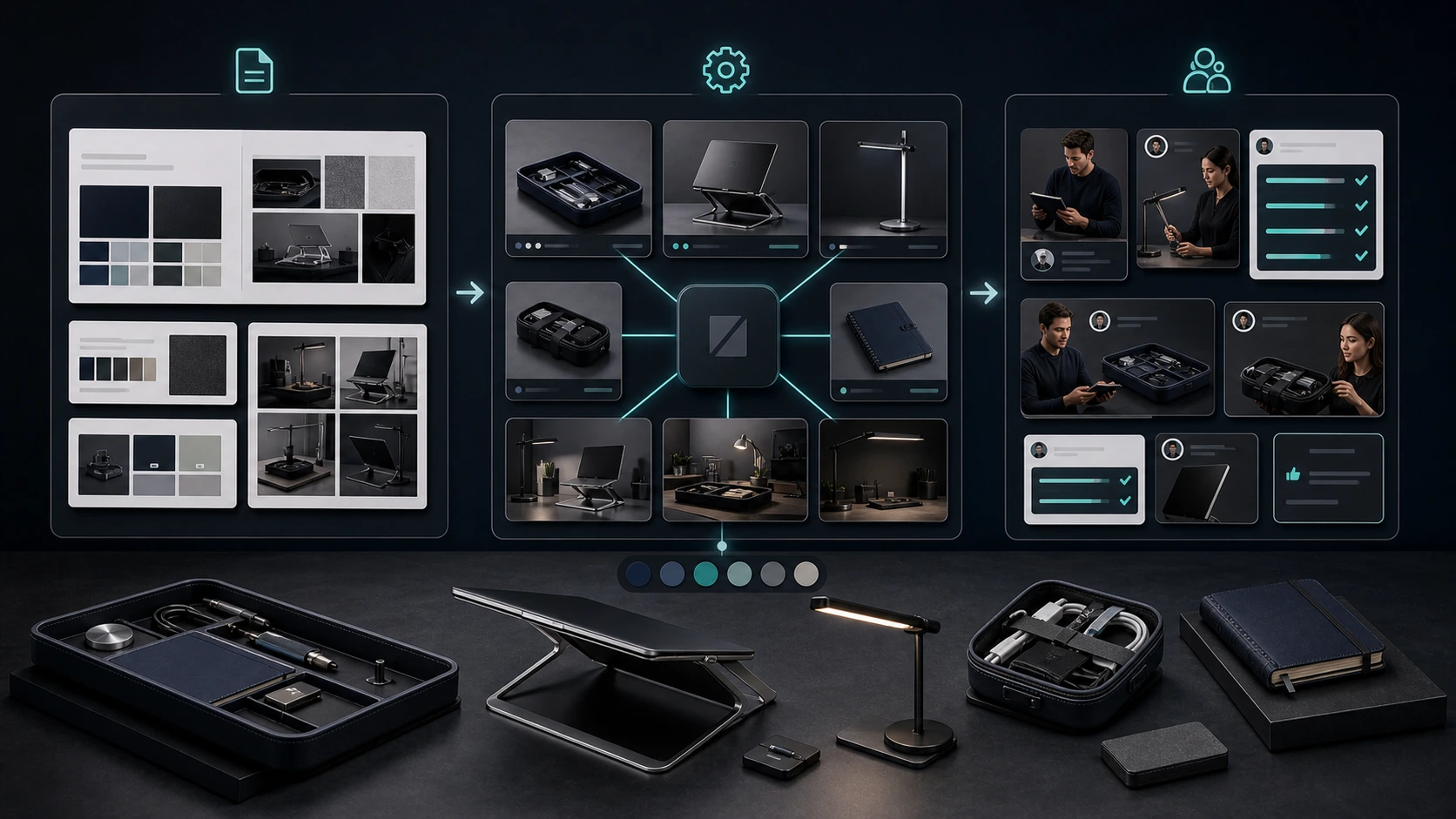
Practical framework: Document, Operationalize, Review
Use this three-part framework.
1. Document
Create clear human-facing brand guidelines:
- logo
- color
- typography
- tone
- voice
- imagery
- do and don’t examples
2. Operationalize
Turn that brand context into Brand DNA:
- website analysis
- product catalog
- product images
- descriptions
- market context
- channel behavior
- claim boundaries
- content history where available
3. Review
Review every output before publishing:
- product accuracy
- brand tone
- visual fit
- claim safety
- channel fit
- marketplace suitability
- cultural or market context
- final approval
This is the mature AI content workflow.
Not “let AI do everything.”
Not “ignore AI and do everything manually.”
Turn the brand into usable context, then review the outputs.
Conclusion
Brand guidelines and Brand DNA solve different problems.
Brand guidelines help humans understand how the brand should look, sound, and behave.
Brand DNA helps AI content workflows use brand and product context while creating ecommerce content.
For ecommerce teams, this distinction matters because content is not only copy. It includes product photos, AI creator videos, marketplace images, Amazon A+ content, campaigns, scripts, founder-led content, ads, and social posts.
Brand guidelines are still useful.
But AI workflows need something more operational.
They need reusable brand and product context.
That is Brand DNA.
Turn your brand guidelines into usable Brand DNA with AgenixSocial.