Brand-Aware AI Content: How Ecommerce Teams Stop Repeating Brand Context in Every Prompt
Brand-aware AI content is content generated with reusable knowledge of a brand's voice, identity, products, audience, visual direction, and content rules.
For ecommerce teams, this matters because generic AI content is easy to create but hard to trust.
A generic AI tool can write a polished caption. It can suggest a campaign. It can draft product copy. It can even create image prompts or video scripts.
But unless the system understands the brand and the product, the output often feels slightly wrong.
The tone may be close, but not quite right. The product benefit may be vague. The image direction may miss the category. The video script may sound like every other product ad. The marketplace image concept may ignore the rules. The campaign may look good but fail to sound like the brand.
That is the gap brand-aware AI content is meant to solve.
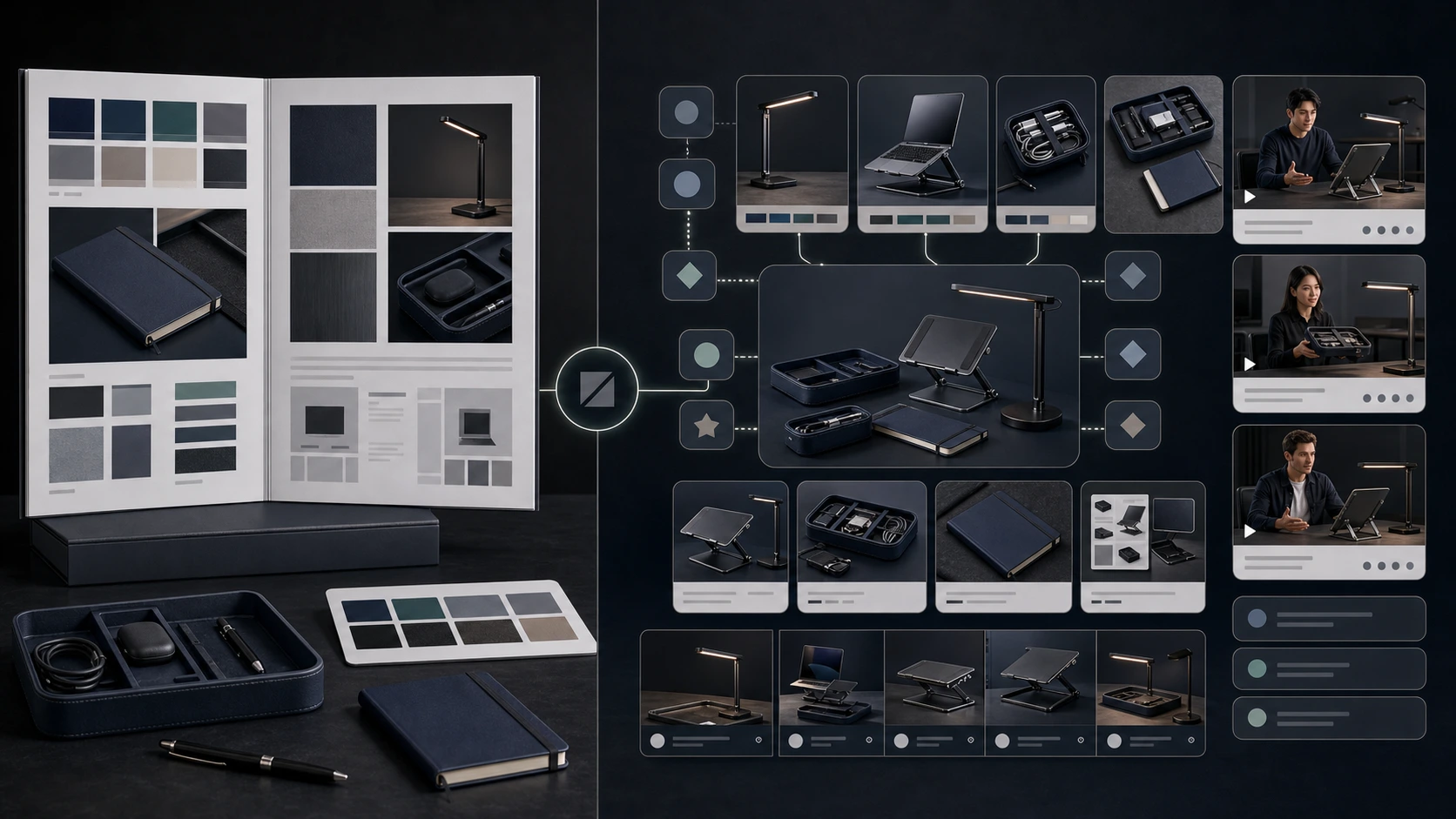
Quick answer: what is brand-aware AI content?
Brand-aware AI content is AI-generated content created using reusable brand context such as voice, tone, visual style, audience, positioning, products, competitors, and content rules. For ecommerce brands, the strongest brand-aware AI workflows also use product catalog context so social posts, product shots, videos, marketplace assets, Amazon A+ content, and campaigns stay grounded in what the brand actually sells.
Why generic AI content feels off-brand
Generic AI content usually fails for one simple reason: the model has not been taught enough about the brand's actual operating context.
It may know what a good caption looks like.
It may know what a skincare brand, coffee brand, apparel brand, or gadget brand usually sounds like.
But "usually" is the problem.
Most ecommerce brands are not trying to sound like the average brand in their category. They are trying to sound like themselves.
Generic AI content often feels off-brand because it relies on patterns:
- common marketing phrases
- generic benefit language
- overused urgency
- vague emotional copy
- broad customer assumptions
- category stereotypes
- polished but empty captions
That kind of content may look acceptable in isolation. But across a full brand calendar, it starts to feel interchangeable.

HubSpot's brand voice tooling shows how this category often begins with writing personality and tone. Its documentation describes using AI to analyze character and tone so generated content can follow a brand's voice. HubSpot brand voice setup
That is useful, but it is only the beginning of the ecommerce problem.
Brand voice is not the whole problem
Brand voice matters, but brand voice is only one part of brand-aware content.
A brand voice guide might say:
- friendly but expert
- direct and warm
- premium but accessible
- playful but not childish
- educational without being clinical
Useful, yes.
Enough for ecommerce content? Not really.
An ecommerce content system also needs to know:
- what the product is
- who buys it
- what the product costs
- what the product looks like
- what claims are safe
- what the brand should avoid saying
- what marketplace or platform the content is for
- what visual style fits the product category
- what campaign goal the content supports
- whether the output is for social, listing images, A+ content, ads, video, or launch storytelling
A brand voice guide can help the writing sound closer. It cannot, by itself, make the workflow product-aware.
Jasper's Brand Voice positioning reflects the broader tool category: teams can tune voice, tone, style, and visual guidelines so outputs look and sound more consistent. Jasper Brand Voice
Figma's AI brand guideline page points to the wider brand system layer across color, type, layout, imagery, and voice. Figma AI brand guidelines
For ecommerce, that wider view matters because content has to move across copy, product visuals, videos, listings, and campaign assets.
What should AI know about your brand?
A brand-aware AI workflow should understand more than tone.
At minimum, it should know:
| Brand context | Why it matters |
|---|---|
| Brand identity | Keeps the content anchored in what the brand stands for |
| Voice and tone | Helps copy sound consistent across channels |
| Audience | Prevents generic customer assumptions |
| Product category | Helps the system understand visual and content expectations |
| Product catalog | Grounds content in what the brand actually sells |
| Visual style | Keeps images, videos, and campaigns from feeling random |
| Competitor context | Helps avoid sounding identical to the category |
| Social history | Helps learn what the brand has already published |
| Platform context | Adapts content to Instagram, Facebook, marketplace listings, or other destinations |
| Content rules | Prevents risky claims, poor formatting, or off-brand language |
The key is reusability.
If your team has to paste this context into every prompt, you do not have a brand-aware workflow. You have a better prompt library.
Prompt libraries help, but they are not enough
Prompt libraries are useful. They help teams avoid starting from a blank page.
A prompt library might include:
- brand voice prompts
- product launch prompts
- social caption prompts
- image generation prompts
- video script prompts
- Amazon listing prompts
- campaign prompts
But prompt libraries still create work.
Someone has to keep them updated. Someone has to paste product details. Someone has to adapt the prompt for each tool. Someone has to remember which version is current. Someone has to check whether the output still matches the product and the brand.
The larger the team or product catalog, the harder this becomes.
Prompt libraries are a starting point. Reusable brand memory is the stronger system.
Brand-aware vs product-aware AI content
Brand-aware content and product-aware content are connected, but they are not the same.
| Area | Brand-aware AI content | Product-aware AI content |
|---|---|---|
| Core question | Does this sound and feel like the brand? | Is this grounded in the actual product? |
| Main context | Voice, tone, style, audience, identity | Product name, images, description, price, use cases, variants |
| Best for | Consistency across channels | Accuracy and usefulness of product content |
| Risk if missing | Generic, inconsistent, off-brand content | Wrong, vague, or misleading product content |
| Ecommerce need | High | High |
For ecommerce teams, the best workflow needs both.
Brand-aware without product-aware can sound good but say very little.
Product-aware without brand-aware can be accurate but dull.
The winning combination is content that knows the brand and understands the product.
Why ecommerce makes brand-aware AI harder
Ecommerce content is not one format.
A brand might need to create:
- product-led Instagram posts
- short captions
- launch campaigns
- founder-led updates
- product shots
- lifestyle images
- product-in-use scenes
- creator-style videos
- ad images
- marketplace listing images
- Amazon A+ modules
- product comparison visuals
- approval-ready assets
- downloadable image sets
Each format carries the brand differently.
A caption carries brand voice. A product photo carries visual identity. A creator video carries tone, language, product education, and customer trust. A marketplace listing image carries clarity and buyer confidence. An Amazon A+ module carries product storytelling and brand credibility. A campaign carries the full narrative.
So brand-aware AI for ecommerce cannot be text-only.
It needs to influence copy, imagery, video, marketplace assets, and campaigns.
The repeated-context problem
This is one of the biggest hidden costs of using generic AI tools.
A founder may start with one AI tool for captions. Then another for images. Then another for video. Then another for scheduling. Then another for listing images.
Each tool needs some version of the same context:
- "Here is our brand."
- "Here is our tone."
- "Here is the product."
- "Here is the audience."
- "Here is what not to say."
- "Here is the platform."
- "Here is the campaign goal."
Repeating this once is fine.
Repeating it across tools, campaigns, products, and weeks becomes operational drag.
It also creates inconsistency. Different tools receive slightly different context, so outputs drift.
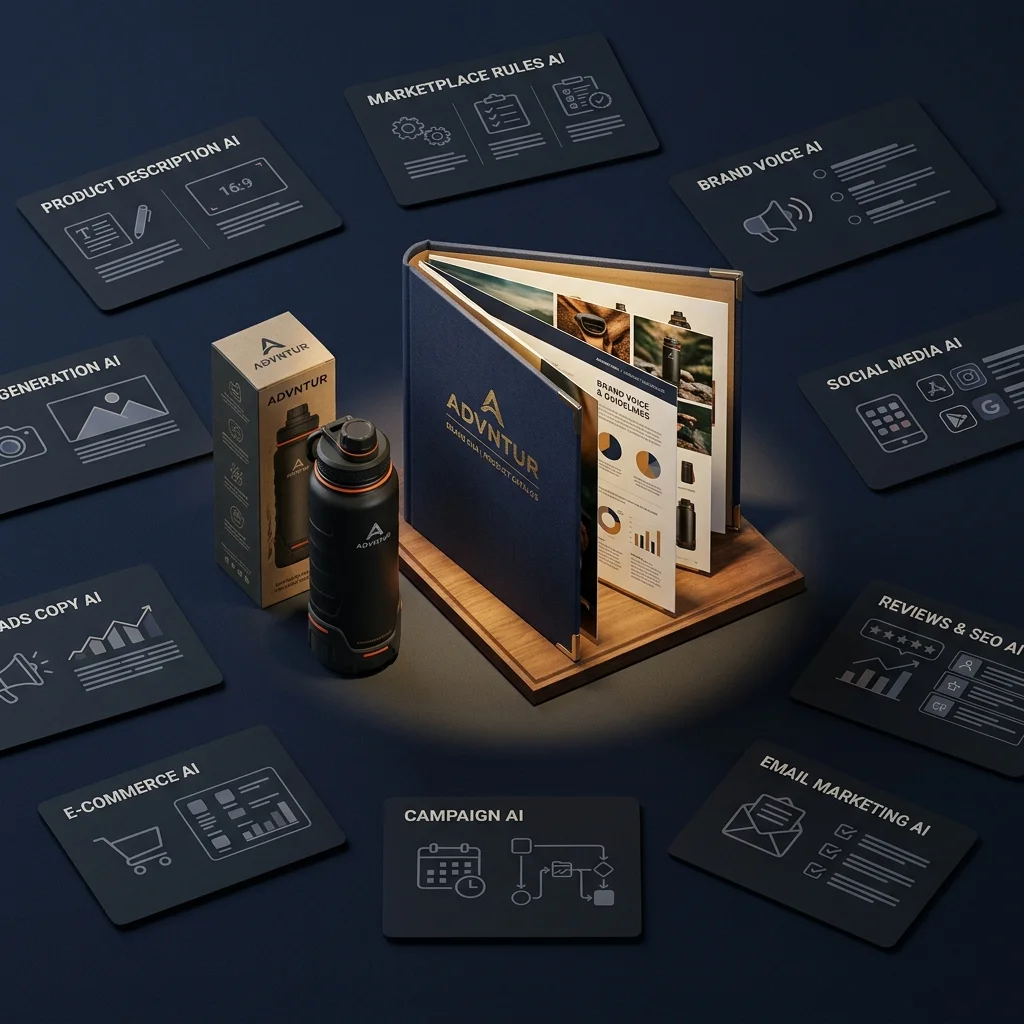
Research on brand consistency of web content notes that maintaining consistent brand messaging becomes harder as content volume grows. Brand consistency research
That problem becomes sharper when each AI tool starts from a different prompt, product description, image reference, or channel instruction.
Brand context drift: how it shows up
Brand context drift is when AI-generated content slowly moves away from the brand's actual voice, positioning, or visual identity.
It can show up as:
- captions becoming too generic
- product claims becoming too broad
- tone becoming too formal or too salesy
- visuals becoming inconsistent
- founder content sounding unlike the founder
- product videos using the wrong customer language
- marketplace assets using the wrong emphasis
- campaign ideas repeating common category cliches
- different tools producing different interpretations of the same brand
The drift is often subtle. That is what makes it dangerous.
One post may not look bad. But after 30 posts, the brand starts to feel less distinctive.
What a brand-aware ecommerce workflow should do
A strong brand-aware ecommerce workflow should help teams do five things.
1. Create brand context once
The system should have a reusable place for:
- brand identity
- tone
- voice
- visual direction
- audience
- product positioning
- competitor context
- platform context
- content rules
This prevents every content request from starting at zero.
2. Connect brand context to products
Brand context should not live separately from the product catalog.
The workflow should understand what the brand sells and how those products should be described, shown, explained, and promoted.
3. Apply context across formats
Brand context should carry into:
- captions
- carousels
- image ads
- product shots
- creator videos
- campaign plans
- founder content
- marketplace images
- Amazon A+ content
If brand context only affects written copy, the workflow is incomplete.
4. Keep humans in the loop
Brand-aware does not mean publish automatically.
Teams should still review:
- product facts
- claims
- tone
- visual accuracy
- marketplace fit
- campaign intent
- audience sensitivity
AI can create a better starting point. Review still protects the brand.
Storyteq makes this operational point directly in its discussion of AI content generation and brand consistency: structured brand inputs, templates, and human oversight all matter. Storyteq
5. Learn from real brand assets
The best brand-aware workflow should connect to existing brand surfaces where possible:
- website
- products
- social posts
- captions
- images
- media assets
- campaign history
- marketplace content
A brand is not only a tone document. It is the pattern created across everything the company publishes.
The structured brand memory idea is also why brand wiki concepts are useful: they move brand knowledge out of scattered documents and into reusable context. ShopOS brand wiki
How brand-aware AI changes different content types
Brand-aware AI should change the output depending on the format.
| Content type | How brand context helps |
|---|---|
| Social posts | Keeps captions, hooks, and visual direction consistent |
| Product shots | Guides scene choice, mood, audience, and product styling |
| AI creator videos | Helps scripts sound like the brand and fit the product |
| Campaigns | Keeps multi-day content aligned around one message |
| Founder-led content | Helps founder content support brand positioning |
| Marketplace images | Keeps product explanation clear and brand-consistent |
| Amazon A+ content | Supports product storytelling and brand credibility |
| Image ads | Keeps promotional visuals from feeling generic |
| Media library assets | Makes reused assets easier to organize and recognize |
This is why brand-aware AI content is not only a copywriting feature. It is a content operations feature.
Common mistakes ecommerce teams make
Mistake 1: Treating brand voice as a prompt
A prompt can describe voice. It cannot maintain the full brand system across every workflow unless the context is reusable and connected.
Mistake 2: Separating brand and product context
A brand-aware caption that ignores product details is still weak ecommerce content.
Mistake 3: Using the same tone everywhere
A brand may sound consistent without sounding identical everywhere. A product education post, creator video, marketplace image, and founder story should not all use the same sentence structure.
Mistake 4: Forgetting visual consistency
Brand-aware content includes visual style. If images and videos look unrelated, the brand still feels inconsistent.
Mistake 5: Skipping review
AI can drift. Product details can be wrong. Claims can be too strong. Images can misrepresent the product. Review remains necessary.
How AgenixSocial Brand DNA helps
AgenixSocial uses Brand DNA as the foundation for brand-aware ecommerce content.
Brand DNA helps create a reusable brand profile that includes brand identity, voice and tone, product context, competitor context, platform context, and social content context.
This matters because the rest of the content system can use that context instead of asking the user to rebuild it each time.
AgenixSocial also connects Brand DNA to product-aware workflows.
Inside AgenixSocial, brand context can support:
- Quick Post for product-led social content
- Product Shots for controlled product visuals
- AI Creator Videos for creator-style product videos
- Campaigns for product or brand campaign planning
- Marketplace Listing Studio for marketplace image sets
- Amazon A+ Studio for Amazon-style storytelling modules
- Founder Studio for founder-led content
- Media Library for organizing assets
- Calendar and Approval Queue for review and publishing workflows
That is the difference between a brand voice prompt and a brand-aware commerce workspace.
Brand DNA vs generic brand voice tools
Generic brand voice tools can be useful, especially for writing.
But ecommerce teams need a broader system.
| Question | Generic brand voice tool | AgenixSocial Brand DNA |
|---|---|---|
| Helps with tone and voice? | Yes | Yes |
| Stores reusable brand context? | Often | Yes |
| Connects to product catalog context? | Sometimes limited | Yes |
| Influences product visuals? | Usually limited | Yes, through product-aware workflows |
| Supports creator-style videos? | Usually separate | Yes, through AI Creator Videos |
| Supports marketplace image workflows? | Usually no | Yes, through Listing Studio |
| Supports Amazon A+ content? | Usually no | Yes, through A+ Studio |
| Includes approvals and calendar? | Usually separate | Yes, through workflow features |
| Built for ecommerce content breadth? | Often text-first | Yes |
The point is not that brand voice tools are bad. The point is that ecommerce teams often need more than voice.
What to review before publishing brand-aware AI content
Even when the output starts from strong brand and product context, teams should review:
- Is the product detail accurate?
- Does the claim need proof or softening?
- Does the content match the brand tone?
- Does the visual style fit the brand?
- Does the image show the real product accurately?
- Does the format fit the platform?
- Does marketplace content follow the relevant rules?
- Does the content sound useful, not just polished?
- Is the CTA appropriate?
- Is the asset ready to publish, download, or hand off?
Brand-aware AI improves the starting point. It does not remove responsibility.
Brand-aware AI content checklist
Use this checklist when evaluating a brand-aware AI content workflow.

Brand memory
- Can the system store reusable brand context?
- Can it reflect tone, voice, identity, and audience?
- Can the team update the brand profile?
- Can it avoid repeated prompt setup?
Product context
- Can it use real product details?
- Can it use product images?
- Can it generate content for specific products?
- Can it support manual products if the brand is marketplace-first?
Content formats
- Can it generate social posts?
- Can it generate product visuals?
- Can it support creator-style videos?
- Can it create campaign plans?
- Can it support marketplace listing assets?
- Can it support Amazon A+ content?
Workflow
- Is there a review step?
- Can assets be saved and reused?
- Can content move into a calendar?
- Can teams download or export assets?
- Does the system reduce tool switching?
Trust
- Does it avoid unsupported claims?
- Does it make product review easy?
- Does it help the team check marketplace fit?
- Does it keep humans in control?
If a tool only checks the "tone" box, it may be a brand voice tool. It may not be a full brand-aware ecommerce content workflow.
FAQ
What is brand-aware AI content?
Brand-aware AI content is AI-generated content created with reusable brand context such as voice, tone, audience, identity, visual style, products, competitors, and content rules. For ecommerce, it should also connect to product catalog context.
Why does AI content sound off-brand?
AI content often sounds off-brand because the system lacks enough reusable context about the brand's voice, audience, products, positioning, and visual style. Without that context, the output relies on generic category patterns.
Is brand-aware AI the same as brand voice AI?
No. Brand voice AI focuses mainly on tone and writing style. Brand-aware AI is broader. It should include voice, product context, visual direction, audience, platform context, and review workflows.
Why is product context important for brand-aware ecommerce content?
Product context keeps the content grounded in what the brand actually sells. Without it, AI may produce captions, visuals, or scripts that sound good but miss product details, use cases, variants, or buyer objections.
Can prompts make AI content brand-aware?
Prompts can help, but prompts are not enough for repeatable ecommerce workflows. A reusable brand profile or Brand DNA layer is more useful because the brand context can be applied across many content types without starting from zero.
Does brand-aware AI content still need review?
Yes. Teams should review final content for product accuracy, claims, marketplace fit, visual realism, and brand tone before publishing or uploading.
How does AgenixSocial support brand-aware AI content?
AgenixSocial uses Brand DNA to store reusable brand context and connect it to product-aware workflows such as social posts, product shots, AI creator videos, campaigns, marketplace listing images, Amazon A+ content, approvals, and scheduling.
Is brand-aware AI useful for marketplace sellers?
Yes. Marketplace sellers still need consistent product messaging, visuals, and brand presentation. Brand-aware AI is especially useful when combined with product catalog context and marketplace-specific review workflows.
Conclusion
Brand-aware AI content is not just about making captions sound nicer.
For ecommerce teams, it is about creating a reusable brand memory that can guide product content across social posts, product visuals, videos, marketplace assets, Amazon A+ content, campaigns, approvals, and scheduling.
Generic AI tools can generate content. Brand voice tools can improve tone. But ecommerce teams need a stronger system: brand context plus product context plus workflow.
That is the role of AgenixSocial Brand DNA.
It helps teams stop re-explaining the brand in every prompt and start creating from a reusable foundation. The result is not fully automated perfection. It is a stronger, more consistent starting point that teams can review, refine, and publish with more confidence.