Amazon AI may rewrite your product titles: how sellers can stay in control
Amazon's 75-character title update is not just a title-length rule.
It also creates a control problem.
Starting July 27, 2026, Amazon is moving most non-media product titles toward 75 characters or fewer, including spaces. Titles that remain over the limit may be updated gradually to AI recommendations. Brand owners may get time to review, modify, and approve AI-generated recommendations in Review Listings Changes, but sellers should not treat that as a reason to wait.
If your product titles matter to search visibility, conversion, catalog consistency, and brand presentation, you do not want to discover Amazon's preferred rewrite after the deadline.
The better approach is simple:
Prepare your own shorter titles and Item Highlights first.

Quick answer: can Amazon AI rewrite product titles?
Yes. Amazon has said titles still over 75 characters after July 27, 2026 may be updated gradually to AI recommendations. Brand owners may get a review window through Review Listings Changes, but sellers should prepare their own 75-character titles and Item Highlights before relying on marketplace-side automated rewrites.
The best control strategy is to audit titles, rewrite them intentionally, preserve useful details in Item Highlights, and apply approved updates through the correct Seller Central workflow.
Amazon's Seller Central announcement says listings stay active during the gradual process and sellers can make changes to titles and Item Highlights at any time. It also says brand owners have 14 days before implementation to review, modify, and approve AI-generated recommendations for titles and Item Highlights in Review Listings Changes. Amazon Seller Central title update announcement
What are Amazon AI title recommendations?
Amazon AI title recommendations are marketplace-generated suggestions or updates that help bring product titles closer to Amazon's updated listing structure.
In the context of the 75-character title update, these recommendations matter because over-limit titles may eventually be updated to shorter AI-recommended versions.
That does not mean every seller should panic.
It does mean sellers should stop treating title cleanup as a later project.
When a product title is rewritten automatically, the output may be shorter. It may even be reasonable. But it may not reflect the exact phrasing, product priorities, keyword choices, or brand logic that your team would choose.
For a small catalog, you may be able to review everything manually.
For hundreds of listings, waiting can become risky.
Why sellers should not wait passively
The dangerous part is not only that Amazon may rewrite an over-limit title.
The bigger issue is that sellers lose the chance to make the first decision.
Your product title is often one of the highest-impact pieces of listing content. It carries product identity, variant detail, size, material, use case, and sometimes category-specific wording that sellers have carefully tested over time.
If your current title is:
SOULBAR Mystic Musk Handmade Soap with Moroccan Red Clay & Goat Milk | Detox Bath Bar for Pore Cleansing & Moisturizing | Exotic Musk Fragrance | Organic Paraben Free | Unisex Gift for Diwali & Spa | 100g
There are many ways to shorten it.
One version may prioritize product type.
Another may prioritize ingredients.
Another may prioritize fragrance.
Another may prioritize gift use.
A seller who understands the product will usually make a better strategic choice than a generic shortening process.
What can go wrong with passive AI title rewrites?
Automated recommendations can be useful, but they are not the same as seller judgment.
Important details may be removed
A long title often contains too many details, but some of those details are still useful.
If a rewrite removes size, material, variant, compatibility, or fragrance, shoppers may have less context.
The correct move is often not deletion.
It is relocation.
Useful details can move into Item Highlights.
Product identity may become too generic
A title like:
Mystic Musk Handmade Soap with Moroccan Red Clay & Goat Milk, 100g
is specific.
A title like:
Handmade Soap Bar, 100g
is shorter, but far less useful.
Short is not automatically good. The title still needs to identify the product.
Category nuance may be missed
Different categories need different title logic.
For beauty, ingredients and variant names may matter.
For electronics, compatibility and model may matter.
For food, flavor, roast, pack count, and size may matter.
For car accessories, format, fragrance, and quantity may matter.
A one-size-fits-all title rewrite can miss these differences.
Brand tone can become inconsistent
If Amazon's recommendations rewrite some titles but not others, your catalog may become inconsistent.
One product may include the brand name.
Another may not.
One title may include size.
Another may move size elsewhere.
One may keep the variant.
Another may remove it.
Catalog consistency is not cosmetic. It affects how shoppers compare your products.
Teams may be forced into rushed review
A review window sounds helpful, but it still creates work.
If you have many listings, reviewing AI recommendations after they appear can become a deadline-driven cleanup sprint.
It is better to prepare your own structure first.
What is Review Listings Changes?
Review Listings Changes is a Seller Central workflow where brand owners can view proposed Amazon-initiated updates to product information and review upcoming or published changes.
In the context of AI-generated listing updates, this can help brand owners see recommended changes and decide whether to accept, modify, or provide feedback.
Amazon's Seller Central forum describes Review Listings Changes as a tool for brand owners to review and approve AI-powered changes before they go live. Review Listing Changes guide
But sellers should understand the practical limitation:
Review is reactive.
Preparation is proactive.
If your catalog is already ready with shorter titles and Item Highlights, you are less dependent on reactive review.

The seller-control framework
Use this framework to stay in control before Amazon's automated recommendations shape your titles.
1. Audit your current titles
Start by identifying which titles are over 75 characters.
Segment your catalog:
- over 150 characters
- 101 to 150 characters
- 76 to 100 characters
- already under 75 characters
Do not ignore titles already under 75 characters. They may still need Item Highlights or cleanup.
2. Preserve the source listing structure
Do not copy titles into a blank sheet and lose the original listing context.
You want to keep:
- SKU
- ASIN
- listing ID
- product ID
- title
- description
- price
- quantity
- other original catalog columns
That makes review and mapping safer later.
3. Decide title priorities by product group
Do not rewrite every product type the same way.
Create simple title rules by category.
| Product group | Title priority |
|---|---|
| Handmade soap | Brand, variant, product type, hero ingredient, size |
| Car perfume | Brand, fragrance, product type, size |
| Electronics accessory | Brand, product type, model or compatibility, color |
| Cleaning product | Brand, product type, surface or use case, size |
| Coffee | Brand, bean or type, roast or flavor, quantity |
This prevents inconsistent rewriting.
4. Move secondary detail into Item Highlights
When a useful detail does not fit the title, do not delete it automatically.
Move it into Item Highlights if it is source-supported and useful.
Good Item Highlights candidates include:
- materials
- ingredients
- use cases
- benefits
- compatibility
- fragrance
- size or quantity if not in title
- audience when meaningful
- secondary differentiators
5. Remove or flag clutter
Some details should not be moved anywhere without review.
Remove or flag:
- repeated keywords
- noisy separators
- vague promotional phrases
- unsupported claims
- medical or health claims
- excessive audience stacking
- claims needing proof
6. Review risky rows
Give extra attention to rows with:
- missing description
- weak source data
- unclear product type
- sensitive claims
- heavy keyword repetition
- unclear variant names
- low confidence from an AI workflow
7. Apply approved values through the correct workflow
Once titles and Item Highlights are reviewed, apply them through the correct Seller Central update path or category template.
Do not confuse a working review file with a direct Amazon upload file.
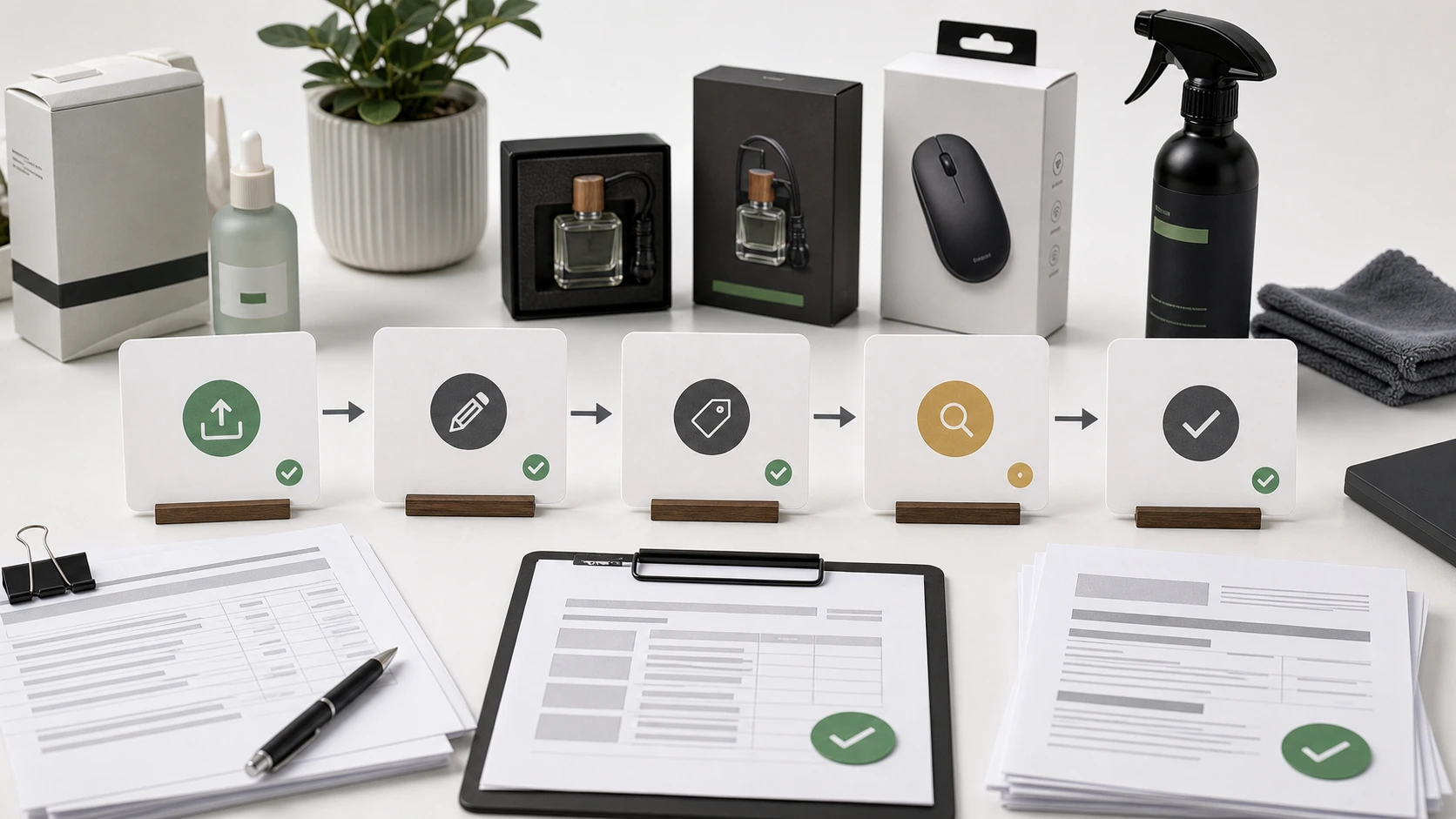
How to get the Amazon TXT file from Seller Central
Before preparing your own title updates, download the right source file.
Use the original tab-delimited .txt file from Amazon Seller Central. Do not convert it to CSV or XLSX before processing if your workflow expects the original Amazon TXT export.
Basic path:
- Log in to Amazon Seller Central.
- Go to Reports.
- Open Inventory Reports.
- Choose Active Listings, All Listings, Open Listings, or Category Listings Report, depending on the catalog view you need.
- Click Request Report.
- Wait until the report status becomes Ready.
- Click Download.
- Use the downloaded
.txtfile for your title and Item Highlights workflow.
This file helps preserve the relationship between the listing title, description, SKU, ASIN, listing ID, product ID, price, quantity, and other catalog fields.
That matters because title control is not only a writing task. It is a catalog operations task.
How to rewrite titles before Amazon AI recommendations apply
Use this simple rewrite process.
Step 1: Pull out the product identity
Identify:
- brand
- product type
- variant or model
- size or quantity
- one essential differentiator if needed
This becomes the title foundation.
Step 2: Draft the 75-character title
Do not start by trimming the old title.
Start by writing the cleanest product identity.
Example:
Old title: Soulbar | Royal Musk | Car Perfume Spray with Hanging Card, 700+ Sprays Long Lasting Car Freshener (80 ml)
Better title: Soulbar Royal Musk Car Perfume Spray, 80 ml
Step 3: Preserve useful detail in Item Highlights
Move secondary details into Item Highlights.
Item Highlights: hanging card, long-lasting freshener, 700+ sprays
This keeps the product story without stuffing the title.
Step 4: Remove weak language
Review phrases like:
- best
- perfect
- premium
- newly launched
- guaranteed
- gift for everyone
- long keyword stacks
Some may be acceptable. Many are just taking up space.
Step 5: Check both fields together
The title and Item Highlights should work as a pair.
Ask:
- Does the title identify the product?
- Do Item Highlights add useful supporting detail?
- Is there too much repetition?
- Are claims supported?
- Are both fields within limit?
- Would a shopper understand the product faster?
Before and after examples
Example 1: handmade soap
Original title: SOULBAR Sakura Blush Handmade Soap with Rose Clay & Goat Milk | Natural Bar for Glowing, Anti-Aging Skin | Cherry Blossom Fragrance | Organic Paraben Free | Gift for Women, Diwali & Weddings | 100g
Seller-controlled title: SOULBAR Sakura Blush Soap with Rose Clay & Goat Milk, 100g
Item Highlights: cherry blossom scent, moisturizing bath bar, daily skincare use
Why this is better: The title keeps brand, variant, product type, hero ingredients, and size. The highlights preserve fragrance and use context. Sensitive claims such as "anti-aging" should be reviewed before reuse.
Example 2: car perfume
Original title: Soulbar | New Car Scent | Car Perfume Spray with Hanging Card, 700+ Sprays Long Lasting Car Freshener | Largest Quantity | 80 ml
Seller-controlled title: Soulbar New Car Scent Car Perfume Spray, 80 ml
Item Highlights: hanging card, 700+ sprays, long-lasting car freshener
Why this is better: The title becomes readable. The highlights keep format and quantity detail.
Example 3: wireless mouse
Original title: ArcLite Wireless Mouse for Laptop with Silent Click, USB Receiver, Ergonomic Design, Long Battery Life, Black
Seller-controlled title: ArcLite Wireless Mouse with Silent Click, Black
Item Highlights: USB receiver, ergonomic design, long battery life, laptop use
Why this is better: The title keeps product identity and one major differentiator. The highlights preserve supporting benefits.
How Item Highlights help sellers stay in control
The 75-character title limit would be much harder if sellers had no place to preserve secondary detail.
Item Highlights matter because they let sellers keep useful information visible without cramming it into the title.
Amazon's title update announcement describes Item Highlights as an additional 125 characters for materials or recommended use cases that help customers compare options. Amazon title update announcement
Use Item Highlights for:
- materials
- ingredients
- use cases
- compatibility
- fragrance
- benefits
- size or quantity if not in title
- secondary differentiators
Do not use them as:
- full bullet points
- backend keyword stuffing
- a second product title
- a place to hide risky claims
Item Highlights are not a loophole. They are a support field.
Bulk catalog workflow before automated rewrites
If you manage a large catalog, treat this as a batch workflow.
Batch 1: highest-risk titles
Start with titles over 150 characters. These are most likely to need major restructuring.
Batch 2: titles from 101 to 150 characters
These usually contain useful details but need compression and allocation.
Batch 3: titles from 76 to 100 characters
These may be close to compliant but still need cleanup.
Batch 4: titles already under 75 characters
These may still need Item Highlights, consistency, or review.
This batching approach helps you avoid turning the whole project into one giant spreadsheet cleanup.

How AgenixSocial helps sellers stay in control
AgenixSocial's Amazon 75-Character Title Compliance workflow helps sellers prepare their own shorter titles and Item Highlights before relying on Amazon's automated recommendations.
The workflow starts with an original Amazon Seller Central TXT export. AgenixSocial primarily uses the item name, item description, and eligible product attributes from each row. It generates a shorter title and one comma-separated Item Highlights value, while preserving original Amazon columns in a review-ready XLSX.
Sellers can:
- upload the original Amazon TXT export
- generate all valid rows
- generate selected rows
- edit generated titles
- edit Item Highlights
- regenerate rows
- review confidence signals
- review validation notes
- preserve original Amazon columns
- export a review-ready XLSX
That matters because the goal is not blind automation.
The goal is controlled preparation.
AgenixSocial does not directly upload changes to Amazon. It does not guarantee Amazon approval. Sellers should still review product accuracy, claims, category fit, and marketplace requirements before applying updates.
The first 100 products are free. After that, it is 1 credit per additional 100 products. See pay-as-you-go credits for how credits work.

Seller control checklist
Use this checklist before Amazon's automated recommendations reach your catalog.
Source file
- Download the original Amazon Seller Central TXT export.
- Use Reports, then Inventory Reports.
- Choose Active Listings, All Listings, Open Listings, or Category Listings Report.
- Do not convert the file before processing if your workflow requires the original TXT file.
- Keep a backup.
Title audit
- Identify titles over 75 characters.
- Segment titles by length.
- Group products by category or product type.
- Define title priority rules for each group.
Rewrite
- Keep brand where source-supported.
- Keep product type.
- Keep variant or model.
- Keep size or quantity when important.
- Move secondary detail into Item Highlights.
- Remove repeated keywords and clutter.
Review
- Review sensitive claims.
- Review low-confidence rows.
- Review missing or weak descriptions.
- Review titles that became too generic.
- Review Item Highlights for repetition or keyword stuffing.
Update
- Export a review-ready working file.
- Preserve SKU, ASIN, listing ID, and product ID context.
- Apply approved values through the correct Amazon workflow.
- Track what changed.
Common mistakes to avoid
Mistake 1: waiting for Amazon AI to solve the problem
Amazon's recommendations may help, but they are not a substitute for your own catalog strategy.
Mistake 2: truncating instead of rewriting
A shorter broken title is still a bad title.
Mistake 3: deleting useful details
Move source-supported details into Item Highlights where appropriate.
Mistake 4: repeating the same words across title and highlights
Use Item Highlights to add context, not duplicate the title.
Mistake 5: ignoring titles already under 75 characters
Short titles can still be incomplete, inconsistent, or missing Item Highlights.
Mistake 6: losing original listing identifiers
Do not separate title work from SKU, ASIN, listing ID, and product ID context.
Mistake 7: treating review as optional for risky claims
AI can help prepare the draft. Sellers should still review claims and marketplace fit.
Related workflows
This article is part of a larger Amazon cleanup workflow. If you are preparing the full catalog, use these next:
- Amazon 75-character title limit
- Amazon seller content workflows
- Marketplace listing image sets
- Amazon A+ content generation
FAQ
Can Amazon AI rewrite my product titles?
Amazon has said titles still over 75 characters after July 27, 2026 may be updated gradually to AI recommendations. Sellers should review current Seller Central guidance and prepare their own title updates where needed.
What are Amazon AI title recommendations?
They are Amazon-generated title suggestions or updates designed to bring listings closer to Amazon's updated title structure and content standards.
What is Review Listings Changes?
Review Listings Changes is a Seller Central workflow where brand owners can review proposed Amazon-initiated listing updates, including AI-generated recommendations.
Do brand owners get time to review AI title recommendations?
Amazon has said brand owners will have a review window for AI-generated recommendations before certain changes are implemented. Sellers should confirm the current workflow inside Seller Central.
Should I wait for Amazon's AI recommendations?
No. Sellers should prepare their own shorter titles and Item Highlights first, especially if titles affect search visibility, brand consistency, or product clarity.
What happens if my title is already under 75 characters?
Still review it. A short title may still need Item Highlights, better structure, or consistency with the rest of the catalog.
How do Item Highlights help?
Item Highlights give sellers a compact place to preserve useful supporting details that no longer fit in the shorter title.
Where do I get the Amazon TXT file?
Go to Amazon Seller Central, then Reports, then Inventory Reports. Choose Active Listings, All Listings, Open Listings, or Category Listings Report, request the report, wait until it is ready, then download the original .txt file.
Can I use ChatGPT to prepare titles before Amazon AI rewrites them?
You can use a generic AI prompt for a few titles, but catalog-scale work needs row processing, character counts, validation notes, original column preservation, and export structure.
Does AgenixSocial prevent Amazon from changing my titles?
No. AgenixSocial helps sellers prepare structured title and Item Highlights updates. It does not prevent Amazon from making marketplace-side changes.
Does AgenixSocial directly upload changes to Amazon?
No. AgenixSocial creates a review-ready XLSX. Sellers should apply approved values through the correct Amazon update workflow.
Does AgenixSocial guarantee Amazon approval?
No. AgenixSocial helps with compliance preparation and review. Sellers should still check product accuracy, claims, category fit, and marketplace requirements before applying updates.
Final takeaway
Amazon's AI title recommendations are not something sellers should ignore.
They are also not something sellers need to fear blindly.
The right response is control.
Audit your titles. Download the right Amazon TXT export. Decide what belongs in the 75-character title. Move useful supporting details into Item Highlights. Review risky claims. Preserve original listing identifiers. Apply approved updates through the correct Amazon workflow.
The sellers who do this early will not be stuck reacting to automated rewrite suggestions under pressure.
AgenixSocial helps sellers prepare that workflow. Upload your Amazon TXT export, generate shorter titles and 125-character Item Highlights, review confidence and validation notes, edit or regenerate where needed, and export a review-ready XLSX your team can use.
Stay in control of your Amazon title updates with AgenixSocial's Amazon 75-Character Title Compliance workflow.