AI Product Content Generator for Ecommerce: Beyond Product Descriptions
An AI product content generator helps ecommerce teams create product-related content faster.
But the phrase is often used too narrowly.
Many tools that call themselves AI product content generators are really product description generators. They help write descriptions, titles, bullets, SEO metadata, or product FAQs.
That is useful.
But ecommerce product content is much bigger than copy.
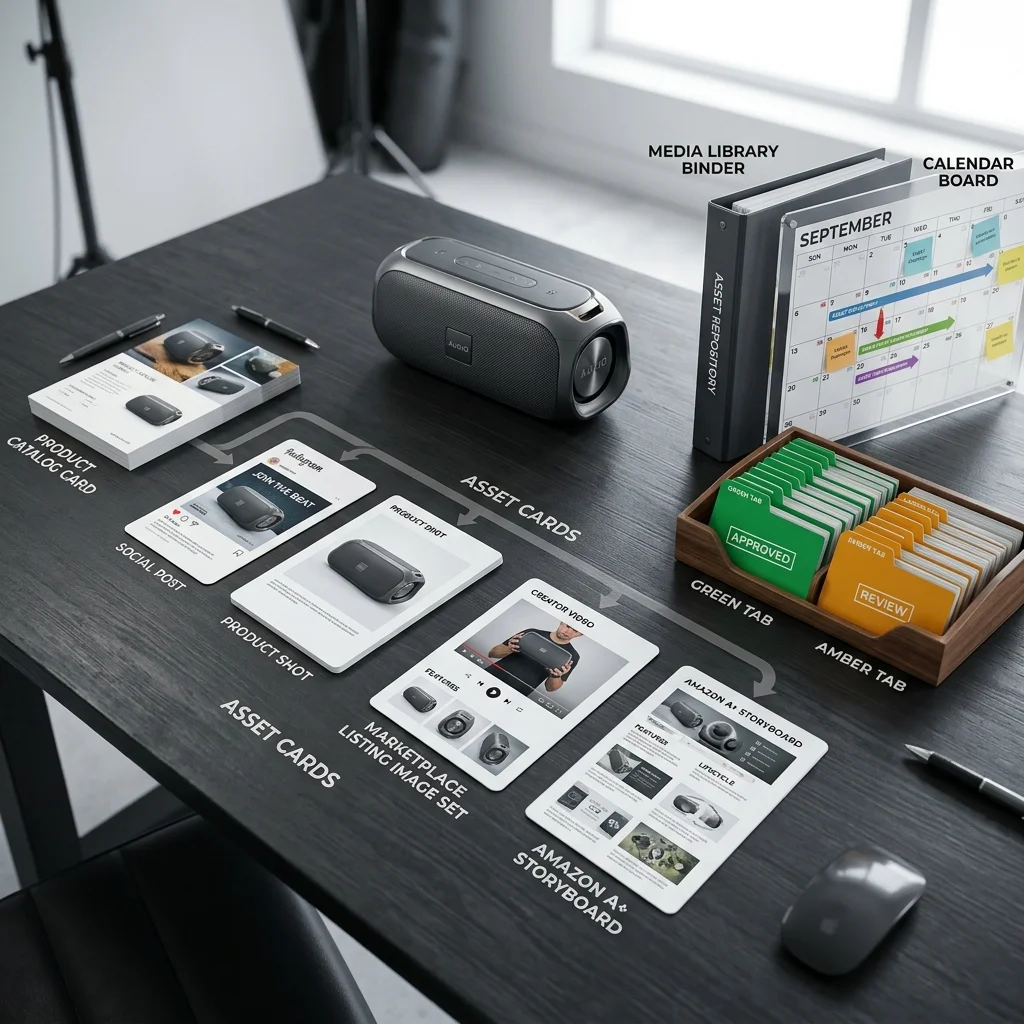
A product needs social posts, product images, creator videos, product videos, marketplace listing images, Amazon A+ modules, campaign assets, founder-led stories, and review-ready outputs.
So the better question is not:
"Can AI write a product description?"
The better question is:
"Can AI turn product context into the full set of content a brand needs to sell, explain, launch, and promote that product?"
Quick answer: what is an AI product content generator?
An AI product content generator is a tool or workflow that uses product information to create ecommerce content such as product descriptions, titles, bullets, social posts, product images, videos, marketplace listing assets, Amazon A+ modules, campaign content, and product education assets. The strongest systems use real product catalog context so outputs stay grounded in what the brand actually sells.
Product content is not only product descriptions
Product descriptions are only one layer of ecommerce content.
They explain the product in words.
But shoppers also rely on visuals, videos, listing images, product modules, social proof, campaign content, and brand storytelling.
A complete product content workflow may include:
- product title
- product description
- bullets
- product FAQs
- SEO metadata
- social captions
- product-led social posts
- carousels
- product photography
- lifestyle images
- image ads
- product videos
- creator-style videos
- marketplace listing images
- Amazon A+ content
- product launch campaign assets
- comparison visuals
- founder-led product stories
If a tool only writes descriptions, it may still be valuable.
But it is not solving the full product content problem.
Shopify Magic is a useful signal for where the category is going: Shopify describes AI-powered features across store building, marketing, customer support, back-office management, text generation, and media generation. Shopify Magic
That wider view is closer to what ecommerce teams actually need.
AI product description generator vs AI product content generator
| Area | AI product description generator | AI product content generator |
|---|---|---|
| Main job | Write product copy | Create product content across formats |
| Common outputs | Descriptions, bullets, SEO titles, metadata | Copy, social posts, images, videos, listing assets, campaigns |
| Starting point | Product name or short prompt | Product catalog and brand context |
| Visual support | Usually none | Product shots, ads, videos, listing images |
| Marketplace support | Usually limited to copy | Can include marketplace image sets and A+ content |
| Review needs | Copy accuracy and claims | Copy, visuals, videos, marketplace fit, brand tone |
| Best for | Improving PDP copy | Running product-aware content workflows |
The distinction matters because ecommerce teams usually need both.
A product description can improve the product page. Product content can support the entire selling journey.
Jasper's product description workflow is a good example of the copy-first end of the category. It connects product specs, Brand Voice, Knowledge Base assets, and workflow review to scale product descriptions. Jasper product description workflow
That is valuable, but product-aware ecommerce workflows should extend beyond PDP copy.
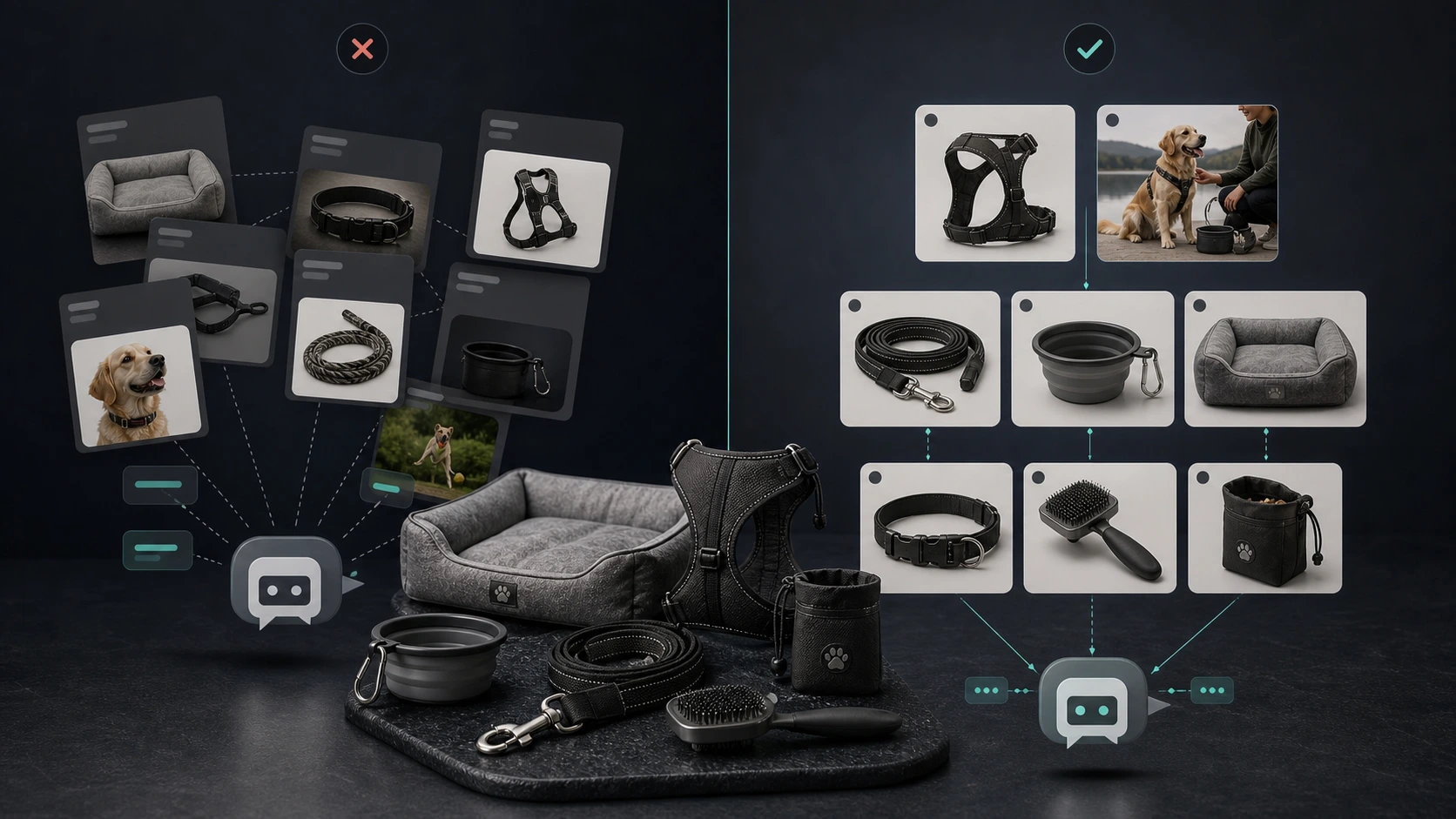
Why product catalog context matters
AI product content is only as strong as the product context behind it.
A weak prompt produces weak product content.
A strong product catalog gives the AI workflow:
- product name
- product images
- product description
- price
- variants
- product category
- materials or ingredients
- key features
- use cases
- customer objections
- brand positioning
- marketplace requirements
- user-added bullet points
Without this context, AI often falls back to generic language.
"Premium quality." "Perfect for everyday use." "Designed for modern lifestyles." "Upgrade your routine."
These phrases may sound acceptable, but they rarely help a shopper understand the product.
Product-aware content should explain the actual product.
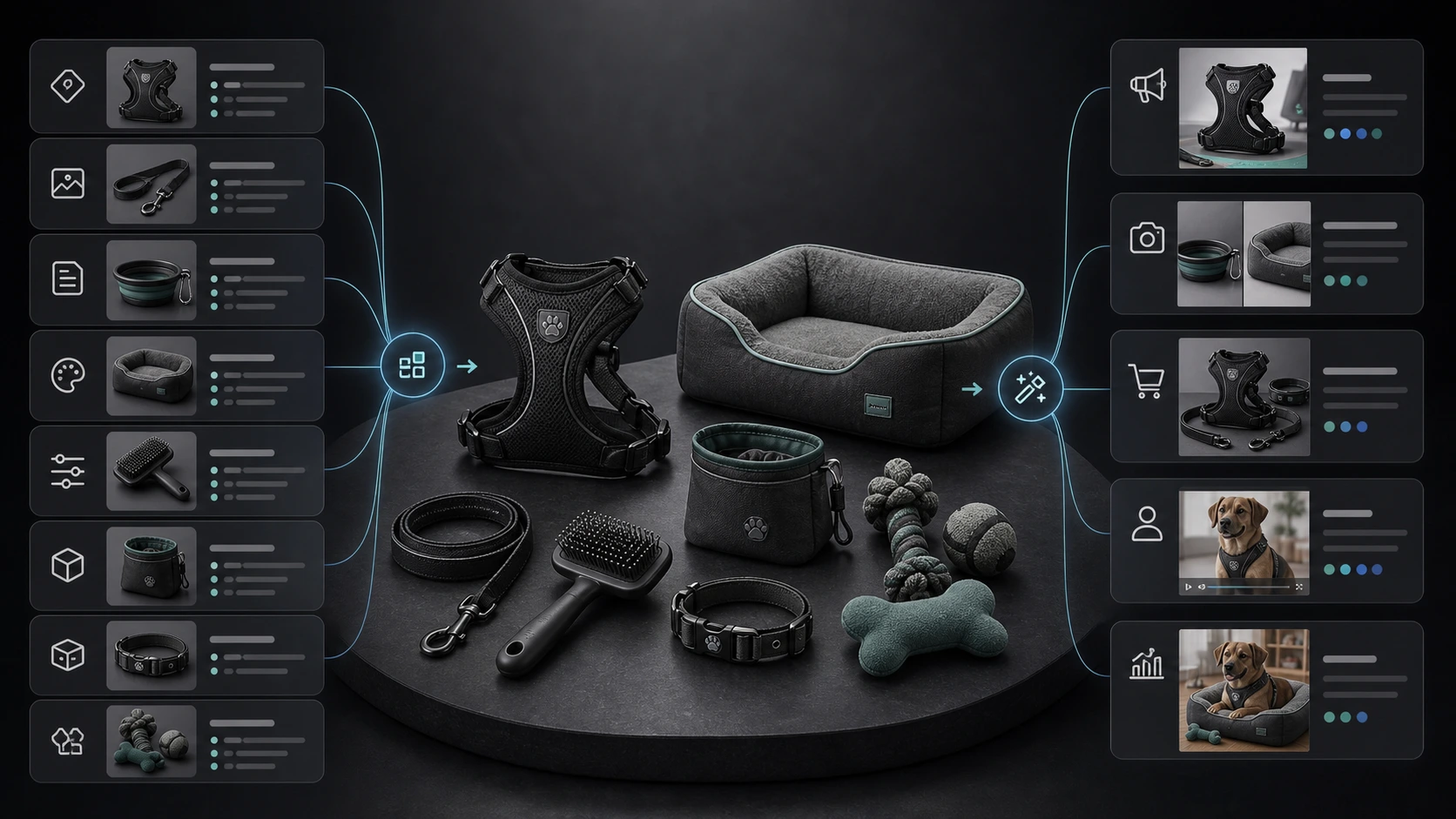
Research on intelligent product listing makes the same product-context point from a technical angle: multimodal systems can use product attributes and product photos to generate listings, and domain-specific tuning can reduce hallucination risk. IPL research paper
What product-aware AI content should create
A useful AI product content generator should support multiple content jobs.
1. Product descriptions
AI can help write:
- long descriptions
- short descriptions
- feature-led copy
- benefit-led copy
- SEO product descriptions
- marketplace descriptions
- variant-specific descriptions
But descriptions should be reviewed for accuracy, claims, and missing product details.
2. Product titles and bullets
AI can help create:
- concise product titles
- feature bullets
- benefit bullets
- marketplace-ready copy
- title alternatives
- product highlight lines
This is useful when sellers need to clean up product content or create different versions for different channels.
3. Product-led social posts
AI can turn product context into:
- Instagram posts
- Facebook posts
- Threads posts
- X posts
- carousels
- launch posts
- product education posts
- objection-handling posts
For ecommerce, social posts should not start from generic content prompts. They should start from the product.
4. Product images
AI can help create:
- studio shots
- lifestyle shots
- flat lays
- product-in-use visuals
- macro/detail shots
- environmental images
- ad-style visuals
- platform-specific creative
Product images still need review because AI can distort shape, scale, color, packaging, texture, or product details.
AI product photography is already a visible ecommerce category, with current guides focused on tools for listing and lifestyle-style product imagery. Claid AI product photography guide
5. Product videos
AI can help generate:
- short product ads
- cinematic product clips
- reveal videos
- product-in-use videos
- unboxing-style concepts
- product education videos
These assets are useful for social, ads, launch campaigns, and product pages.
AI video tools are also emerging specifically around ecommerce product showcases, including text- or image-led product video generation. Luma ecommerce product video generator
6. Creator-style videos
AI creator videos can help turn product context into:
- testimonial-style videos
- problem-solution videos
- product education videos
- lifestyle videos
- founder story videos
- social proof-style videos
- multilingual product explainers
The script should still be reviewed before rendering.
7. Marketplace listing images
Marketplace sellers need product image sets, not random visuals.
A product-aware workflow can help create:
- main image concepts
- supporting image sequences
- detail images
- scale images
- use-case images
- benefit-led visuals
- packaging images
- marketplace-specific exports
The seller still needs to review final assets against the marketplace's current rules.
8. Amazon A+ content
For Amazon sellers, product content can include A+ modules.
AI can help with:
- A+ storyboards
- module sequence
- benefit modules
- detail modules
- comparison modules
- brand story direction
- large-format visual assets
Again, AI should create review-ready drafts, not bypass Seller Central review.
9. Product campaigns
A product content generator should also help create campaign structure.
That can include:
- 3-day campaign
- 5-day campaign
- 7-day campaign
- launch sequence
- seasonal campaign
- product education series
- sale support assets
- campaign image directions
A campaign is more valuable than a pile of isolated posts.
The product content lifecycle
A strong ecommerce product content workflow follows a lifecycle.
- Product context enters the system.
- Brand context shapes the message.
- The team chooses the content format.
- AI creates draft assets.
- The team reviews accuracy and claims.
- Approved assets move to media storage.
- Content is scheduled, downloaded, exported, or uploaded.
- The team reuses product context for future campaigns.
This is the shift from "generate copy" to "operate product content."
BigCommerce frames generative AI in ecommerce more broadly than copy alone, including content creation, product design optimization, and personalization. BigCommerce generative AI ecommerce
Why generic AI product content feels weak
Generic AI product content usually fails in predictable ways.
It overuses vague benefits
The output sounds polished but says very little.
Examples:
- "High-quality design."
- "Perfect for any occasion."
- "Built for your lifestyle."
- "A must-have essential."
These lines do not explain the product.
It misses product detail
If the model does not have product context, it may ignore:
- size
- material
- use case
- variant
- compatibility
- ingredients
- care instructions
- what is included
It exaggerates claims
AI may create claims that sound persuasive but are not supported.
This is risky for categories like beauty, wellness, health, baby products, electronics, supplements, food, and safety products.
It disconnects text and visuals
A caption may say one thing while the image suggests another.
A product video may use a different angle from the product page.
A marketplace image may show a use case that is not mentioned anywhere else.
It creates one-off assets
A single output may be useful, but the team still has to organize, review, adapt, and schedule it.
That is why workflow matters.
Research benchmarking machine-generated product ads and descriptions also points to a practical limitation: model outputs vary in coherence and product focus, so the workflow still needs product grounding and review. Product advertisement benchmarking paper
What ecommerce teams should review
AI product content should always go through review.

Product accuracy
- Is the product described correctly?
- Are materials or ingredients accurate?
- Are colors and sizes correct?
- Are variants represented properly?
- Are included accessories clear?
- Does the image or video show the right product?
Claim safety
- Are claims supported?
- Are results exaggerated?
- Are health, beauty, safety, or performance claims reviewed?
- Are comparison claims fair?
- Are certifications or awards real?
Brand fit
- Does the tone match the brand?
- Does the visual style feel consistent?
- Does the product positioning make sense?
- Does the content avoid category cliches?
Platform fit
- Does the output fit the channel?
- Is it for a product page, social post, marketplace listing, ad, or A+ module?
- Does the format match the platform?
- Does the marketplace require specific image rules?
Workflow readiness
- Is the asset approved?
- Is it saved in the right place?
- Is the file named clearly?
- Is it ready to schedule, download, export, or upload?
- Does the team know which product it belongs to?
Product content for Shopify brands
Shopify brands often start with product pages.
That means AI can help with:
- product descriptions
- SEO titles
- meta descriptions
- product page sections
- product FAQs
- social posts
- product photography
- launch campaigns
But Shopify product content should not stay trapped on the product page.
The same product context can also feed:
- Instagram content
- Facebook content
- product videos
- image ads
- marketplace assets
- email campaign ideas
- founder-led launch posts
The product page is the source. The content system should help the brand reuse that product context across channels.
Product content for marketplace sellers
Marketplace sellers have a different challenge.
They may not have a Shopify store or a polished D2C website.
They may need content for:
- Amazon
- Walmart
- Flipkart
- Lazada
- Shopee
- TikTok Shop
- Etsy
- eBay
- Facebook Marketplace-style listings
In that case, product context may come from manual product setup, seller exports, existing listings, or product images.
A useful AI product content workflow should still help sellers create:
- product titles
- short highlights
- listing images
- supporting visuals
- marketplace-specific image sets
- A+ content for Amazon where relevant
- downloadable assets for upload
The workflow should not assume every brand starts from Shopify.
Product content for agencies
Agencies need repeatability.
An agency may manage many brands and products.
The challenge is not only content generation. It is context management.
Agencies need:
- separate brand profiles
- product context per client
- repeatable content workflows
- review and approval
- organized media
- exports and handoffs
- pricing that fits bursty client work
If every client requires a different tool stack, agency operations become messy.
A product-aware content workspace helps agencies avoid rebuilding context from scratch for every brief.
What to look for in an AI product content generator
Use this checklist before choosing a tool.
Product context
- Can it store or import product data?
- Can it use product images?
- Can it work with manually added products?
- Can it use product descriptions, price, and bullet points?
- Can it keep content connected to the product?
Brand context
- Can it remember brand voice?
- Can it use brand identity and positioning?
- Can it avoid generic category language?
- Can it apply brand context across formats?
Content formats
- Can it write product copy?
- Can it create social posts?
- Can it generate product images?
- Can it create product videos?
- Can it create creator-style videos?
- Can it support marketplace images?
- Can it support Amazon A+ content?
- Can it plan campaigns?
Workflow
- Is there a review step?
- Can assets be saved?
- Can assets be downloaded?
- Can content be scheduled?
- Can teams organize outputs by product or campaign?
Pricing
- Is it subscription-based?
- Is it credit-based?
- Does pricing fit campaign bursts?
- Are costs visible before generation?
- Does it replace or reduce separate tools?
How AgenixSocial works as a product-aware content workspace
AgenixSocial is designed around product-aware commerce content.
Products acts as the content source of truth. Product information can include names, images, descriptions, prices, and additional bullet points.
Brand DNA adds reusable brand context.
Content Studio then uses that context across multiple product content workflows, including:
- Quick Post for product-led social content
- Product Shots for controlled product visuals
- AI Creator Videos for creator-style product videos
- Video for product ad videos
- Campaigns for product and brand campaigns
- Image Ads for promotional creatives
- Marketplace Listing Studio for marketplace image sets
- Amazon A+ Studio for Amazon A+ storyboards and modules
- Amazon Title Compliance for review-ready title and highlight outputs
The value is not only that each workflow exists.
The value is that they can start from the same product and brand foundation.
AgenixSocial also includes Media Library, Approval Queue, Calendar, downloads, and pay-as-you-go credits, so the workflow does not stop after content is generated.
AgenixSocial gives ecommerce teams a stronger starting point by grounding workflows in reusable brand and product context. Teams still review final assets for product accuracy, claims, marketplace fit, and brand tone before publishing or uploading.
AI product content generator vs product-aware commerce workspace
| Question | Basic AI product content generator | Product-aware commerce workspace |
|---|---|---|
| Writes product descriptions? | Yes | Yes |
| Uses brand context? | Sometimes | Yes |
| Uses product catalog context? | Sometimes limited | Yes |
| Creates product images? | Usually no | Yes |
| Creates creator-style videos? | Usually no | Yes |
| Creates marketplace image sets? | Usually no | Yes |
| Supports Amazon A+ workflows? | Usually no | Yes |
| Includes review workflow? | Usually external | Yes |
| Stores generated assets? | Usually external | Yes |
| Supports scheduling? | Usually separate | Yes |
| Best for | Product copy | Product content operations |
FAQ
What is an AI product content generator?
An AI product content generator is a tool that uses product information to create ecommerce content such as descriptions, titles, bullets, social posts, images, videos, marketplace assets, and campaign content.
Is an AI product content generator the same as a product description generator?
No. A product description generator focuses mainly on copy. A product content generator should support a broader set of product-related assets, including visuals, videos, listing content, social posts, and campaigns.
Can AI generate ecommerce product descriptions?
Yes. AI can generate product descriptions, titles, bullets, FAQs, and SEO metadata. Teams should still review product facts, claims, tone, and category-specific requirements before publishing.
Can AI generate product images and videos?
Yes. AI can help generate product shots, lifestyle visuals, product videos, creator-style videos, and ad-style images. These assets should be reviewed carefully for product accuracy, realism, and brand fit.
Why does product catalog context matter?
Product catalog context helps AI content stay grounded in the real product. Without it, outputs may sound generic, miss important details, or invent unsupported product features.
What should ecommerce teams review before using AI product content?
Teams should review product accuracy, claims, visual realism, brand tone, platform fit, marketplace requirements, file readiness, and approval status before publishing or uploading.
How does AgenixSocial support AI product content generation?
AgenixSocial uses Products as the content source of truth and Brand DNA as reusable brand context. Content Studio then uses that context across social posts, product shots, creator videos, campaigns, marketplace image sets, Amazon A+ content, and other product workflows.
Is AI product content useful for marketplace sellers?
Yes. Marketplace sellers can use AI to create titles, highlights, image sets, listing visuals, and Amazon A+ content where relevant. Human review is still needed before upload.
Conclusion
AI product content generation should not stop at descriptions.
Descriptions matter, but ecommerce teams need more.
They need product images, videos, social posts, creator-style content, campaigns, marketplace listing assets, Amazon A+ modules, organized media, approvals, downloads, and scheduling.
The strongest workflow starts with real product context and reusable brand context.
That is the difference between a basic AI writing tool and a product-aware commerce content workspace.
AgenixSocial is built around that difference. It helps teams turn real products into review-ready commerce content across formats, without rebuilding the workflow from scratch every time.